#abstract
78 posts · Last used 3h
Boosted by @trending@homestead.social
 . "Aqua City".
120904 c : Peinture abstraite datée, non signée #abstract #abstractart #painting #art #peinture #abstrait #scanned Collection: https://pixelfed.fr/c/603679425996001612

G .
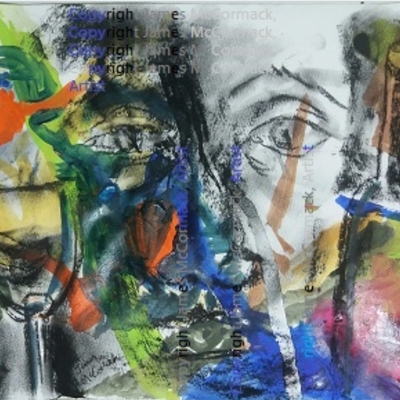
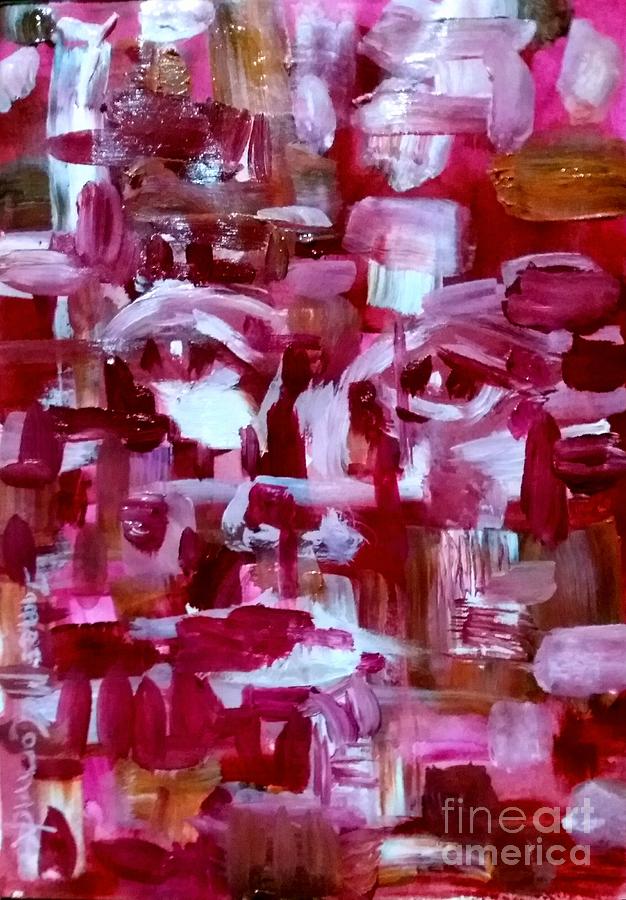
Lost in Red is a mixture of abstract painting combined with face elements, showing the artist immersed in crimson, vermilion, rose, pink, with touches of orange, white and brown.
[ Prints : https://james-mccormack.pixels.com/featured/lost-in-red-james-mccormack.html ]
#abstract #painting #face #immersed #crimson #vermilion #rose #pink #orange #white #brown #BuyIntoArt #FediGiftShop #MastoArt #MastoDaoine
-
Started last week
-
Finished now
#art #abstractexpressionism #abstractart #oilpastels #abstract #colour
Macro Fun 🤓
I noticed these patterns on the glass of an old candle container and I thought they'd look good with some colorful light.
What do you think?
'Textur' #FotoVorschlag / 'Texture' #PhotoSuggestion#Photography #MacroPhotography #Macro #Patterns #Texture #Colors #Glass #Darktable #Gimp #Abstract
I used to see my art as childish and something that anyone could throw together. Being able to do art regularly meant I had to get over and start ignoring that voice that told me I wasn't a good enough artist. It also meant doing away with the concept of there being 'good' and 'bad' art.
I still don't call myself an artist, but maybe I should start doing that.
#artist #art #abstract #abstractart #abstractexpressionism #scribble #heart #oilpastels #drawing #colourtherapy
Boosted by @trending@homestead.social
(Re-uploading to this instance)
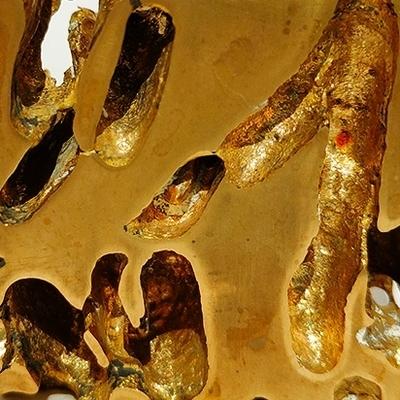
Brass cast little sculpture of a wood cube showing tunnels carved by a woodworm. Of course the tree was already firewood when I found it, I only cut it into a rough cube. And the woodworm was long gone: Wherever you are, I hope you're OK, it was nice making this collab with you.
#MetalCasting #art #ContemporaryArt #sculpture #insect #beetle #abstract #organic #geometric #WoodWorm #carcoma #SciArt #wood #biology #entomology #casting #xylophague #collaboration
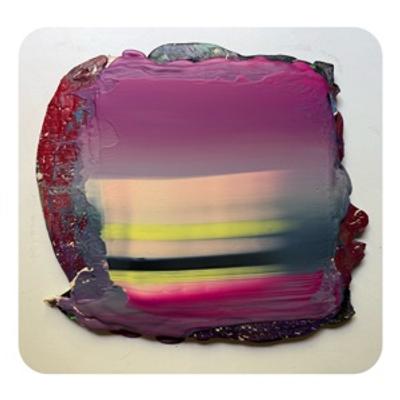
Kaleidos, Hans Hofmann, 1958
I hope this is huge, and is somewhere where it can pump its color magic into the human pinball machine.
Maybe someone will see this on their screen today and think, maybe the world isn't such a bad place. Look at all the orange. 😎
#art #orange #abstract #expressionism #blocks #happy #alive #vibrant #harmony #texture #smile

Industrial toxic mud from the Muruntau Gold Mine - Uzbekistan
🌏 : https://maps.app.goo.gl/V1Ge9ZhNdFp5KM7X9
4K link : https://i.imgur.com/gUCFdh7.jpeg
#uzbekistan #googleearth #satelliteview #aerialphotography #abstract #texture #red #blue #atlas #earthart #earthfromabove #earthfromspace #mine #toxic #waste #openpit #landscape #worldview #dji #MastoArt #Mapstodon
Boosted by @trending@homestead.social
lily pads from a canoe on a bright sunny day
#NaturePhotography
#abstract

Artfight attack for TmrrwAfterTmrrw! This is one of the more abstract illustrations that I've done, presenting many interlocking shapes in black and white. They flow around and make a path for the main character; 🐋🎴
#art #illustration #drawing #abstract #character #night #moon #artfight #rebelle
I remember reading Raymond Wilder's #book “Mathematics As a Cultural System” and feeling conflicted.
How can something as universal as mathematics be influenced by #culture?
Then I found some of Stanislas Dehaene & team's studies, collected in “The Number Sense”.
Digging deeper, I reached the inevitable nature vs. nurture debate, including studies from the 40s and 50s, like E. L Kaufman's.
Back to the present, it shouldn't come as a surprise, then, when #Science published an article in June 2025 showing that culture, #education, and the environment do play a role in our #abstract understanding.
Such factors go as far as influencing our visual perception and its mental processing.
For example, the Himbas, an ethnic group from Namibia, are less susceptible to optical illusions that usually trick people who grew in urban areas and had a modern education.
The Himba natives are primed by their lifestyle and rural organization, which is based on circular huts and dens, grouped together in a larger circular area.
When shown the famous Coffer Illusion, Himbas can easily focus on the circles, whereas most of us (including myself) see 20 rectangles.
Does this mean that abstraction, in the form of seeing shapes and labeling them mentally as “squares” or “circles”, is culturally biased?
This is a question I explore further in The Gradient.
https://www.thegradient.xyz/circle-or-rectangle-the-abstract-through-the-eyes-of-culture/

Invisible Chasm (2026)
#TextureTuesday #LandscapePhotography #Photography #Abstract #Mountains #InvisibleChasm
Replying to
Invisible Chasm Ⅱ (2026)
#TextureTuesday #LandscapePhotography #Photography #Abstract #Mountains #InvisibleChasm
Monday moonlight.
July 27, 2026. Wolverine Lake, Michigan.
#photography #moonrise #moon #reflection #art #abstract #michigan #summer #MastoArt