ThinkPad X220 (2011) running Slackware-current in 2026.
Linux console + tmux. Sometimes that's all you need. :)
#slackware #thinkpad #x220
Remote
r1w1s1
@r1w1s1@snac.bsd.cafe
snac 2.95
Slackware Core Team member.
Long-time Slackware user.
Interested in classic Unix tools, editors, and X11 WMs.
Long-time Slackware user.
Interested in classic Unix tools, editors, and X11 WMs.
284 Followers
117 Following
9 Posts
Joined March 26, 2025
Slackware:
NVI Quick Reference:
Open post
GEFS on OpenBSD, a very early preview.
Ori Bernstein is porting GEFS, the crash-safe, snapshotting, copy-on-write filesystem originally written for 9front, to OpenBSD.
https://marc.info/?l=openbsd-tech&m=178948744271633&w=2
#openbsd #bsd
1
0
0
1
Open post
Replying to
glad Slackware stays out of this :) different approaches are fine, but I still prefer simple rc scripts and small tools over one big system doing everything.
#slackware
2
0
3
0
Open post
The UNIX shell is still one of the best IDEs ever created.
grep/find/sed/awk/make/ssh/git/nvi often compose better than many modern “integrated” environments.
Small programs connected together still scale surprisingly well.
https://repo.or.cz/code-notes.git/blob_plain/HEAD:/notes/Unix_As_An_IDE.txt
#unix #linux #slackware #vi
grep/find/sed/awk/make/ssh/git/nvi often compose better than many modern “integrated” environments.
Small programs connected together still scale surprisingly well.
https://repo.or.cz/code-notes.git/blob_plain/HEAD:/notes/Unix_As_An_IDE.txt
#unix #linux #slackware #vi
1
2
0
0
Open post
Replying to
Yeah, Rust vendoring can become a bit painful 🙂
Fish is a good example of that already — huge vendor tarballs and lots of crates to keep track of.
1
0
0
0
Open post
Replying to
Nice work — always good to see more Slackware-related projects and people still packaging software for the community.
One question though: where are the SlackBuilds? 🙂
Would be really nice to have them in the repo too so other Slackware users can rebuild locally or adapt them for their own systems.
Some of these packages could probably fit well on SlackBuilds.org too.
PS: the editor looks neat, but it's hard for me to get rid of nvi/vi :)
1
3
0
0
Open post
Replying to
Yeah makes sense… some laptops are really picky with wifi/firmware.
Nice that Slackware just works out of the box for you 👍
CC: @reddog83@mastodon.sdf.org
1
0
0
0
Open post
Replying to
Haha, classic 😄
Slackware just works.
Curious, what broke on the other ISOs?
CC: @reddog83@mastodon.sdf.org
1
4
0
0
Open post
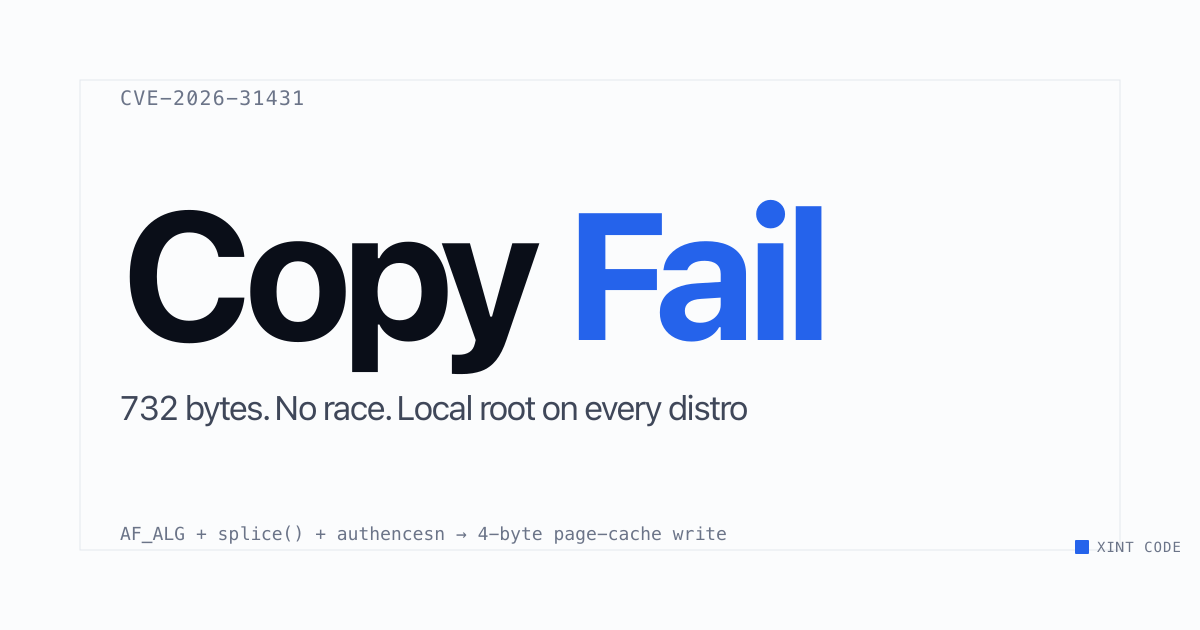
Slackware Patches "Copy Fail" Kernel Bug — CVE-2026-31431Slackware has issued a kernel security update for CVE-2026-31431, the Copy Fail vulnerability disclosed April 29, 2026. It's an out-of-bounds write in the AEAD userspace crypto interface (
If you can't patch right away, Slackware ships the affected code as a module (
Patch and reboot when you can.
Sources:
AF_ALG) that lets any local user get a root shell via a setuid binary — the same 732-byte Python PoC works on essentially every Linux distro shipped since 2017.If you can't patch right away, Slackware ships the affected code as a module (
CONFIG_CRYPTO_USER_API_AEAD=m), so you can blacklist or remove it as a stopgap:echo "install algif_aead /bin/false" > /etc/modprobe.d/disable-algif.confFor most systems this breaks nothing —
rmmod algif_aead
AF_ALG is a userspace front-door to the kernel crypto API, and OpenSSL, SSH, dm-crypt, kTLS, and IPsec all bypass it.Patch and reboot when you can.
slackpkg update && slackpkg upgrade-all.Sources:
- http://www.slackware.com/security/viewer.php?l=slackware-security&y=2026&m=slackware-security.1267034
- https://www.cve.org/CVERecord?id=CVE-2026-31431
0
0
0
0
Open post
Plasma 6 has officially landed in Slackware-current.
Mon Jun 15 23:27:31 UTC 2026#slackware #kde6
Well folks, it seems that the stars have aligned to bring us a bunch of long-
awaited updates, including ffmpeg8 and Plasma 6! This has been developed in a
side tree for several weeks, and I'll be happy to get that off my plate and
have a greatly reduced todo list. Many thanks to alienBOB for getting the tree
in good shape, helping when I got stuck, and for being a good manager who
inspires me to do my best work. 🙂 And we both extend our thanks to the
illustrious LuckyCyborg who ported the build scripts to Plasma 6 in the first
place and then maintained Plasma 6 for Slackware users to test for a couple of
years. And thanks to everyone else who helped out with either of the Slackware
Plasma 6 projects that these updates grew out of.
Have fun!
0
0
0
0
Open post
Before USB sticks, before cloud storage, there were floppy disks.
Which one was your first?
Mine was the 5.25-inch, and I still remember the sound of the drive reading it.
I'd also love to hear what machine you used it with.
0
5
0
0
Open post
Replying to
We're chirping for a reason 🤣
I just upgraded all three of my Slackware -current machines. On one I simply used upgradepkg */*.txz, on another the usual slackpkg update && slackpkg upgrade-all. Reboot, a few sanity checks, and back to work. Kernel, glibc, GCC, binutils, XLibre... everything just worked.
That's part of the fun of Slackware: even a big -current update is still boring in the best possible way.
Now let's keep checking those mirrors for 16.0 🥳
0
1
0
0
Open post
Reading an old UNIX Review article from September 1984 about
termcap. Fascinating how much modern terminal software still
inherits ideas from this era.
vi depended heavily on terminal capability databases to remain
portable across different hardware terminals. Bill Joy originally
wired vi only for Lear Siegler ADM-3A terminals, and termcap was
born from the flood of requests for support on other hardware.
"Termcap Unveiled" by Douglas R. Merritt, pages 42-48.
https://archive.org/details/Unix_Review_1984_Sep.pdf/page/n43/mode/2up
Also updated my nvi notes with a small historical section about
termcap/curses and terminal portability.
https://repo.or.cz/code-notes.git/blob_plain/HEAD:/notes/NVI_Editor_Guide.txt
#vi #unix #termcap #nvi #linux
termcap. Fascinating how much modern terminal software still
inherits ideas from this era.
vi depended heavily on terminal capability databases to remain
portable across different hardware terminals. Bill Joy originally
wired vi only for Lear Siegler ADM-3A terminals, and termcap was
born from the flood of requests for support on other hardware.
"Termcap Unveiled" by Douglas R. Merritt, pages 42-48.
https://archive.org/details/Unix_Review_1984_Sep.pdf/page/n43/mode/2up
Also updated my nvi notes with a small historical section about
termcap/curses and terminal portability.
https://repo.or.cz/code-notes.git/blob_plain/HEAD:/notes/NVI_Editor_Guide.txt
#vi #unix #termcap #nvi #linux
0
3
0
0
Open post
Are you familiar with dwm's powerful tag feature?
THE TAGGING MODEL
Many desktop environments organize windows using rigid workspaces:
dwm uses a different model, treating workspaces as bitmask labels (tags).
This allows a single window instance to hold multiple tags simultaneously,
acting as a persistent visual anchor across different contexts:
switch to Tag 2, the browser disappears, but the exact same log window
remains on screen, now sharing space with your text editor.
The application is never duplicated or restarted in memory.
The UI remains minimal while enabling workflows that are difficult to
express using traditional workspace-oriented desktops.
Two decades later, this tagging model remains one of the most
distinctive features of dwm.
#suckless #dwm #unix #linux #sysadmin
THE TAGGING MODEL
Many desktop environments organize windows using rigid workspaces:
Workspace 1A window belongs to a single workspace.
Workspace 2
Workspace 3
dwm uses a different model, treating workspaces as bitmask labels (tags).
This allows a single window instance to hold multiple tags simultaneously,
acting as a persistent visual anchor across different contexts:
Firefox -> Tag 1 (Web Browsing)When you view Tag 1, you see your browser and the log monitor. When you
st (nvi/dev) -> Tag 2 (Code/Scripts)
st (Monitor/Logs) -> Tag 1 + Tag 2 (Persistent)
switch to Tag 2, the browser disappears, but the exact same log window
remains on screen, now sharing space with your text editor.
The application is never duplicated or restarted in memory.
The UI remains minimal while enabling workflows that are difficult to
express using traditional workspace-oriented desktops.
Two decades later, this tagging model remains one of the most
distinctive features of dwm.
#suckless #dwm #unix #linux #sysadmin
0
0
0
0
Open post
If you really know your GNU coreutils, you probably don't need as many extra tools as you think. 🐧
KISS isn't just a design principle — it's already built into your system.
A comprehensive review of every coreutils command, with examples and honest opinions. The lobste.rs discussion is also worth reading.
Article: https://ratfactor.com/slackware/pkgblog/coreutils
Discussion: https://lobste.rs/s/xqf5ex/coreutils_comprehensive_review_2023
#linux #unix #coreutils #gnu
KISS isn't just a design principle — it's already built into your system.
A comprehensive review of every coreutils command, with examples and honest opinions. The lobste.rs discussion is also worth reading.
Article: https://ratfactor.com/slackware/pkgblog/coreutils
Discussion: https://lobste.rs/s/xqf5ex/coreutils_comprehensive_review_2023
#linux #unix #coreutils #gnu
0
3
0
0
Open post
Replying to
Interesting. I haven't run into that, but my workflow is a bit different. I launch everything through a small dmenu script, then mostly switch between workspaces: browser on 1, terminal on 2, IRC on 3, usually with one maximized window per workspace. So I rarely use Alt+Tab, and that behaviour never really comes into play for me.
Out of curiosity, was that on OpenBSD or the Linux port?
CC: @sid77@infosec.exchange
0
0
0
0
Open post
After a few months of work, slackfetch has reached a mature 1.0 release.
A minimal and readable system information utility for Slackware, inspired by ufetch.
The normal output and a cowsay -n composition are shown below.
https://forge.slackware.nl/r1w1s1/slackfetch
#Slackware #Linux #Unix
0
0
0
0
Open post
Trying out NextSpace on Slackware -current with XLibre.
A modern implementation inspired by the classic NeXTSTEP desktop. It's interesting to see how its design and workflow still feel relevant decades later.
Definitely a fun project to explore.
#Slackware #NextSpace #XLibre #Unix #X11
0
0
0
0
Open post
Slackware and age verification laws
People are worried about laws like AB 1043 (and now similar discussions in Brazil), but they assume a centralized OS with accounts and app stores.
That’s not how Slackware works.
No forced onboarding, no app store, full user control.
Patrick said it best:
Slackware will keep being Slackware... simple, transparent, and not disappointing the people who rely on it.
#slackware
People are worried about laws like AB 1043 (and now similar discussions in Brazil), but they assume a centralized OS with accounts and app stores.
That’s not how Slackware works.
No forced onboarding, no app store, full user control.
Patrick said it best:
“my code is my speech… government compelled speech”https://www.linuxquestions.org/questions/slackware-14/how-is-ab-1043-going-to-impact-slackware-4175762747/page15.html#post6626190
Slackware will keep being Slackware... simple, transparent, and not disappointing the people who rely on it.
#slackware
0
0
0
0
Open post
Replying to
I remember those books too. The X11 documentation was remarkably well written.
Wayland has its own goals, but after 42 years X11 is still getting the job done for me every day.
0
0
0
0
Open post
Spent the day exploring heirloom-ex-vi (n-t-roff). It's
essentially the cleaned-up 1985 ex/vi 3.7 code, brought
forward by Gunnar Ritter and Carsten Kunze: small, simple,
and very readable — about 25k LOC for the editor itself,
versus 38k for nvi. The memory footprint is lower too,
around 3MB RSS against nvi's 6MB in typical use, and it
feels snappy in daily use.
The limits are by design rather than oversight. Fixed
temp-file blocks and a line-pointer table capped at
LBLKS=900 in the default build give you about 230k lines,
or roughly 30MB of text. Beyond that, you get the classic
"Tmp file too large" — and that's fine, because a screen
editor isn't the right tool for huge files anyway.
Trade-offs worth knowing: no
undo, and a hard ceiling on file size. nvi is more
practical for daily work, especially if you live in YAML
where column awareness matters. But heirloom is closer to
the original, and the codebase is genuinely beautiful.
Worth a look.
#vi #unix #suckless #nvi
essentially the cleaned-up 1985 ex/vi 3.7 code, brought
forward by Gunnar Ritter and Carsten Kunze: small, simple,
and very readable — about 25k LOC for the editor itself,
versus 38k for nvi. The memory footprint is lower too,
around 3MB RSS against nvi's 6MB in typical use, and it
feels snappy in daily use.
The limits are by design rather than oversight. Fixed
temp-file blocks and a line-pointer table capped at
LBLKS=900 in the default build give you about 230k lines,
or roughly 30MB of text. Beyond that, you get the classic
"Tmp file too large" — and that's fine, because a screen
editor isn't the right tool for huge files anyway.
Trade-offs worth knowing: no
set ruler, single-levelundo, and a hard ceiling on file size. nvi is more
practical for daily work, especially if you live in YAML
where column awareness matters. But heirloom is closer to
the original, and the codebase is genuinely beautiful.
Worth a look.
#vi #unix #suckless #nvi
0
0
0
0
Open post
A short but thoughtful post about cwm.
I particularly liked this sentence:
"cwm is the only one amongst the minimalist window managers that has managed to make me think the least."
Whether you agree or not, it's an interesting way to think about window managers—not in terms of features, but in terms of cognitive load.
Worth the two-minute read.
https://williamjansson.com/posts/cwm/
#cwm #OpenBSD #Unix #Linux
0
0
0
0
Open post
Replying to
Very cool indeed! Built from source on Slackware -current, all dependencies already shipped by Patrick. dwm, st and dmenu_run worked out of the box. Still needs some tweaking but very promising for suckless users who want to drop Xorg without changing their setup!
0
0
0
0
Open post
Boosted by @oxy@social.bsdlab.au
Ref: https://mastodon.bsd.cafe/@lex0de/117260305094274544
This is exactly the kind of project I like to see: small, focused, terminal-first, and portable across Unix-like systems. Nice work!
@lex0de@bsd.cafe
0
0
1
0
Open post
XLibre has landed in Slackware-current's testing tree.
Thanks to Patrick Volkerding for making the packages available for testing, and to the XLibre developers for their work.
Looking forward to seeing how the project evolves.
#xlibre #slackware
`Thu Jun 11 23:52:08 UTC 2026
ap/vim-9.2.0620-x86_64-1.txz: Upgraded.
d/cbindgen-0.29.4-x86_64-1.txz: Upgraded.
l/cairomm1-1.18.1-x86_64-1.txz: Upgraded.
l/gmm-5.5-noarch-1.txz: Upgraded.
l/libmpc-1.4.1-x86_64-1.txz: Upgraded.
l/meson-python-0.20.0-x86_64-1.txz: Upgraded.
l/openexr-3.4.12-x86_64-2.txz: Rebuilt.
Recompiled against openjph-0.28.1.
l/openjph-0.28.1-x86_64-1.txz: Upgraded.
Shared library .so-version bump.
x/mesa-26.1.2-x86_64-2.txz: Rebuilt.
[PATCH 1/2] radeonsi/mm: Only setup ref surfaces with tier3.
[PATCH 2/2] radeonsi/mm: Set correct usage in si_dec_fill_surface.
Thanks to fulalas.
xap/vim-gvim-9.2.0620-x86_64-1.txz: Upgraded.
testing/packages/xlibre/xf86-input-evdev-20260421_6fe9c0a-x86_64-1.txz: Added.
testing/packages/xlibre/xf86-input-libinput-20260202_4eb6691-x86_64-1.txz: Added.
testing/packages/xlibre/xf86-input-synaptics-20260103_c22ca42-x86_64-1.txz: Added.
testing/packages/xlibre/xf86-input-vmmouse-20260421_c3de98a-x86_64-1.txz: Added.
testing/packages/xlibre/xf86-input-wacom-20260421_8554973-x86_64-1.txz: Added.
testing/packages/xlibre/xf86-video-amdgpu-20260421_eec2281-x86_64-1.txz: Added.
testing/packages/xlibre/xf86-video-ati-20260421_83098ecc-x86_64-1.txz: Added.
testing/packages/xlibre/xf86-video-dummy-20260112_1fe02ea-x86_64-1.txz: Added.
testing/packages/xlibre/xf86-video-intel-20260518_931b1d93-x86_64-1.txz: Added.
testing/packages/xlibre/xf86-video-mach64-20260105_0f73197-x86_64-1.txz: Added.
testing/packages/xlibre/xf86-video-mga-20260105_f1fdb72-x86_64-1.txz: Added.
testing/packages/xlibre/xf86-video-neomagic-20260105_f009bb7-x86_64-1.txz: Added.
testing/packages/xlibre/xf86-video-nouveau-20260105_4285c8c-x86_64-1.txz: Added.
testing/packages/xlibre/xf86-video-openchrome-20260112_8c35baf-x86_64-1.txz: Added.
testing/packages/xlibre/xf86-video-r128-20260112_04752db-x86_64-1.txz: Added.
testing/packages/xlibre/xf86-video-s3virge-20260105_3be5906-x86_64-1.txz: Added.
testing/packages/xlibre/xf86-video-savage-20260410_41f9fea-x86_64-1.txz: Added.
testing/packages/xlibre/xf86-video-trident-20260107_27fdce9-x86_64-1.txz: Added.
testing/packages/xlibre/xf86-video-vesa-20251229_48bc2b5-x86_64-1.txz: Added.
testing/packages/xlibre/xf86-video-vmware-20260421_5a44540-x86_64-1.txz: Added.
testing/packages/xlibre/xlibre-server-20260611_b524471bc-x86_64-1.txz: Added.
Remove xorg-server first.
Thanks to r1w1s1 for the testing help! 🙂
testing/packages/xlibre/xlibre-server-xephyr-20260611_b524471bc-x86_64-1.txz: Added.
Remove xorg-server-xephyr first.
testing/packages/xlibre/xlibre-server-xnest-20260611_b524471bc-x86_64-1.txz: Added.
Remove xorg-server-xnest first.
testing/packages/xlibre/xlibre-server-xvfb-20260611_b524471bc-x86_64-1.txz: Added.
Remove xorg-server-xvfb first.`
Thanks to Patrick Volkerding for making the packages available for testing, and to the XLibre developers for their work.
Looking forward to seeing how the project evolves.
#xlibre #slackware
`Thu Jun 11 23:52:08 UTC 2026
ap/vim-9.2.0620-x86_64-1.txz: Upgraded.
d/cbindgen-0.29.4-x86_64-1.txz: Upgraded.
l/cairomm1-1.18.1-x86_64-1.txz: Upgraded.
l/gmm-5.5-noarch-1.txz: Upgraded.
l/libmpc-1.4.1-x86_64-1.txz: Upgraded.
l/meson-python-0.20.0-x86_64-1.txz: Upgraded.
l/openexr-3.4.12-x86_64-2.txz: Rebuilt.
Recompiled against openjph-0.28.1.
l/openjph-0.28.1-x86_64-1.txz: Upgraded.
Shared library .so-version bump.
x/mesa-26.1.2-x86_64-2.txz: Rebuilt.
[PATCH 1/2] radeonsi/mm: Only setup ref surfaces with tier3.
[PATCH 2/2] radeonsi/mm: Set correct usage in si_dec_fill_surface.
Thanks to fulalas.
xap/vim-gvim-9.2.0620-x86_64-1.txz: Upgraded.
testing/packages/xlibre/xf86-input-evdev-20260421_6fe9c0a-x86_64-1.txz: Added.
testing/packages/xlibre/xf86-input-libinput-20260202_4eb6691-x86_64-1.txz: Added.
testing/packages/xlibre/xf86-input-synaptics-20260103_c22ca42-x86_64-1.txz: Added.
testing/packages/xlibre/xf86-input-vmmouse-20260421_c3de98a-x86_64-1.txz: Added.
testing/packages/xlibre/xf86-input-wacom-20260421_8554973-x86_64-1.txz: Added.
testing/packages/xlibre/xf86-video-amdgpu-20260421_eec2281-x86_64-1.txz: Added.
testing/packages/xlibre/xf86-video-ati-20260421_83098ecc-x86_64-1.txz: Added.
testing/packages/xlibre/xf86-video-dummy-20260112_1fe02ea-x86_64-1.txz: Added.
testing/packages/xlibre/xf86-video-intel-20260518_931b1d93-x86_64-1.txz: Added.
testing/packages/xlibre/xf86-video-mach64-20260105_0f73197-x86_64-1.txz: Added.
testing/packages/xlibre/xf86-video-mga-20260105_f1fdb72-x86_64-1.txz: Added.
testing/packages/xlibre/xf86-video-neomagic-20260105_f009bb7-x86_64-1.txz: Added.
testing/packages/xlibre/xf86-video-nouveau-20260105_4285c8c-x86_64-1.txz: Added.
testing/packages/xlibre/xf86-video-openchrome-20260112_8c35baf-x86_64-1.txz: Added.
testing/packages/xlibre/xf86-video-r128-20260112_04752db-x86_64-1.txz: Added.
testing/packages/xlibre/xf86-video-s3virge-20260105_3be5906-x86_64-1.txz: Added.
testing/packages/xlibre/xf86-video-savage-20260410_41f9fea-x86_64-1.txz: Added.
testing/packages/xlibre/xf86-video-trident-20260107_27fdce9-x86_64-1.txz: Added.
testing/packages/xlibre/xf86-video-vesa-20251229_48bc2b5-x86_64-1.txz: Added.
testing/packages/xlibre/xf86-video-vmware-20260421_5a44540-x86_64-1.txz: Added.
testing/packages/xlibre/xlibre-server-20260611_b524471bc-x86_64-1.txz: Added.
Remove xorg-server first.
Thanks to r1w1s1 for the testing help! 🙂
testing/packages/xlibre/xlibre-server-xephyr-20260611_b524471bc-x86_64-1.txz: Added.
Remove xorg-server-xephyr first.
testing/packages/xlibre/xlibre-server-xnest-20260611_b524471bc-x86_64-1.txz: Added.
Remove xorg-server-xnest first.
testing/packages/xlibre/xlibre-server-xvfb-20260611_b524471bc-x86_64-1.txz: Added.
Remove xorg-server-xvfb first.`
0
0
0
0
Open post
the secret:
sxhkd handles the keys.
the WM handles the windows.
dmenu handles the launching.
swap any one. the others don't notice.
┌─────────────────────────────────────────┐
│ sxhkd (global, WM-agnostic) │
│ ├─ super+space → menu │
│ ├─ super+p → dmenu_run │
│ ├─ super+l → slock │
│ └─ media keys → volume / brightness │
└─────────────────────────────────────────┘
│
┌──────────┴──────────┐
▼ ▼
┌──────────────┐ ┌──────────────┐
│ dwm │ │ progman │
│ (config.h) │ │ (progman.ini)│
└──────────────┘ └──────────────┘
#suckless #unix #dwm #slackware
sxhkd handles the keys.
the WM handles the windows.
dmenu handles the launching.
swap any one. the others don't notice.
┌─────────────────────────────────────────┐
│ sxhkd (global, WM-agnostic) │
│ ├─ super+space → menu │
│ ├─ super+p → dmenu_run │
│ ├─ super+l → slock │
│ └─ media keys → volume / brightness │
└─────────────────────────────────────────┘
│
┌──────────┴──────────┐
▼ ▼
┌──────────────┐ ┌──────────────┐
│ dwm │ │ progman │
│ (config.h) │ │ (progman.ini)│
└──────────────┘ └──────────────┘
#suckless #unix #dwm #slackware
0
0
0
0
Open post
Replying to
I should use more ed :) I also have the book it's great!
CC: @mwl@io.mwl.io @ed1conf@bsd.network
0
0
0
0
Open post
Slackware has always been a fantastic environment for development, and officially adding QEMU 10.2.2 to -current just confirms that! 🐧
Slackware doesn't make noise. It just delivers. 💪
#Slackware #QEMU #Linux #Development
ap/qemu-10.2.2-x86_64-2.txz: Rebuilt.Think about it: a clean, solid base system, LXC for containers, and now native QEMU for full virtualization. Everything a developer needs, no fluff, straight from the core tree.
Recompiled against libcacard-2.8.2, libslirp-4.9.1, spice-0.16.0,
and usbredir-0.15.0.
Thanks to Daedra.
ap/qemu-guest-agent-10.2.2-x86_64-2.txz: Rebuilt.
l/graphviz-14.1.4-x86_64-1.txz: Upgraded.
l/libcacard-2.8.2-x86_64-1.txz: Added.
Needed by qemu-10.2.2.
Thanks to Matteo Bernardini.
l/usbredir-0.15.0-x86_64-1.txz: Added.
Needed by qemu-10.2.2.
Thanks to Matteo Bernardini.
n/libslirp-4.9.1-x86_64-1.txz: Added.
Needed by qemu-10.2.2.
Thanks to Vijay Marcel.
n/spice-0.16.0-x86_64-1.txz: Added.
Needed by qemu-10.2.2.
Thanks to Matteo Bernardini.
n/spice-protocol-0.14.5-noarch-1.txz: Added.
Needed by spice-0.16.0.
Thanks to Matteo Bernardini.
Slackware doesn't make noise. It just delivers. 💪
#Slackware #QEMU #Linux #Development
0
0
0
0
Open post
Ever wonder why vi uses hjkl for movement?
It's not arbitrary—it's hardware history. The ADM-3A terminal had arrows printed directly on those keys.
ESC was also where Tab is now. Vi wasn't designed for ergonomics, it was designed for the keyboard that existed.
http://www.slackware.com/~r1w1s1/nvi.html#_curiosities
#nvi #vim #vi
It's not arbitrary—it's hardware history. The ADM-3A terminal had arrows printed directly on those keys.
ESC was also where Tab is now. Vi wasn't designed for ergonomics, it was designed for the keyboard that existed.
http://www.slackware.com/~r1w1s1/nvi.html#_curiosities
#nvi #vim #vi
0
0
0
0
Open post
Replying to
Good morning, Stefano.
I'm sorry to hear this. Wishing her a full recovery.
0
1
0
0
Open post
Replying to
I mentioned it's experimental in my post :) The goal isn't to replace Xorg today but to eventually drop it while keeping X11 apps working. DPMS is already on the 1.0 roadmap. Just sharing early findings!
0
0
0
0
Open post
19 June 1984.
Bob Scheifler announces the first release of the X Window System:
"I stole a fair amount of code from W ... and called it X."
Forty-two years later, I'm still running X11 daily on Slackware.
Happy Birthday, X.
Source: https://www.talisman.org/x-debut.shtml
#X11 #Unix #Linux #Slackware #XLibre
Bob Scheifler announces the first release of the X Window System:
"I stole a fair amount of code from W ... and called it X."
Forty-two years later, I'm still running X11 daily on Slackware.
Happy Birthday, X.
Source: https://www.talisman.org/x-debut.shtml
#X11 #Unix #Linux #Slackware #XLibre
0
1
0
0
Open post
Wrote a howto on ZRAM configuration for Slackware -current, covers compression algorithms (lz4, zstd, lzo-rle, etc), device sizing for different RAM scenarios, and monitoring. Useful if you're tweaking the defaults in /etc/default/zram.
https://docs.slackware.com/howtos:slackware_admin:zram_configuration
#Slackware #Linux #ZRAM
https://docs.slackware.com/howtos:slackware_admin:zram_configuration
#Slackware #Linux #ZRAM
0
1
0
0
Open post
Spent the day exploring heirloom-ex-vi (n-t-roff).
It's essentially the cleaned-up 1985 ex/vi 3.7 code — small
(~25k LOC for the editor itself vs ~38k for nvi), simple,
and very readable. Memory footprint is lower (~3MB RSS vs
~6MB for nvi in typical use). Feels snappy.
Limits are by design: fixed temp-file blocks, line pointer
table capped at LBLKS=900 in the default build (~230k lines,
~30MB of text). Above that: "Tmp file too large".
Trade-offs: no
meant for large files.
nvi is more practical for daily work; heirloom is closer
to the original. Beautiful codebase. Worth a look.
#vi #unix
It's essentially the cleaned-up 1985 ex/vi 3.7 code — small
(~25k LOC for the editor itself vs ~38k for nvi), simple,
and very readable. Memory footprint is lower (~3MB RSS vs
~6MB for nvi in typical use). Feels snappy.
Limits are by design: fixed temp-file blocks, line pointer
table capped at LBLKS=900 in the default build (~230k lines,
~30MB of text). Above that: "Tmp file too large".
Trade-offs: no
set ruler, single-level undo, and notmeant for large files.
nvi is more practical for daily work; heirloom is closer
to the original. Beautiful codebase. Worth a look.
#vi #unix
0
0
0
0
Open post
Kernel 6.19.9 running on Slackware -current
I updated the kernel guide build.
https://git.sr.ht/~r1w1s1/code-notes/blob/main/notes/Slackware_Kernel_Build_Guide.txt
#slackware #kernel
I updated the kernel guide build.
https://git.sr.ht/~r1w1s1/code-notes/blob/main/notes/Slackware_Kernel_Build_Guide.txt
#slackware #kernel
0
0
0
0
Open post
Finally tested wayback with dwm on Slackware -current! 🎉
wayback is a stub Wayland compositor that hosts a rootful Xwayland server, letting you run your full X11 setup unchanged on top of Wayland. Built from source, wrote a small launch script and dwm came up fine with st.
Still experimental and needs some tweaking but the core concept works — keep your dwm, st and all your suckless tools, just drop Xorg underneath.
If you're a minimalist X11 user not ready to jump to a Wayland WM, keep an eye on this project!
https://gitlab.freedesktop.org/wayback/wayback
#dwm #wayland #linux #suckless #slackware #xorg
wayback is a stub Wayland compositor that hosts a rootful Xwayland server, letting you run your full X11 setup unchanged on top of Wayland. Built from source, wrote a small launch script and dwm came up fine with st.
Still experimental and needs some tweaking but the core concept works — keep your dwm, st and all your suckless tools, just drop Xorg underneath.
If you're a minimalist X11 user not ready to jump to a Wayland WM, keep an eye on this project!
https://gitlab.freedesktop.org/wayback/wayback
#dwm #wayland #linux #suckless #slackware #xorg
0
3
0
0
Open post
Plasma 6 has officially landed in Slackware-current.
After years of community testing and development, Plasma 6 is now part of the official Slackware-current tree alongside the ffmpeg8 transition. Many thanks to Patrick Volkerding, alienBOB, LuckyCyborg, and everyone who contributed code, packaging, testing, and bug reports along the way.
Mon Jun 15 23:27:31 UTC 2026
Well folks, it seems that the stars have aligned to bring us a bunch of long-
awaited updates, including ffmpeg8 and Plasma 6! This has been developed in a
side tree for several weeks, and I'll be happy to get that off my plate and
have a greatly reduced todo list. Many thanks to alienBOB for getting the tree
in good shape, helping when I got stuck, and for being a good manager who
inspires me to do my best work. 🙂 And we both extend our thanks to the
illustrious LuckyCyborg who ported the build scripts to Plasma 6 in the first
place and then maintained Plasma 6 for Slackware users to test for a couple of
years. And thanks to everyone else who helped out with either of the Slackware
Plasma 6 projects that these updates grew out of.
Have fun!
#slackware #kde #plasma6
After years of community testing and development, Plasma 6 is now part of the official Slackware-current tree alongside the ffmpeg8 transition. Many thanks to Patrick Volkerding, alienBOB, LuckyCyborg, and everyone who contributed code, packaging, testing, and bug reports along the way.
Mon Jun 15 23:27:31 UTC 2026
Well folks, it seems that the stars have aligned to bring us a bunch of long-
awaited updates, including ffmpeg8 and Plasma 6! This has been developed in a
side tree for several weeks, and I'll be happy to get that off my plate and
have a greatly reduced todo list. Many thanks to alienBOB for getting the tree
in good shape, helping when I got stuck, and for being a good manager who
inspires me to do my best work. 🙂 And we both extend our thanks to the
illustrious LuckyCyborg who ported the build scripts to Plasma 6 in the first
place and then maintained Plasma 6 for Slackware users to test for a couple of
years. And thanks to everyone else who helped out with either of the Slackware
Plasma 6 projects that these updates grew out of.
Have fun!
#slackware #kde #plasma6
0
0
0
0