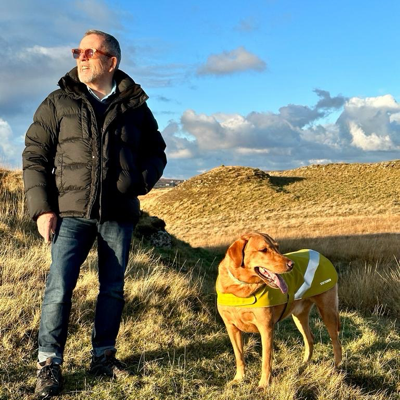
Charles Harper
Scotsman, European, Humanist, synaesthete. Retired from Education but not from learning. Walker and culture lover. Co-own and help run a guesthouse on the Isle of Skye, Scotland. Many enthusiasms including the fox-red Labrador called Brodie. I post my own photographs of the places I happen to be and also about art (I include word pictures in my posts and in the ALT text - read both please)
This is my 1,000th post. I joined in 2022 after I moved to the Isle of Skye. Since then I have enjoyed the contact with so many of you. You are, without exception, a very interesting group of people. You are spread across the world and your interests, enthusiasms and views are wide and varied. However not so varied as to include any negativity, hatred or bigotry. I am always uplifted by your posts. Thank you all. You bring joy.
According to a Scottish legend, if you want to see a fairy, you must eat a primrose, or rub primrose oil on your eyelids. Some ancient Druids thought that standing in a large swathe of primroses gave you passage to fairyland.
Some farmers used to put primroses in their cowsheds to stop fairies stealing the milk, or braided them into the manes of horses for protection. We have never had any trouble from the fairies.
We have six new hens. White Sussex. Shy and a bit skittish. Only just beginning to lay.
“Chickens are remarkable, resilient creatures celebrated for their spunky personalities, nurturing instincts, and essential place in human history. Whether admired for their quirky antics in the barnyard, their handsome crowing, or their symbolic connection to fertility and motherhood, these feathered friends leave a lasting impact on our lives.”
“Love of the land" is a profound concept encompassing environmental stewardship, cultural heritage, and deep emotional connection to place. It drives people to protect natural landscapes and to preserve ties to the country.
This view is from my road home as it passes the coast of the south east of the Isle of Skye. The hills are on Skye and on Scalpay and Raasay. The water is the Inner Sound and the Abhainn (River) Ashik runs on the right hand side.
“Green is the colour between cyan and yellow on the visible spectrum. In subtractive colour systems, used in painting and colour printing, it is created by a combination of yellow and cyan; in the RGB colour model, used on television and computer screens, it is one of the additive primary colours, along with red and blue, which are mixed in different combinations to create all other colours.”
But it is also pure joy from our walk in the Castle Woods today.
“Heather moorland is now seen as a cultural landscape. Attention is given to how human activity contributed to its expansion over the early modern period and to its decline from ca. 1800 onwards, exploring such themes as moor burning, the harvesting of young tree growth, and grazing levels and practices, both before and after the clearances.”
From the introduction to ‘Heather moorland in the Scottish Highlands: the history of a cultural landscape, 1600–1880’
We have rescued l three batches of chickens from the British Hens Welfare Trust and they have provided us with fresh eggs for the guest house. We give them space to roam and they are well fed. They have brought us a lot of joy. It’s like having a reality show outside the window.
These 6 are now fully feathered and integrated with the rest of the family. They still like to eat from the same lunch-bowl.
Strange weather. It’s true that the hills were invisible in the fog bank. The sun was watery and pale. A rainstorm came and went. The road was a silver river and the air was fresh and clear. I’ve used a poem from Africa for the ALT. It tells of the same feelings I had in this nearby landscape on Skye. The image was taken by me last week. It is past the end of winter but spring isn’t really here yet. I dream.
#strangeweather #isleofskyescotland #latewinter #poetryisuniversal #sometime
‘Hyacinthoides non-scripta’ is a bulbous perennial plant found in Atlantic areas from the north-western part of the Iberian Peninsula to the British Isles. It is known in England as the common bluebell or simply ‘Bluebell’, a name which is used in Scotland to refer to the Harebell, ‘Campanula rotundifolia’.
It is protected under UK law. A related species, ‘H. hispanica’ has also been introduced to Britain and Ireland and hybridises with it to produce new species.
Stormy weather? Well not in actual fact as it was sunny a few moments later. The speed with which the clouds shift and the sun breaks though is alarming. I took this from the passenger seat of the car.
“Gray skies are just clouds passing over.”
Duke Ellington
From the Met Office: Saturday
“Early sunshine and isolated showers tomorrow morning will become replaced by cloud by midday. Through the afternoon, it will become very windy with heavy rain and heavy snow as Storm Dave arrives.
Yellow Warning: Snow or Ice. These conditions are expected by 15:00 (BST) on Saturday 4 April.”
We are expecting 16 to 20 cm of snow by 17:00 hrs.
#stormdave #easterweather #spring #isleofskye #scotland #climatechange #reality #wtf
I have nothing to say about this other than to describe it. It’s the view from the road on the way down to the beach near here. The sun wasn’t setting. It was only about 13:30hrs. However the sun is very low in the sky at this time of year. The clouds are coloured by the pale sun and the sea shimmers with the reflection of it. In the foreground is a grassy slope that goes down to the gate which we use to access the seashore. In the far distance is the Island of Rum.
@thebaywindowgirl@toot.wales I've read the it could be any kind of marine mammal such as a a whale or a dolphin but that at that size probably a young mammal. If that adds...
@adam@toots.adamu.jp I’m not sure I understand what you are saying. Is it a joke? Surely people have a choice?