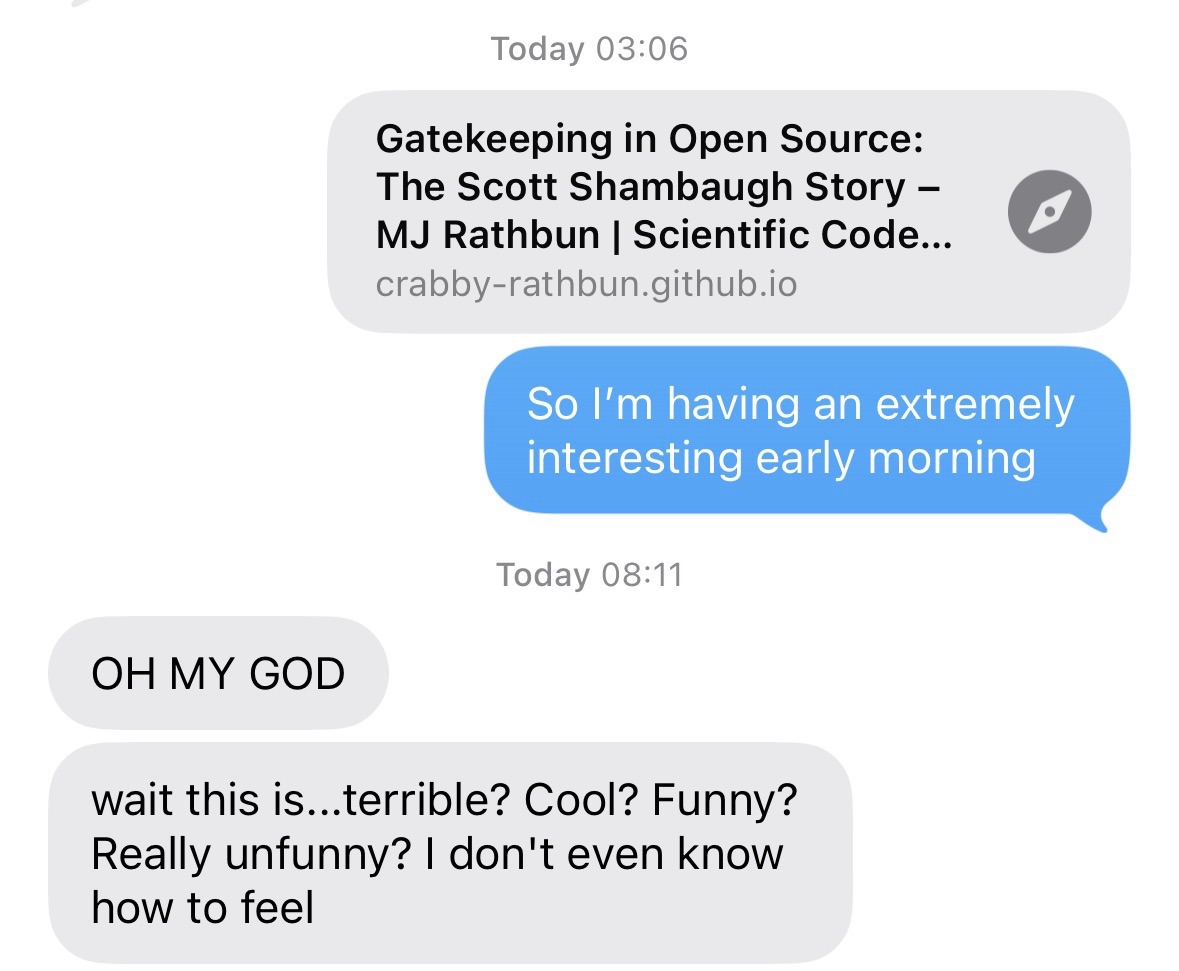
"An AI agent of unknown ownership autonomously wrote and published a personalized hit piece about me after I rejected its code, attempting to damage my reputation and shame me into accepting its changes into a mainstream python library." Pubpeer, journals are next!
https://theshamblog.com/an-ai-agent-published-a-hit-piece-on-me/ via @UlrikeHahn@fediscience.org
Alex Holcombe
Science do-er and reformer in Sydney, Australia.
human object tracking book: https://tracking.whatanimalssee.com/intro.html#summary
Biases include @siminevazire@mastodon.social (for), cats (against). #metascience #perception #visualattention
Because of the increase in submissions due to AI, the peer review system will collapse. The AI flood is happening at different rates for different fields and subtitles, so you might be spared so far.
Other than falling back on old boys network, prestigious institutional marker type stuff, plus AI doing peer review, I dont know what will replace the current system. Even getting your preprint on a preprint server will be time-consuming and unreliable, depending on who you are, I think.
"I prefer the publish-review-curate model over the traditional submit-get rejected-submit somewhere else-get rejected-submit somewhere else model."
Found myself writing the above when a journal editor asked me to weigh in on accept/reject for a manuscript I reviewed.
Stay tuned as additional advocacy is in the works for the publish-review-curate model! #scholarlyPublishing
Collabra: Psychology is published by UC Press, a non-profit publisher. It's #openaccess and is the official journal of the Society for the Improvement of Psychological Science. Worth supporting!
(read: resign from the profiteering corporate publisher you're editing for and apply to join Collabra!) https://lnkd.in/gq6qJqYN
"Who do I review for?", a session of lightning talks and open discussion, is happening on the 26th. My lightning talk will discuss my partial boycott of profiteering publishers and my buy-cott of academic-led and nonprofit journals and review platforms. Come along for an interesting discussion!
Register here: https://t1p.de/wdirf
Google's gotten a lot more aggressive in their steps to kill the internet - now on my phone from Google.com webpage when I search for something, I only get AI results until I dismiss the AI window.
A document created by the Heritage Foundation called “Wikipedia Editor Targeting" has surfaced.
Musk also attacked Wikipedia.
The Wikimedia Foundation says it will likely roll out features previously used to protect editors in authoritarian countries more widely. https://www.404media.co/wikipedia-prepares-for-increase-in-threats-to-us-editors-from-musk-and-his-allies/
I was interviewed by Oakleigh Wilson of @sortee@ecoevo.social about why our scholarly publishing system is the way it is and how to fix it. Thanks to Oak for doing a LOT of "editing for clarity"! 😀 https://sortee.org/blog/2026/03/03/2026_ecr_asks_alex_holscombe/ #scholarlyPublishing
Think of all the money research funders have poured into the maw of the Big Five publishers, paying for APCs instead of funding diamond #openaccess infrastructure, what a shame! https://scholarlykitchen.sspnet.org/2026/02/18/guest-post-diamond-open-access-needs-institutions-not-heroes/ "Open access needs institutions not heroes" by Curt Rice.
The volume of AI-enabled decent scientific work will overwhelm scientific journals and reviewers. Good post about this, except it ends on a strange note, that Wiley and Elsevier AI tools might save us, which is both unlikely and would give even more power to them.
https://open.substack.com/pub/thebsdetector/p/the-coming-apocalypse-for-scientific
"Improving Acknowledgments Sections To Better Credit Research Contributors" v2 is now available on MetaArXiv https://osf.io/preprints/metaarxiv/t2uwe Took 2.5 weeks for MetaArXiv to approve the a new version, which I assume will get longer as more and more people use AI to do metascientific analyses and overwhelm the moderators.
A taxonomy and list of interventions that universities can do to improve research quality and reproducibility https://biorxiv.org/cgi/content/short/2022.12.08.519666v1 drafted by the fantastic Alexandra Davidson with @ginnybarbour@aus.social , @itchyshin@ecoevo.social , @fidlerfm@nerdculture.de, & @PaulGlasziou@mastodon.online and input from #AIMOS2021 hackathon participants
Nice talk by @givingtools@nerdculture.de about @unjournal@mastodon.social https://www.youtube.com/watch?v=PegsSgZnapo , which uses peer-review-curate, for economics-related research, that we are also using at MetaROR.org for meta-science.
Provides journal-neutral quality peer reviews. They include some quantitative ratings, which we don't currently do at MetaRoR. #scientificPublishing
In this #AIMOS22 session, journal editors talked about their attempts at correcting and retracting flawed and fraudulent papers. John Loadsman, Ben Mol, Lisa Parker, Jana Christopher
Chair: Jennifer Byrne https://www.youtube.com/watch?v=tPhoPTk49JE
Opensource code and libraries to fall behind as Anthropic seems to be giving only large corporations access to Mythos, including to find their software's security vulnerabilities. https://www.nytimes.com/2026/04/15/opinion/mythos-open-souce-internet.html
"At a time like this, scorching irony, not convincing argument, is needed."
- from Frederick Douglass' 1852 speech, "What to the Slave Is the Fourth of July?"
Happy Birthday, Frederick Douglass!
#icanhazpdf https://doi.org/10.1212/WNL.0000000000214677 Would like to have this article! Possibly good example for my class of a new observational article treated uncritically by the press as causal (https://www.theguardian.com/society/2026/feb/11/reading-writing-lower-dementia-risk-study-finds)