By Edgar Degas (1834–1917), The Dance Lesson, ca. 1879, pastel and black chalk on three pieces of wove paper, joined together, 25 3/8 x 22 1/8 inches (64.5 x 56.2 cm), The Metropolitan Museum of Art, New York. #arthistory #impressionism #pastel #drawing
From the museum: “Degas made various adjustments to this composition, presumably to accommodate the violinist in his final design. He added strips of paper at the top and to the right, and there is evidence to suggest that he may have altered the dancer's pose. A pastel study for the musician is in the Museum's collection (19.51.1). The present work was formerly owned by Gustave Caillebotte, who probably bought it from or soon after the Impressionist exhibition of 1879. In 1894 he bequeathed it to Renoir, who sold it shortly thereafter.”
#arthistory
39 posts · Last used 8d
Rose Bay and Woollahra Point
Postcard with a black and white photograph of "Rose Bay and Woollahra Point", and a message on the reverse.
Ink, Paper
Woollahra Point, Woollahra, Sydney, New South Wales, Australia
https://collectionsearch.nma.gov.au/s/hw/EMU.EMUIRN/31055
--
#Art #History #Museum #ArtHistory #Gallery #MastodonArt #MastoArt #Culture #Random #Australia
By Peter Max (October 19, 1937 – September 14, 2026), “Cosmic Music City,” designed as a tribute to Nashville. The artist passed away earlier this week. #arthistory #popart #psychedelicart
From Matt Schudel: “If any artist was responsible for defining the visual vocabulary of the 1960s, it was Peter Max, whose vividly fluorescent paintings, posters and graphic imagery were ubiquitous during the era of flower children and the Age of Aquarius.
Countless college dorm rooms of the late ’60s and early ’70s had a Peter Max poster on the wall, next to the burning incense. Through savvy marketing, his pulsating colors and images adorned hundreds of objects — from buses and subways to pantyhose and the soles of sneakers that imprinted his name in the earth and sand.
Mr. Max’s color-saturated, almost hallucinatory depictions of stars, sun rays and people in profile showed up on walls and coffee mugs, on clothing, clocks, stationery, and even airplanes and cruise ships. In some ways, Mr. Max created the graphic equivalent of the rock-and-roll revolution in music.” ~ Matt Schudel, “Peter Max, whose psychedelic art came to symbolize the ’60s, dies at 88,” The Washington Post, September 16, 2026.
Boosted by @MaryAustinBooks@mstdn.social
By Flemish painter David Teniers the Younger (1610–1690), better known for his scenes of peasants and tavern life: Cat Concert (Katzenkonzert), oil on panel, 26 x 31.5 cm, Bavarian State Painting Collections, Staatsgalerie Neuburg. #art #arthistory #painting #oilpainting #cats
Katzenkonzert was a popular theme at the time. Sometimes called a “glaring of cats,” referring to a group of 3 or more cats.
Boosted by @trending@homestead.social
Anthorite can be found in lunar & cometary rocks, but Sphalerite gets my vote with cool optical/electrical properties & its role in art history as main zinc ore. Zn has been used in brass & bronze for centuries. Since the 18th century it was used to make ZnO pigments & etching, plates. 🧵1/2 #MinCup26 #scicomm #artHistory #minerals
#NVO987 #ArtHistory #Culture #NEXARIUM
How Roy Cohn Taught Donald Trump Everything
The lawyer who showed an outer-borough striver how to ignore the rules, avoid a paper trail, and make up a good story for the media.
https://www.newyorker.com/magazine/2026/08/10/roy-cohn-profile
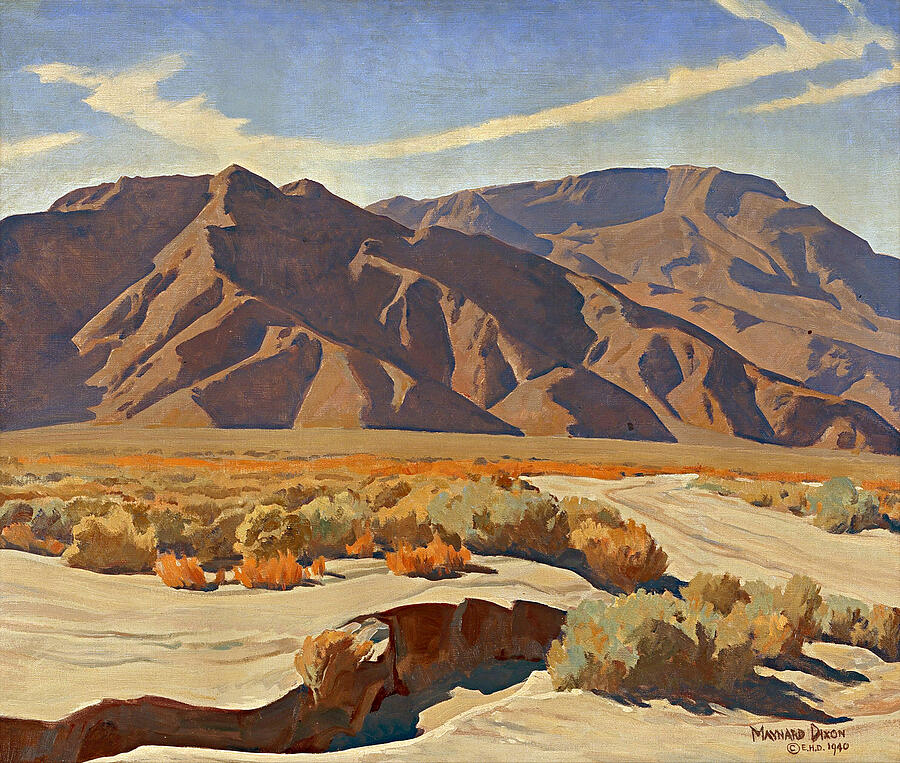
"Desert Ranges" (1940) is a powerful, late-period landscape by Maynard Dixon, showcasing his unparalleled ability to capture the stark, architectural beauty of the Western wilderness. The painting portrays a vast, silent desert expanse dominated by a colossal mountain range that stretches across the horizon under a soft blue sky streaked with wispy clouds.
https://stellar-art.pixels.com/featured/desert-ranges-1940-maynard-dixon-1875-1946.html
#art #ArtHistory #Western #landscape
Decorated Text Page (Ms. 116 (2018.43), fol. 467)
--
Date: 1296
Creator: Unknown, French or German
Place: or Germany; France
Size: 27.5 × 21 cm
Material: Tempera colors, gold, and ink
--
https://www.getty.edu/art/collection/object/109P68
--
#Art #History #Museum #ArtHistory #Gallery #MastodonArt #MastoArt #Culture #Random
Vincent van Gogh (1853–1890), The Prison Courtyard (after Gustave Doré), 1890, oil on canvas, 31.4x25.1 inches (80x64 cm), Pushkin Museum of Fine Arts. #arthistory #painting #oilpainting #vangogh #prison
From HSE University, Moscow: “Vincent van Gogh painted The Prison Courtyard in 1890, inspired by an engraving by French illustrator Gustave Doré. In February 1890, Van Gogh was staying at the Saint-Paul-de-Mausole asylum, where he had no opportunity to paint from life…
When examining Van Gogh's painting, one can notice a pair of butterflies fluttering against the prison wall. For the artist, they may have symbolized hope for liberation…
When painting this work, Van Gogh primarily used blue paint. The artist was known for his fondness for cool blue, which he combined with warm yellow to convey his inner state. The clash of these two colors also symbolizes the inner conflict that marked Van Gogh’s life—between hope and despair, joy and sorrow. The artist often used blue for his self-portraits. Through blue and its many shades, he sought to understand himself as a person and as an individual.”
Coogee Beach, Sydney, N.S.W
A postcard featuring a colourised photograph of a beach scene with rocks in the foreground, a stone wall on the left hand side and buildings in the ba…
Ink, Paper
Coogee Beach, Coogee, Sydney, New South Wales, Australia
https://collectionsearch.nma.gov.au/s/hw/EMU.EMUIRN/212986
--
#Art #History #Museum #ArtHistory #Gallery #MastodonArt #MastoArt #Culture #Random #Australia
Historiated Initial from a Bible (Ms. 38 (89.MS.45))
--
Date: about 1131–1165
Creator: Unknown, French
Place: Northeastern France (probably), France
Size: 13.7 × 13.5 cm
Material: Tempera colors and ink
--
https://www.getty.edu/art/collection/object/103RWR
--
#Art #History #Museum #ArtHistory #Gallery #MastodonArt #MastoArt #Culture #Random
💁🏻♀️ ICYMI: 📜🧑🌾 An animated short #film dispels common #myths about women in the #MiddleAges. Beyond working fields and running shops, #medieval women managed large estates and governed land as nuns while contributing to #science, #politics, and trades.
👉 Learn more: https://seethis.tv/post/illuminated-lives-a-brief-history-of-womens-work-in-the-middle-ages
#animation #art #arthistory #culture #europe #farming #food #history #illustration #medicine #nationalfilmboardofcanada #religion #textiles #weaving #womeninstem #tksst #video
💁🏻♀️ ICYMI: 📜🧑🌾 An animated short #film dispels common #myths about women in the #MiddleAges. Beyond working fields and running shops, #medieval women managed large estates and governed land as nuns while contributing to #science, #politics, and trades.
👉 Learn more: https://seethis.tv/post/illuminated-lives-a-brief-history-of-womens-work-in-the-middle-ages
#animation #art #arthistory #culture #europe #farming #food #history #illustration #medicine #nationalfilmboardofcanada #religion #textiles #weaving #womeninstem #tksst #video
Not quite sure how to hashtag this...
I have a reference in a book to "the Devon vine pattern" - judging by context, a carved design. Naturally my online searches are full of Spoonflower pages and interiors.
Can any historians of art and design in the UK help?
#AskFedi #Devon #HistoryOfArt
Edit: #MastoArt #carving #ArtHistory #ArtHistoryMatters #WoodCarving #art #design
Your art history post for today: by Thomas Cole (1801-1848), “The Course of Empire: Destruction,” 1836, oil on canvas, 39 1/4 × 63 1/2 inches (99.7 × 161.3 cm), collection of The New York Historical. #arthistory #painting #oilpainting
From the museum: ‘On August 30, 1836 the artist wrote to his friend and fellow artist Asher B. Durand "I have been engaged in Sacking & Burning a city ever since I saw you & am well nigh tired of such horrid work." The vainglorious city that Cole depicted in The Consummation of Empire has fallen to a savage enemy, and the critic for the New-York Mirror lauded Cole's critique of imperial rule, agreeing with the artist's depiction that "[s]uch is the merited downfall of all the empires which the earth has heretofore known." Instead of the statue of Minerva, goddess of wisdom, that kept watch over The Consummation of Empire, a headless colossal figure taken from the Louvre's Borghese Warrior witnesses the rapacious acts of the invading army. Cole was likely influenced by the English painter John Martin's panoramic scenes of apocalyptic disaster, and he no doubt knew that his depiction would bring to mind the terror and destruction wrought in New York by the Great Fire of 1835. Unlike the other paintings, here Cole's signature is audaciously large and carved in slashing letters, almost like an act of vandalism, on the pedestal of the ruined statue at the right.’
Estes Park, Colorado (1867) is a breathtaking masterwork by Albert Bierstadt, currently held in the prestigious White House Collection. Painted during the peak of his career, this work captures the majestic serenity of the Rocky Mountains, specifically the lush valley that would eventually become one of America's most beloved national parks.
https://stellar-art.pixels.com/featured/estes-park-colorado-1867-albert-bierstadt.html
#art #ArtHistory #Colorado #vintage #FediGiftShop
Cronulla Beach, near Sydney.
A postcard featuring a coloured black and white photograph of a beach scene with buildings on a headland in the background. Printed text on the front …
Ink, Paper
Cronulla Beach, Cronulla, Sydney, New South Wales, Australia
https://collectionsearch.nma.gov.au/s/hw/EMU.EMUIRN/213602
--
#Art #History #Museum #ArtHistory #Gallery #MastodonArt #MastoArt #Culture #Random #Australia
Reverie (In the Days of Sappho) by John William Godward (1861-1922). Godward specialized in portraying women alone in settings suggesting antiquity, usually decorative, dark-haired beauties in diaphanous gowns created with ingenious contrasts of colors and flesh tones.
https://fineartamerica.com/featured/reverie-in-the-days-of-sappho-1904-john-william-godward-1861-1922.html
#art #ArtHistory #antiquity
Your art history post for today: by African-American artist Charles White (1918–1979), “General Moses and Sojourner Truth,” 1954, wolff carbon pencil and white chalk over traces of graphite pencil, 27 7/8 in x 38 inches, Blanton Museum of Art, The University of Texas at Austin, ©The Charles White Archives. #arthistory #blackart #blackartist #BlackHistory #drawing
From the museum: ‘Charles White’s 1954 drawing General Moses and Sojourner Truth, represents two famed African American women who fought for equality in different ways. Harriet Tubman is presented in the guise of “General Moses,” grasping a staff like the one Moses used to part the Red Sea. The intellectual nature of Sojourner Truth’s writings and speeches in support of abolitionism and women’s rights is suggested through her upward gaze, in contrast to Tubman’s direct engagement with the viewer.’
St. Francis. From a supposedly unique etching by Murillo.
--
Date: 1845–1846
Creator: Nicolaas Henneman, British
Size: 8.6 × 6 cm
Material: Salted paper print from a paper negative
--
https://www.getty.edu/art/collection/object/106S8M
--
#Art #History #Museum #ArtHistory #Gallery #MastodonArt #MastoArt #Culture #Random