I put together a (free) ebook: ‘For the Love of Trees' is a collection of 70 B&W photographs of Scottish trees and treescapes, tf.photography/ebooks/
#BelieveInFilm #AnalogPhotography #Trees #Scotland
 mastodon 4.6.8
A Scottish nature lover, large format (analogue) photographer, (bike-walking)cyclist, (hill)runner. A guy who cuts his urban lawn with a scythe.
#BelieveInFilm #LargeFormat #Darkroom #HillRunning #Cycling #RoughStuffFellowship. (I am rarely here these days, most of the posts here syndicated from my blog by bridgy; all my pages come with rss feeds, for anyone that cares about that sort of a thing.)
I put together a (free) ebook: ‘For the Love of Trees' is a collection of 70 B&W photographs of Scottish trees and treescapes, tf.photography/ebooks/
#BelieveInFilm #AnalogPhotography #Trees #Scotland
Black Mirror
#Fomapan100 in #PyrocatHD, 210mm lens, R25 filter.
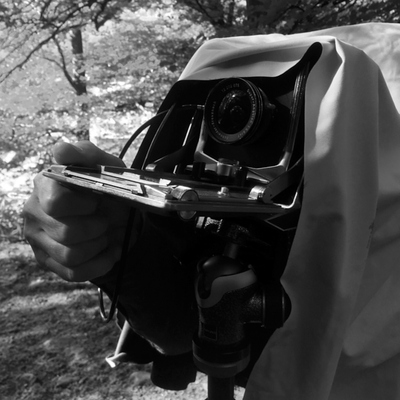
Mirrors and #LargeFormat cameras are lot of fun. 😀 I would have preferred to take this with Fujinon 300-W which has a massive image circle for 4x5, but run out of physical space in the living room to set it up.
Back on the bike after quite a while. Forgot my bike computer (!), but my legs (and bum) reckon bit over 40k and ~850m climbing. Did a wee bit of exploring, and found lovely singletrack, as well as a nice new spot for coffee and home made lentil ‘cup-a-soup’. Featuring Penguin, my personal barista (and selfie double), for #coffee matters. #cycling #gravel #gravelfoyle #trossachs (@jd@social.mrdonaldson.net this my #AlcoholStove setup)
The Punch Bowl, Glen Quoich
One of the rare occasions when the camera movements give a near perfect alignment of the focal and film plains, I would have probably got away with f11 here for more definition in the water.
It needed a bit more of the top, I will likely end up cropping it to square (I was preoccupied with the diagonal, and limited by the 210 lens; I’ll bring 180 next time).
#Fomapan100 (4x5) in #PyrocatHD, 210mm f16 @ 1/2s
#BelieveInFilm #LargeFormat #FilmPhotography
And we had this oddest of experiences along the way. There are sheep in the glen, small flocks of them, with little lambs — I am no expert, but I reckon just days old, there certainly were none a couple of weeks ago. But they are quite used to people, so we just make sure not to spook them, give them enough personal space, etc.
As we are passing one of these flocks, a little fella, clean white lamb with a black face, and tiny horns — the cutest lamb you have ever seen — peels off from his mother and starts running with me.
Endearing as it might be I am weary, I don’t want to split him from his mum. But perhaps if I speed up he will go back, so I speed up (with difficulty; this is steep hill), and he does too (effortlessly). So I stop, and he stops, and looks up at me at starts making moves like he will rub against my legs, so I hop around to prevent that, and then start running again, and he jogs alongside me.
In the meantime the mum runs silently a bit off to the left parallel with us, doesn’t seem freaking out, yet. By now it is clear this could go on for miles, so I stop again.
Fortunately there is this bubbly stream just ahead crossing the track, and the noise catches the wee fella’s attention and he goes to investigate, so about a two meter gap opens between me and him.
At this point the mum sprints up ahead, and blocks the track about another couple of meters up above him. And she says,
‘That’s enough Kilian’,
And he stands there, and looks at me, and looks at her, and then looks at me again, and then decides to join her, and they amble off the track at a leisurely pace, and we carry on alone.
Sheep are strange, but I sort of hope we will run into the wee fella again the next time, truth be said we could do with a bit of pacing up that bloody hill.
What I learnt about moving Mastodon instances last week:
The federation between instances is completely unpredictable, and the smaller the instance, the worse this gets. If the instance's fediverse links don't match well with your interests you will be missing hashtagged posts, and not seeing replies on posts you take a closer look at; the simple truth of Mastodon federation is that the bigger the instance the better the user experience in terms of reach across the ecosystem (for an explanation of how the federation works see @iain@kolektiva.social).
There is no way to predict how well a particular instance will work for you in advance, so the thing to do is to open an account on the instance you are considering and use the ‘redirect' feature on the old account: this temporarily disables the old account, and redirects everything from it to the new one (including followers), and the redirect can be undone any time without consequences.
You will know within 24h how well that instance is going to work for you. If you are happy, you can make the move permanent using the 'move’ feature, but you can only do that once every 30 days, so make sure you are happy with how the instance is working before doing this.
Oh, and do boost even hashtagged posts, just because it's tagged doesn't mean your followers who also follow that tag are seeing it.
I predict that on the back of #AI proliferation we will see revival of all sorts of #analog technologies, with a whole new constituency of folk looking for AI resistant processes and means of expression. And with that renewed importance of corporality and physical space. Real people producing and exchanging tangible things, building networks of trust.
Pylons are not so much the price for cheaper electricity as they are the price of living beyond our means. Electricity should be generated near to where it is used. One of the problems with the current renewables gold rush is that it allows the concentrated overconsumption of our urban centres to ingress yet farther afield than in the past; it further expands our invasive species’ conquest of new spaces: a land occupied by a pylon is forever tainted, bearing the hallmark of being damaged, and with it an invitation to future abused.
One of the particularly insidious aspects of pushing our energy generation further away from where we live, and even out into the sea, is it conceals from us the reality of our lifestyles, it transforms reality into an impersonal abstraction, and such abstractions are invariably easy to justify.
It is easy to dismiss objections to pylons as nothing more than nymbism, but nimbyism is an entirely valid response to nimbyism itself -- there is absolutely nothing wrong with refusing to carry undersirable consequences for those who do not want to face up to them themselves.
I have very little doubt that future generations (assuming there will be many) will look at our carefree deployment of renewables at massive scale with the same horror they will view our love affair with oil and gas; we are not solving the core problems of our existence, merely transforming them into a different space, one that at present might seem to us less problematic, not least because our criteria are constrained ad absurdum. But no activity at a huge scale is ever without dramatic consequences. Scale is everything, and nothing ever scales infinitely.
Some thoughts on #AI and creativity in #photography
A great deal of photographers, not least landscape and nature photographers, are concerned these days about AI, and are voicing the need to be able to differentiate images that are the product of human creative process from those created by AI (and looking for technological solutions to facilitate that); the common assumption being that AI images are inferior, fake and fraudulent.
But it seems to me that the big problem in all of this discussion is that the distinction between human creative manipulation and AI is entirely artificial, i.e., if a human artist and an autonomous AI system were to produce an identical image, it would be an identical image; at this point the differentiation between the two has no longer anything to do objectively with the image, but is purely a subjective value judgement regarding agency.
Conversely, if we couch the debate in terms of veracity and fraud then the agency doesn’t matter, only the manipulation does, i.e., there is no reason why an AI generated image could not be closer to reality than a creatively manipulated one — the ‘creative’ label stops being meaningful in this context, the image is either objectively faithful (however we choose to define that) to external reality or not.
In other words, the defence of ‘human creativity’ against ‘AI’ hinges entirely on where the agency lies with AI generated content, and given that current AI systems are not autonomous, those images still have human agency. So what we are really talking about when we say ‘creativity’ in this context is a value judgement about the tools the artist chooses to use. I might very well greatly value one set of tools over the other, but I think the target audience in general doesn’t care that much. Could we develop a system to indicate the tooling? Most likely. Does it mean that images created without AI will sell better? I suspect not (and I think that’s really what most of the concern is about).
I expect at some point in our dystopian future AI could become autonomous, i.e., we could be looking at images generated without any human agency at all, but that doesn’t fundamentally change the nature of these deliberations: it still all comes down to the value assigned to the particular type of agency, and has little to do with objective properties of the image.
The real problem for photographic genres such as landscape and nature is not AI per se, it’s the fact that the connection with reality has been severed long time ago in the name of artistic creativity. What the arrival of AI does is merely to create a situation where suddenly even the best can be outdone at this creative game.
For the record, I am not a believer in AI. It brings real, multifaceted, problems, the two that concern me most at present is the sheer level of inane noise LLMs generate, and the environmental costs of all these systems. But as far as landscape and nature photography are concerned, we just need to find ways which genuinely give value to the human agency behind our images; if we can’t we deserve all the AI generated content world’s data centres can throw at us.
The Scottish hills are strewn with remains of crashed airplanes. The current trend seems to be to collect bits as souvenirs, but I find them somber places that make me contemplate the transience of our existence. One such crash happened on this day in 1941 near Inchnadamph. Below is a short reflection I wrote in 2016; I run the #Assynt Traverse the day before, and could not shake off that story in the solitude of the wee hours on Quinag.
@kristiedegaris@mastodon.scot oh, that looks like my kind of a place, thanks for sharing that.
Unsurprisingly, Lithium batteries are not good for the environment. This paper notes the manufacturing is an overlooked significant source of ‘forever' chemicals, https://www.nature.com/articles/s41467-024-49753-5
I’d not be surprised if Apple pull out of the European market in the near future, it accounts for less than 20% of their revenue, and that includes India, Middle East and Africa under the ‘Europe’ heading, and has the lowest profit margin, I expect they could make this up fairly quickly from China, which is already lot more significant for them than ‘Europe’.
@simon_brooke@mastodon.scot @Tarbh@mastodon.ie @bobjmsn@mastodon.scot yes, and the Pentland Firth is, after a better part of a decade, managing to produce whole 6MW, the planned tidal capacity to land this decade is a few tens of MW. Orders of magnitude gap to address the 1.4GW we are going to loose when Torness is decommissioned in 2028. There are no tidal installations anywhere in the world that would get even to 300MW, even though the technology has been around for over half a century. Hm.