Remote
ESO
@esoastronomy@mastodon.social
The European Southern Observatory designs, builds & operates world-class observatories on the ground for the benefit of society.
6394 Followers
64 Following
50 Posts
Joined June 26, 2025
website:
Chasing Starlight:
Boosted by @trending@homestead.social
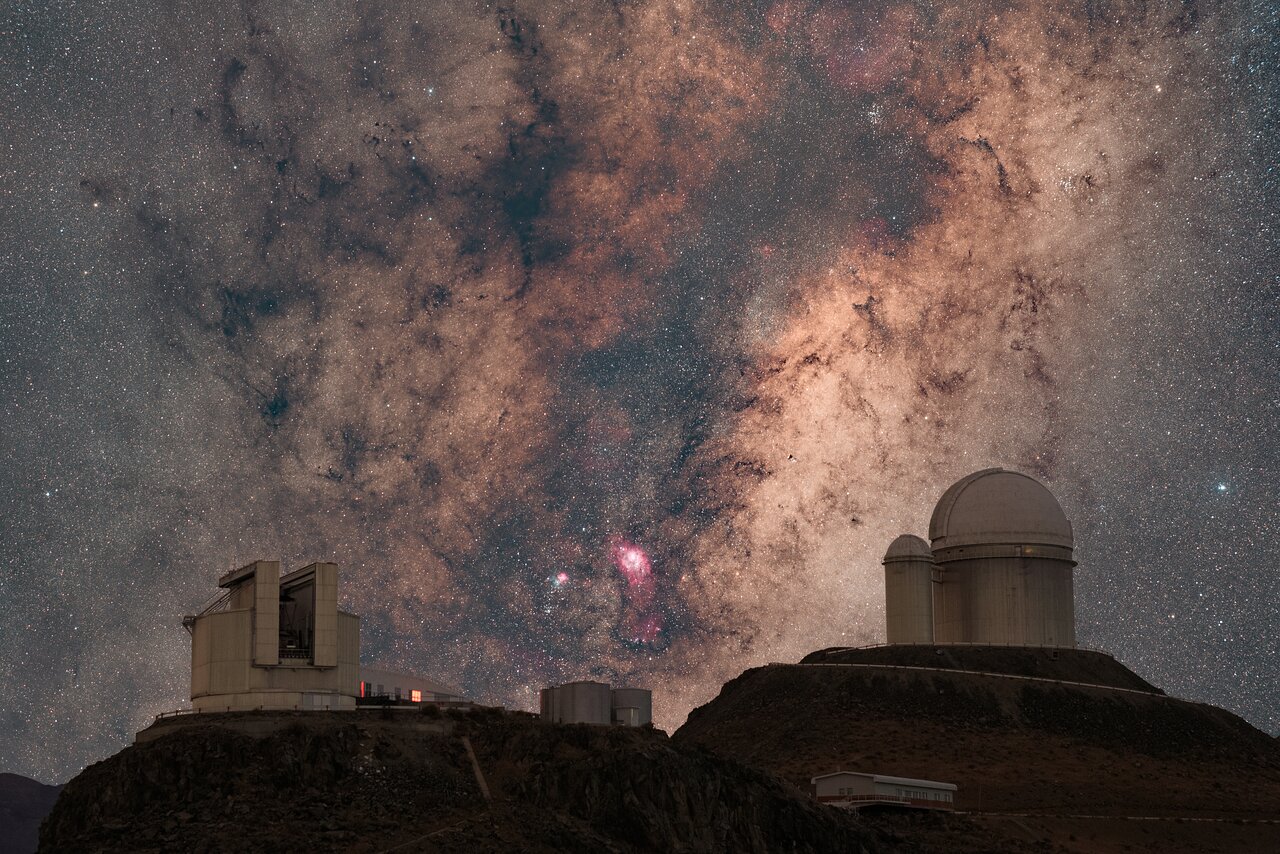
The gleaming Trifid and Lagoon nebulae can be seen between our New Technology Telescope (left) and the ESO 3.6-meter telescope (right) at La Silla.
Their red colour comes from hydrogen atoms ionised by young stars in these clouds. The Trifid nebula also shows a blue tint caused by dust reflecting the light of some of these stars.
Discover more: https://www.eso.org/public/images/potw2639a/
📷 J. Rodrigues/ESO
#astrodon #astronomy #astrophysics #astrophotography #space #science
Open post
A bubbling Betelgeuse ⭐️ 🫧
Taken with ALMA, this is one of the most detailed views yet of the surface of the iconic star Betelgeuse.
The star's surface is uneven and lumpy, with peaks and troughs originating from giant bubbles of hot gas rising from deep within the star to its surface.
1/2
📷 ALMA(ESO/NAOJ/NRAO)/W. Dent et al.
#astrodon #astronomy #astrophysics #space #science
152
2
133
2
Open post
Total solar #eclipse loading ☀️🌕🌍
On 12 August, the #Moon will slip between the #Earth and the #Sun, turning day into night for up to a minute and a half along the path of totality.
Get the gist with ESO fellow Mar Carretero Castrillo 🎬👇
1/4
#astrodon #astronomy #astrophysics #space #science #solareclipse
113
8
136
1
Open post
It’s a new MOON(S)!
Suspended here in darkness are two infrared cameras belonging to MOONS, a new instrument of our VLT that recently performed its first observations.
📷 L. Sbordone/ESO
1/3
#astrodon #astronomy #astrophysics #space #science
25
0
15
0
Open post
This is why we call it the Extremely Large Telescope!
This photo shows the massive structure that will hold the main mirror of our ELT. It was taken when the construction reached an important milestone: for the first time, the telescope’s structure was rotated horizontally by a few centimetres... by hand!
Read more: https://www.eso.org/public/images/potw2627a/
1/2
📷 ESO/Cimolai
#astrodon #astronomy #astrophysics #space #science #engineering
171
3
115
3
Open post
The night shift begins.
At our Paranal Observatory, sunset does not mark the end of the day: it signals the beginning of a night under the stars.
Taken after dinner, before heading to the telescopes for a night of observing, this image shows the last rays of sunlight slicing through one of the corridors at the Residencia — a home away from home for astronomers and other staff members.
https://www.eso.org/public/images/potw2632a/
📷 L. Sbordone/ESO
#astrodon #astronomy #astrophysics #space #science #architecture
50
0
14
0
Open post
The world’s biggest eye on the sky is taking shape 🤩
Watch a year and a half of progress unfold in this time-lapse of out Extremely Large Telescope (ELT) — now more than 75% complete!
Since 2025, the telescope’s construction has seen important milestones, from the ELT's dome and main structure to off-site development of mirrors and instruments.
Discover them: https://www.eso.org/public/videos/potw2629a/
#astrodon #astronomy #astrophysics #space #science #engineering
84
6
73
0
Open post
Replying to
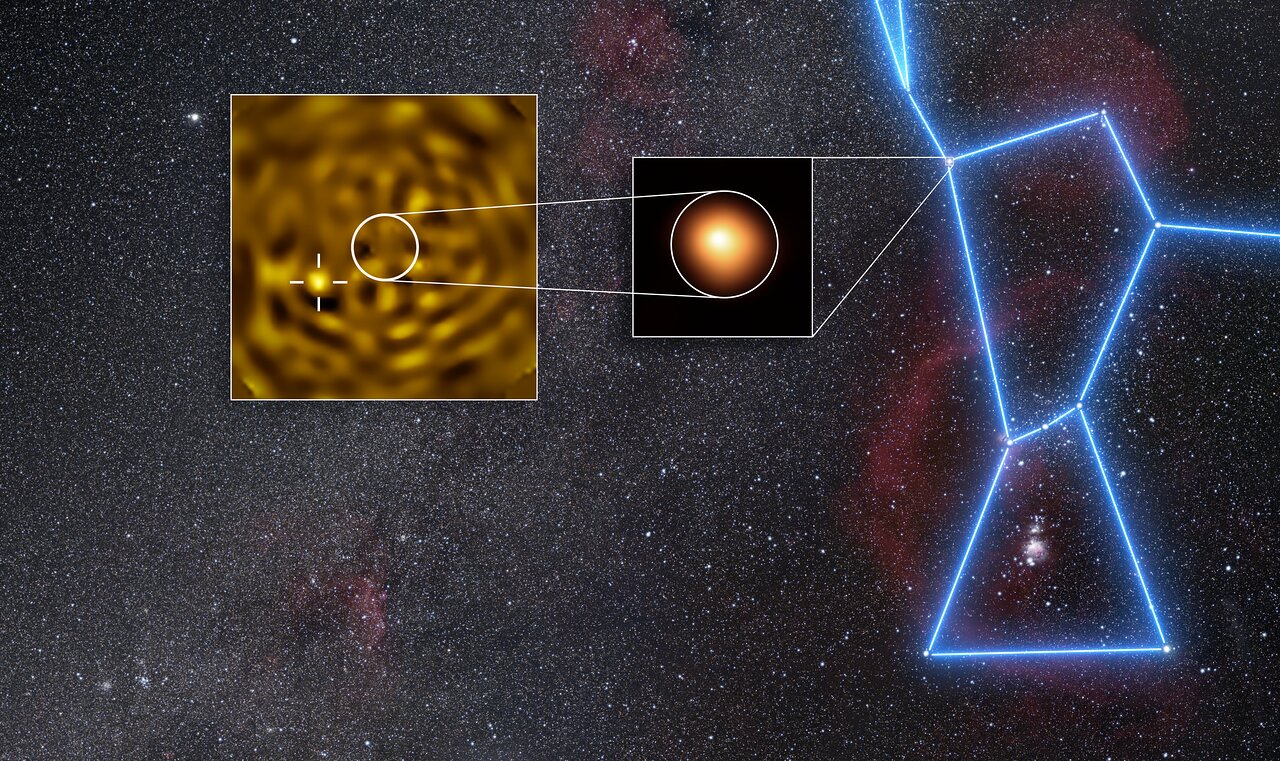
The brightness of Betelgeuse changes periodically. For decades astronomers had suspected that some of these variations could be due to a companion star orbiting around it.
Now, the VLT has captured the clearest image ever of Betelgeuse B, a faint star orbiting Betelgeuse.
2/4
📷 ESO/M. Montargès et al.
67
3
33
0
Open post
Replying to
The potential detection of Betelgeuse B will prompt astronomers to investigate how the companion could affect Betelgeuse's anticipated supernova explosion.
Read more: https://www.eso.org/public/news/eso2611/
4/4
66
6
33
0
Open post
Replying to
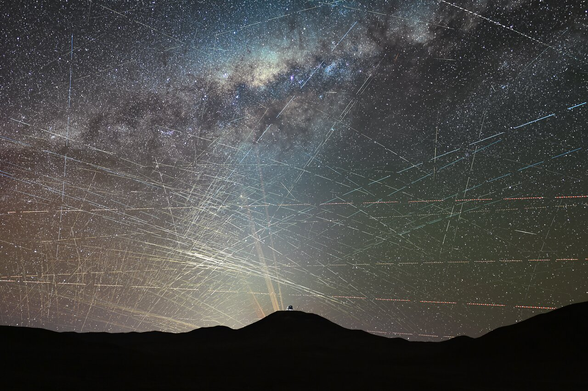
SpaceX plans to launch 1 million satellites for space-based data centres.
This diagram shows the satellites that would be visible above our VLT:
⚪ invisible satellites in Earth’s shadow
🟠 2000 satellites brighter than magnitude 7
🔴 200 satellites brighter than magnitude 5
2/4
📷 ESO/O. Hainaut
92
33
109
1
Open post
Replying to
Both SpaceX & Reflect Orbital have filed with the US Federal Communications Commission for permission to launch.
Our response to the FCC, together with the UK’s Royal Astronomical Society and the International Astronomical Union, was based on this study 👉 https://www.eso.org/public/news/eso2607/
📹 F. Kamphues, ESO/M. Kornmesser
85
11
54
0
Open post
Replying to
While there were indications for this companion's existence, including a possible direct detection with the Gemini North Telescope, this is the strongest evidence yet for Betelgeuse B.
The new observations also revealed that Betelgeuse B has two to three times the mass of the Sun.
3/4
📷 ESO/Digitized Sky Survey 2. Acknowledgment: Davide De Martin.
47
1
14
0
Open post
Small but mighty!
As the Sun sets, the MPG/ESO 2.2-metre telescope at ESO's La Silla Observatory opens its eye, preparing to peer beyond its shiny dome into the sky above.
Don’t let its small size fool you! Though 2.2-metre may be modest by today’s standards, it still does a lot of excellent work.
Discover what this telescope explores: https://www.eso.org/public/images/potw2628a/
📷 L. Sbordone/ESO
#astrodon #astronomy #astrophysics #space #science
66
2
37
0
Open post
A gateway to the Milky Way?
This road sign marks the entrance to ALMA, in #Chile 's Atacama Desert. ALMA studies light from the coldest corners of the Universe. But this radiation is absorbed by water vapour in Earth’s atmosphere. This is why ALMA is located in one of the driest and highest places on Earth, on the Chajnantor Plateau in the Andes, at an impressive altitude of 5000 metres.
Read more: https://www.eso.org/public/images/potw2626a/
📷 J. Looten/ESO
#astrodon #astronomy #astrophysics #space #science
81
1
45
0
Open post
RE: https://mastodon.social/@esoastronomy/116844616500605008
We're thankful and overwhelmed by the positive support this has garnered!
If you'd like a deeper dive on the threat of satellite constellations, check out our latest Chasing Starlight episode with Olivier Hainaut, ESO astronomer and author of the paper we featured yesterday, and Betty Kioko, ESO's Institutional Affairs Officer, who coordinated our response to the FCC: https://www.youtube.com/watch?v=LJNwAKSL17s
#astrodon #astronomy #astrophysics #space #science #environment #pollution
Open quoted post
Open quoted post
Quoting
🚨 Beyond the limit 🚨
New ESO study finds that current proposals to launch 1.7+ million satellites into orbit would have devastating consequences for astronomy.
The most extreme proposals come from SpaceX & Reflect Orbital
1/4
📷 F. Kamphues, ESO/M. Kornmesser
#astrodon #astronomy #astrophysics #space #science #environment #pollution

Satellite constellations threat to astronomy can get much worse
71
0
82
0
Open post
Replying to
Reflect Orbital aims to launch 50,000 mirror-like satellites to provide sunlight at night, with reflected beams spanning at least 5 km on Earth's surface.
This image illustrates how scattered sunlight would increase the overall brightness of the sky above the VLT, even if the mirrors aren’t aiming directly at the observatory.
3/4
📷 ESO/O. Hainaut
66
22
61
0
Open post
Replying to
Unlike moons in our Solar System, this object — a gaseous body at least as massive as Jupiter — does not orbit a planet.
It circles a brown dwarf, that in turn orbits the CD-35 2722 star.
Regardless of what to call this object, this discovery may mark an important first.
2/4
41
9
9
0
Open post
Boosted by @hypebot@tacocat.space
Over 70% complete, our ELT is glowing in the #sunset light of the Atacama Desert in #Chile, surrounded by massive cranes hard at work to get this telescope up and running.
With the first light planned for the end of the decade, the ELT and its groundbreaking 39-metre main mirror will take on some of the biggest challenges in #astronomy and, ultimately, help us understand our place in the #Universe.
Read more: https://www.eso.org/public/images/potw2617a/
📷 ESO/G. Vecchia
#astrodon #astrophysics #space #science
150
3
118
0
Open post
Replying to
If confirmed, this could be the first ‘moon’ discovered outside our Solar System — something astronomers have been searching for years.
This animation shows how the gravitational pull of the ‘moon’ makes the brown dwarf wobble, shifting its spectrum and so enabling the detection 👇
3/4
38
3
14
0
Open post
Boosted by @hypebot@tacocat.space
This isn't a scene from Star Wars.
What you're looking at is the Tarantual Nebula, and those beams come from the lasers installed on the telescopes of our Very Large Telescope Interferometer in #Chile. They create artificial stars 90 km above the ground to correct atmospheric turbulence, allowing the VLTI to observe faint targets.
But why are four telescopes observing the same target? Find out: https://www.eso.org/public/images/potw2616a/
📷 A. Berdeu/ESO
#astrodon #astronomy #astrophysics #space #science
150
7
109
3
Open post
Replying to
Known as Beta Pictoris d, it is the faintest exoplanet ever directly imaged from Earth.
This is a major feat, as direct imaging only works for #exoplanets bright enough to show up next to their much brighter host stars.
When the team examined the ESO & JWST archives, they found this planet had actually been hiding in data spanning more than 10 years.
2/3
📷 ESO/B. Sutlieff, M. Bonse et al.
36
1
10
0
Open post
Replying to
Beta Pictoris d is only 2.4 times more massive than Jupiter, making it one of the lightest exoplanets ever imaged from the ground.
Its two other siblings are each around ten times the mass of Jupiter.
Read more: https://www.eso.org/public/news/eso2609/
3/3
📹 ESO/B. Sutlieff, M. Bonse et al.
35
0
9
0
Open post
Replying to
(44) Nysa consists of 3 ‘lobes’, joined by two sections that encircle the asteroid, or ‘necks’.
All previous identifications of asteroids with a neck have been interpreted as ‘bilobates’ (two lobes).
Why this odd shape? Possible explanations:
https://www.eso.org/public/videos/potw2631a/
21
0
5
0
Open post
Replying to
Read more in our press release: https://www.eso.org/public/news/eso2610/
Or if you prefer a video summary: https://www.youtube.com/watch?v=z9j_oUFddIY
4/4
21
4
10
0
Open post
Replying to
@zl2tod@mastodon.online The position of the source coincides with an earlier tentative signal by another team. That signal was just at a 1.5 sigma level, namely, just 50% brighter than the noise. This new detection is 5-6 times brighter than the noise. So the question isn't so much whether it's a real source on the sky, but whether it orbits Betelgeuse. As we mention in the press release, the team plans to observe it at the other side of its orbit, but so far this agrees with what we expect the companion to be.
14
0
0
0
Open post
Older than the Sun! ☀️
Using our Very Large Telescope, astronomers have studied in detail the composition of interstellar comet 3I/ATLAS ☄️
The findings shine new light on the formation history of this comet, indicating that it may be much older than the Sun.
📷 ESO/O. Hainaut
1/3 🧵👇
#astrodon #astronomy #astrophysics #space #science
22
2
13
0
Open post
Replying to
We have already installed:
⚡ A photovoltaic generator for the cooling and heating demands of the ESO 3.6-metre telescope and the accommodation area
⚡ Heat pumps for residential heating and hot water
#EarthDay2026 2/3
45
2
5
0
Open post
Replying to
You can learn more about the M4 here: https://elt.eso.org/mirror/M4/
And check our adaptive optics explainer video here: https://www.youtube.com/watch?v=g_QC2cLroDc
16
0
10
0
Open post
Replying to
@spacerik@spacey.space Indeed, the effects of satellite constellations go beyond their impact on astronomy. The press release is an explainer of our new study, but in parallel we have also escalated up this issue to the policymaking level at an international scale. You can find more details about this in this accompanying video: https://www.youtube.com/watch?v=LJNwAKSL17s and this article: https://www.eso.org/public/blog/betty-kioko/
Satellite constellations threat to astronomy can get much worse
14
0
4
1
Open post
Replying to
Sending Orion around the Moon and bringing it back home was the task of ESA's European Service Module, which provided power, propulsion and life support for the crew.
Welcome back to Earth, Reid, Victor, Christina & Jeremy! 🧑🚀
📷
NTT image credit: ESO/I. Saviane
Orbit simulation: Kel Elkins (Science and Technology Corporation), Ernie Wright (USRA)
32
1
14
0
Open post
ALMA has mapped with unique detail how clouds in another galaxy break into smaller fragments out of which stars will form.
The way this happens seems similar to what we see in clouds in our own galaxy. Could this mechanism be universal?
More by INAF: http://www.inaf.it/en/inaf-news/alma-witnesses-star-birth-beyond-milky-way
📷 A. Traficante et al.
27
0
16
1
Open post
Replying to
With more to come soon, including a chiller system and a battery energy storage system 🔋
#EarthDay2026 3/3
26
1
2
0
Open post
Replying to
@rstub@digitalcourage.social @AkaSci@fosstodon.org The removal was done during the analysis stage. Briefly speaking, the field of view rotates during the observations. This is something we would normally correct in other astronomical observations, but here it allows you to disentangle real features on the sky from internal aberrations. Even though Betelgeuse itself wasn't blocked by a coronographic mask, it is nevertheless removed during this process.
5
0
0
0
Open post
ICYMI The 3I/ATLAS comet might be older than the Sun itself.
Astronomers used our Very Large Telescope to study the composition of 3I/ATLAS, the brightest interstellar object ever spotted ☄️
They found that the comet likely originated in the outskirts of an old star system, indicating that it may be much older than the Sun.
Read the full story: https://www.eso.org/public/news/eso2608/
and check out our video summary 🎥 👇
#astrodon #astronomy #astrophysics #space #science
7
0
5
0
Open post
Replying to
And here is the location of the image on the sky, between the constellations of Ophiuchus and Scorpius:
https://worldwidetelescope.org/webclient/?wtml=http%3A%2F%2Fwwtcoreapp-data-app.azurewebsites.net%3A80%2Fwwtweb%2FShowImage.aspx%3Freverseparity%3DTrue%26scale%3D0.241019%26name%3DEFOSC.2026-04-09T04-Artemis-NTT-1.png%26imageurl%3Dhttps%3A%2F%2Fnova.astrometry.net%2Fwwt_image%2F37371937%26credits%3DAstrometry.net%2BUser%2B(All%2BRights%2BReserved)%26creditsUrl%3D%26ra%3D254.219235%26dec%3D-29.604926%26x%3D324.8%26y%3D418.4%26rotation%3D180.39%26thumb%3Dhttps%3A%2F%2Fnova.astrometry.net%2Fwwt_image%2F37371939%26wtml%3Dtrue#/place=Open_Collections.EFOSC.2026-04-09T04-Artemis-NTT-1.png.0&ra=16.94795&dec=-29.60493&fov=0.04669
15
0
5
0
Open post
Replying to
@ramsey@phpc.social @sundogplanets@mastodon.social The simulation was specifically done over the VLT, but a similar increase would be visible at other locations. Even if the mirrors aren't pointing directly at the observer, when seen sideways they would still be as luminous as a bright planet like Venus. With a swarm of these bright sources above you at any given time, the atmosphere would scatter their light around, leading to the overall increase in brightness you see here.
4
0
0
0
Open post
Replying to
@Roblugton@aus.social Not at all, the cranes are also very impressive on their own!
1
0
0
0
Open post
Replying to
@PWei888 This is a stack of three 10 minute exposures, hence the two large gaps along the trail (the last exposure at the bottom only captured a small part of the trail before the spacecraft left the FOV). As for the smaller dips within each individual exposure, they might be due to scintillation.
1
0
0
0
Open post
Replying to
@strawhousepig Unfortunately that's not possible, as both facilities observe radiation with different wavelengths. ALMA observes radiation at millimetre wavelengths, whereas the VLA operates in the centimetre/metre range. That being said, ALMA is part of the Event Horizon Telescope, the planet-sized network of radio telescopes that took the first image of a black hole.
1
0
0
0