Turkish researchers have found that tough pioneer plants can help transform lunar and Martian regolith into something tomatoes can grow in.
https://spacebotany.uk/blog/pioneer-plants-could-pave-the-way-for-space-tomatoes/
 mastodon 4.7.3
I'm Emma (she/they), and I am mad keen on the idea of growing plants in space, so that's mostly what I talk about - #plants and #space. I also like mission patches, space food and #gardening on Earth. I'm the producer & host of a podcast called Gardeners of the Galaxy.
I am a human and happy to chat, so if you’ve got a question about plants in space, please do ask!
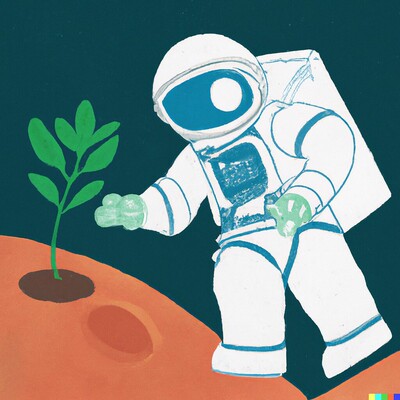
Turkish researchers have found that tough pioneer plants can help transform lunar and Martian regolith into something tomatoes can grow in.
https://spacebotany.uk/blog/pioneer-plants-could-pave-the-way-for-space-tomatoes/
Madison Square Park in midtown Manhattan is now home to a Moon tree – a young American sweet gum sapling that grew from a seed NASA sent around the Moon on the Artemis I mission.
https://www.space.com/astronomy/moon/a-seed-that-flew-around-the-moon-grew-into-this-tree-in-nyc
Chia fed the Aztecs. Now it might feed astronauts. A new study tests chia microgreens against the cosmic radiation of deep space - and they hold up well. 🌱🚀
https://spacebotany.uk/blog/chia-microgreens-show-promising-resilience-to-space-like-radiation/
New on the blog: a University of Turin study asked what will actually stop us growing crops on Mars. 🌽🔴
The answer isn't low gravity or the weak magnetic field – it's the soil.
https://spacebotany.uk/blog/martian-soil-not-low-gravity-is-the-real-enemy-of-mars-grown-maize/
I know it has been a while, but it's Gardeners of the Galaxy's sixth birthday, so I thought I would celebrate with a new episode. It looks into the history… and future… of wine in space. Starting in a medieval toilet, and ending up on the bridge of the Starship Enterprise, it’s a trip of a lifetime - buckle up and enjoy the ride!
An upcoming mission will send hundreds of grape seeds to the International Space Station.
https://spacebotany.uk/blog/a-texas-heritage-grape-is-heading-for-the-space-station/
"Much like terrestrial restaurants, future space-based systems will need to address food’s path from source to table, but with far more stringent requirements. This means meeting nutritional goals, easily producing food-safe ingredients in space, recycling inedible biomass and waste, and offering a culinarily delicious and culturally diverse menu."
https://cen.acs.org/food/food-science/space-exploration-astronaut-food-nutrition/104/web/2026/07
Astronauts on the Chinese space station Tiangong have released a video of their aeroponic tomatoes for Lunar New Year:
https://spacebotany.uk/blog/space-tomatoes-for-lunar-new-year/
ESA has turned one of the articles I worked on earlier in the year - about aquatic moss on Mars - into a short video:
https://www.linkedin.com/feed/update/urn:li:activity:7477663737689210880/
🚀🌱 My latest Mission report has a plasma "Beam Saber" fertiliser inspired by Gundam that could grow rice on the Moon, NASA's poop-to-plant-food machine, a hyperspectral camera that spots thirsty lettuce before it wilts, tough desert moss surviving orbit, Hungarian seeds on a sounding rocket – and why astronauts might one day eat asteroid dust.
Read it here: https://spacebotany.uk/blog/mission-report-7-july-2026/
Women-led research has just grown chickpeas from seed to seed in simulated lunar regolith. The trick is to think like a gardener, and let composting worms and friendly fungi lend a hand.
https://spacebotany.uk/blog/fungi-worms-and-chickpeas-growing-food-in-lunar-regolith/
Lupins! In space! Starbase Brewing sent seeds of Texas Bluebonnets (Lupinus texensis) and other native Texas plants into orbit aboard SpaceX's new Starfall capsule on 23 June, along with dozens of yeast strains from around the world. They'll be analysing how the spaceflight environment affected them all. The brewery's longer-term ambition? Beer on Mars. 🚀🌱🍺
South Africa is sending rooibos tea seeds to the International Space Station this autumn:
https://spacebotany.uk/blog/south-african-tea-seeds-prepare-for-launch/
My latest article for ESA Discovery and Preparation involves a project exploring whether it's possible to turn plant wastes into medical supplies and biocomposites for 3D printing in space:
Interstellar Lab has officially unveiled Little Prince - their mission to send a flowering rose to the Moon.
https://spacebotany.uk/blog/little-prince-a-rose-among-the-stars/
A new research facility designed to simulate the conditions of space habitats has opened in Dübendorf, Switzerland, operating under the European Space Agency’s Ground-Based Facility programme.
The facility’s research scope spans plant biology, microbial systems, bioregenerative life support, and the testing of technologies intended for future lunar and Martian habitats.
https://spacebotany.uk/blog/switzerland-opens-a-new-space-farming-research-facility/
The latest cargo delivery to the ISS contained several space plant experiments, including one on seed ageing from the Royal Botanic Gardens, Kew.
https://spacebotany.uk/blog/kew-gardens-has-sent-seeds-to-space-to-find-out-how-well-they-age/
An ambitious mission to send a living vernal pool into space morphed into a seedy art project when the container leaked.
https://spacebotany.uk/blog/seeds-a-letter-and-a-leak-the-story-behind-project-revive/
Details on the Canadian seeds that are on a trip round the Moon with Artemis II:
https://spacebotany.uk/blog/canadian-seeds-join-artemis-ii-for-round-the-moon-mission/
This is an interesting one - a small-scale, student-led series of high-altitude balloon experiments to build a functioning greenhouse system for space plants. The CO2 needed is provided by fungal mycelium.
https://spacebotany.uk/blog/can-high-flying-fungi-help-plants-breathe-in-space/
I've just captioned a photo "Tim Peake, in the Cupola, with the rocket seeds", and now I think I'm playing some weird version of Cluedo.
Researchers have done some interesting work exploring how well tardigrades can survive in Martian regolith simulants - and found a simple trick can improve its livability.
https://spacebotany.uk/blog/what-water-bears-tell-us-about-growing-plants-on-mars/
Crew-12 have (at least) 3 plant experiments on their docket for their mission on the International Space Station - Project Rapunzel, ChlorISS and Veg-06.
Details on the blog: https://spacebotany.uk/blog/three-plant-experiments-on-the-iss-for-crew-12/
The latest on the blog is an update on the mission to send Argentinian quinoa seeds into space - which has more concrete plans now.
https://spacebotany.uk/blog/argentine-quinoas-space-mission-gets-real/
A quick update for Spudnik-1 fans.
When CRS-32 returns from the ISS in June, it will be carrying the Advanced Plant Habitat, which supported long-duration plant biology studies. It is being mothballed, for eventual museum display. 😱
https://www.nasa.gov/general/nasas-spacex-34th-commercial-resupply-mission-overview/
"Since they looked just like other trees of their respective species, over time the Moon Trees tended to be forgotten, particularly those that had lost their signage."
https://herbariumworld.wordpress.com/2026/02/23/tree-perspectives-moon-trees/
A small US startup is working with university students to build a prototype aquaculture system designed to study oysters in microgravity. The idea is that oysters could one day feed astronauts and filter water, as part of a biological life support system.
Chinese scientists have just confirmed that a butterfly hatched out of a crysalis on a recent suborbital mission.
It wasn't the first butterfly in space, though.
They seem to do OK, which means they could become important space pollinators.
Jeremy Hansen's mission patch for Artemis II mission to the Moon was graciously created by Anishinaabe artist Henry Guimond. It was done with the contribution of Dave Courchene III (Sabe), Leader of the Turtle Lodge in Sagkeeng First Nation (Manitoba).
Working with an Indigenous artist to create the patch was Jeremy's way to recognize the importance of traditional knowledge and Indigenous Peoples in Canada.
https://www.asc-csa.gc.ca/eng/missions/artemis-ii/jeremy-hansen-patch.asp
In Don Pettit's latest photo of Spudnik-1, the space spud is growing with its bottom in an old drink bag.
(I blogged what I have discovered about Pettit's latest space gardening adventures last month: https://spacebotany.uk/blog/spudnik-1-don-pettit-reveals-his-iss-potato-experiment/)
"The Soviets presented science as a utopian ideal. Thousands of researchers worked in imperfect secrecy on ‘big science’ initiatives, mostly for cold war military objectives. In the 1990s, after the collapse of the Soviet Union, many institutions were left destitute and their advanced technology was doomed to extinction. But some scientists persevered, adapting to the landscape."
https://www.theguardian.com/artanddesign/gallery/2026/may/03/symbols-of-soviet-science-in-pictures
"I’m writing to inquire about the opportunity to publish guest posts on spacebotany.uk.
We ensure that all content aligns with your website’s niche and quality standards."
So you can provide fact-checked, fully referenced articles about growing plants in space???
I don't think so!
An update on the Hungarian VITAPRIC experiment to grow microgreens in space - the plant samples have finally made it back home!
https://spacebotany.uk/blog/hungarys-space-grown-microgreens-return-to-earth/
@I_am_a_plant@mastodon.art It is very lovely - I hope they pull it off 🌹


