State of the (Tagged) Union Address by Andrew Kelley
https://www.youtube.com/watch?v=zwi5b5xSsKA
#Programming #OpenSource #ZigLang
#ziglang
13 posts · Last used 9d
marionette: deterministic simulation testing library
https://github.com/sb2bg/marionette
#Programming #Testing #ZigLang
Overengineered calculator: Zig + QBE
https://tomekw.com/overengineered-calculator-zig-qbe/
#Programming #ZigLang #Compilers
Inside Zig's Incremental Compilation
https://mlugg.co.uk/posts/incremental-compilation-internals/
#Programming #Compilers #ZigLang
Cruller: Bun's Zig Runtime, Continued on Zig 0.16
https://ziggit.dev/t/cruller-buns-zig-runtime-continued-on-zig-0-16/16734
#HackerNews #Tech #ZigLang
River is a Wayland compositor written in Zig that defines a window manager protocol so that, like with X11, write your own window management software. As with X11, the protocol is language-agnostic, so you can define your window manager using any programming language at all.
I have been gradually becoming more interested in Zig as a potential replacement for C in systems programming. Rust is another interesting potential replacement.
#tech #software #Zig #ZigLang #Linux #Wayland #WindowManager #WaylandCompositor #RiverCompositor #UnixPorn
An adult and reasonable take on #rustlang and #LLM use. I'm starting to get tired of the #ziglang hype. Soon you'll remember why the borrow checker and the "enforced" functional style was a good idea. Sure, Rust is bloated and messy. Many rewrites has been silly or about copyleft. Still, the backlash has not been in proportional.
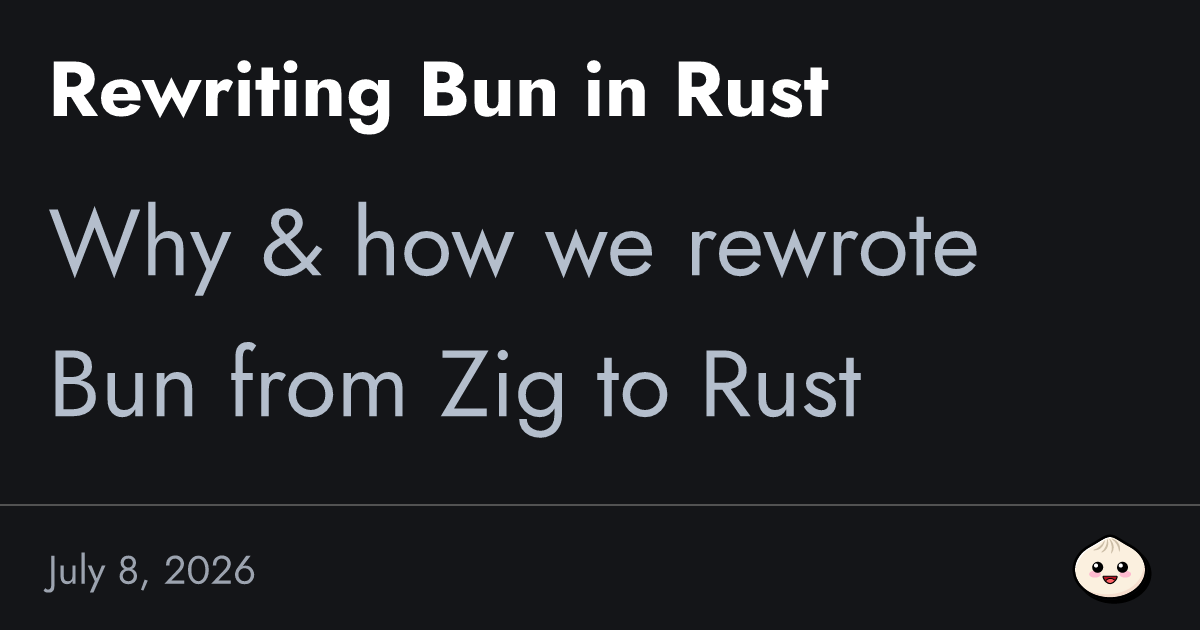
https://bun.com/blog/bun-in-rust
How is Zig working out after 3 years and 100k lines of game code?
https://www.youtube.com/watch?v=HXpUShkr2VQ
#Programming #ZigLang #GameDev
How is Zig working out after 3 years and 100k lines of game code?
Questions about pointers:
I'm learning a bit of Zig and have never used pointers before (I do understand the general concept of how to use them, that they point to address etc).
afaik using pointers is faster than operating on/ looking up the variables themselves?
My main confusion (using example below) is, why dereference the pointer with 'ptr.*' in the 3rd line? Why not just plug in the address directly with '&num'? Is that for performance too? Otherwise the code seems convoluted for no reason.
var num: u8 = 12;
const ptr: *u8 = #
std.testing.expectEqual(ptr.*, num);
#ziglang

Boosted by @coolboymew@shitposter.world
You've seen all posts