The Transmitter
Dedicated to helping neuroscientists stay current and build connections. Subscribe to receive the latest news and perspectives on neuroscience: www.thetransmitter.org/newsletters/
Prediction without understanding sustained astronomy through a thousand years of epicycles, writes Anthony Zador. AI is now offering neuroscience the same deal.
A new preprint shows that deep learning can make a fly walk realistically using a worm’s brain — exposing a fundamental problem with how connectome models are being built and sold to investors.
By Natalia Mesa
In his new book, @romainbrette@mastodon.social pushes back against theories that describe the brain as a “biological computer.” In this excerpt, he challenges equating brain evolution with programming, and the universality of neural network models.
Mac Shine talks with Melissa Cooper about her new work showing that astrocytes—long dismissed as the brain’s housekeepers—are wired together in precise, long-range networks that remodel in response to experience.
Myelin may serve as an energy reserve for the brain, according to recent studies. Carlos Matute argues that these findings might mean that structure and metabolism should no longer sit in separate boxes.
Exploring why Claude develops something like emotion could ultimately help us better understand the function that emotions serve in humans, writes @NicoleCRust@neuromatch.social.
By designing decision-making tasks that vary along multiple dimensions and truly challenge our animals, we might finally understand how multiple brain areas coordinate to drive decisions, writes Chand Chandrasekaran.
In the latest “This paper changed my life,” Maria Geffen shares how John Hopfield’s neural networks taught her to always ground research questions in biology.
Mice use the same thalamocortical pathway to decode orientation selectivity established by Hubel and Wiesel in cats, showing that this visual feature “is preserved through evolution,” says Jose-Manuel Alonso.
By Claudia López Lloreda
Paul Middlebrooks talks with Liset M. de la Prida about how her efforts to understand the varieties of sharp wave ripples in the hippocampus led to her discovery that specific types of neurons control the properties of neural manifolds.
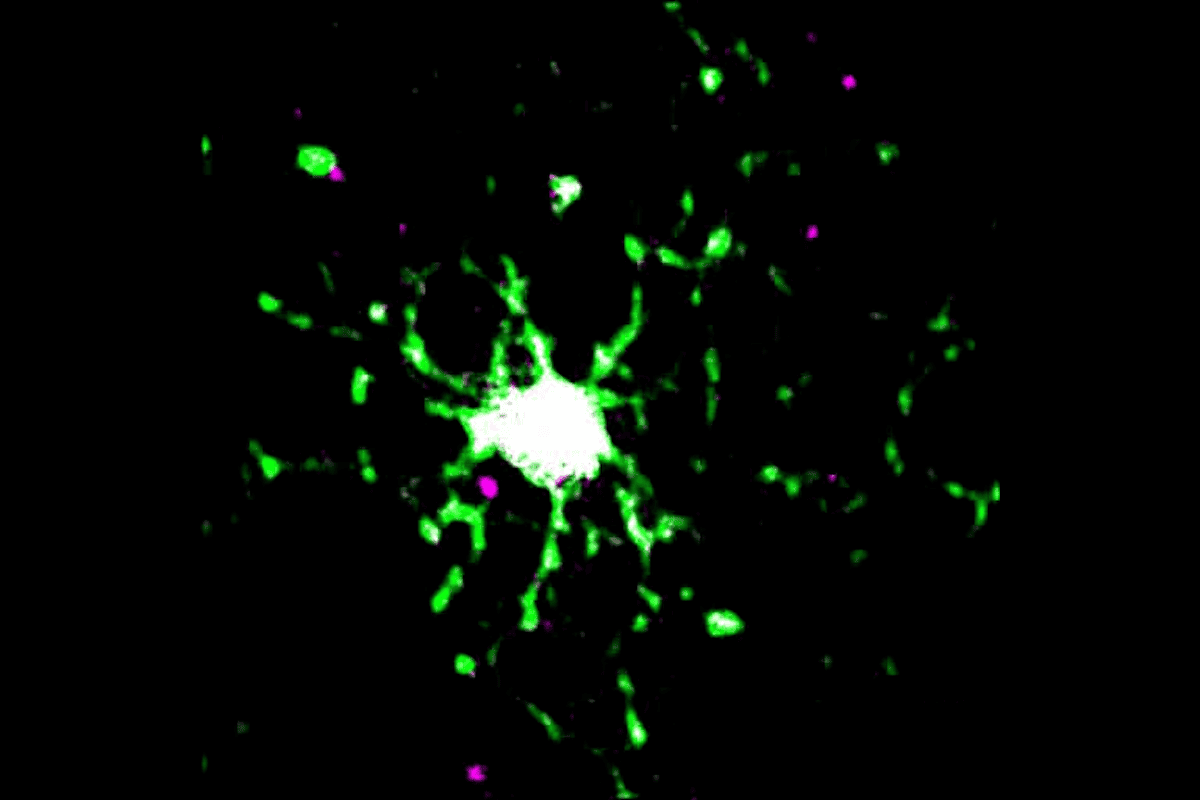
The locus coeruleus, which provides norepinephrine to the rest of the brain, is even more spatially and functionally diverse than previously thought, new findings suggest.
By Holly Barker
Researchers at a national primate center in Oregon have formed a grassroots nonprofit to argue against the center becoming an animal sanctuary, a transition the facility’s host university has been exploring since February.
By Calli McMurray
On 12 May, Argentines took to the streets to protest science funding cuts and advocate for salary increases for public university workers.
By Claudia López Lloreda, Natalia Mesa and Anita Pouchard Serra
“Recognizing the scope and impact of heterogeneity in basic neuroscience is essential if we want to understand complex conditions and the brain in health and disease,” write Linda Douw, Klaus Eyer and Lara Keuck.
The ethics issues that arise in neuroscience research are usually novel and understudied. Timothy E. Brown argues that ethicists help provide novel and impactful perspectives that contribute to how basic neuroscience research is done.
Despite growing interest in facilitated-communication techniques, a new review finds studies of these approaches neglect to test authorship, which would help confirm authentic communication.
By Brendan Borrell
In disrupting the status quo, AI can help us critically reassess and redefine what neuroscience graduate training should look like—and potentially address long-standing training challenges in novel and innovative ways, writes Taralyn Tan.
Personalize your search results with trusted sources. Simply select @thetransmitter@mastodon.social as a Preferred Source in your “source preferences” settings to zoom in faster on news insights and tools geared to help advance your neuroscience career.
When writing a grant or reasoning about a problem, artificial intelligence can exert a subtle bias that often goes undetected, even when we’re doing our best to be aware of it, writes Tim Requarth.
More than 1,000 scientists have signed an open letter protesting changes to the European Research Council’s stricter grant application rules.
By Lauren Schenkman
How long-read sequencing will transform neuroscience.
By Tychele Turner
A leader in the field of voltage-gated calcium channel research over the course of a five-decade career, Annette Dolphin was “amongst the luminaries.”
By Michael Eisenstein
“This year, we really wanted to bring back the interdisciplinary nature of [INSAR].” – Christine Wu Nordahl.
By Diana Kwon
Throughout his six-decades-long career, Howard Fields became a leading figure in both pain and addiction.
By Natalia Mesa
In this month’s “Liftoff,” Jonathan Tsay talks about the need to embrace unpolished drafts and Clara Ortega-de San Luis discusses the importance of team-building activities in the lab. https://www.thetransmitter.org/liftoff-new-lab-alerts-early-career-neuroscientists/?utm_source=mastodon&utm_medium=org-social&utm_campaign=20260521-liftoff-may
By Francisco Rivera Rosario
“Siento que va a ser difícil que algo cambie para mejor", dice Nara Muraro, neurocientífica en Buenos Aires. “Entonces vas a la protesta de todas formas, pero sabes que no va a servir para nada”.
By Claudia López Lloreda, Natalia Mesa
In the latest entry in our Frameshift series, Suzanne Wood discusses the perks of being a teaching neuroscience professor.
By Katie Moisse
Basic neuroscientists need to connect with the broader autism community—here are six steps that can help.
By Juliana Chase, Hannah R. Monday and Lea Witkowsky
AI is pushing scientific publishing to the brink. For a field as sprawling as neuroscience, the crisis may also be an opportunity to finally connect findings across subfields, writes Tim Requarth.