
Elektrine
Log in Register
Paige Chat Timeline Gallery Friends Email Drive DNS Private DNS Domains VPN Kairo Nerve
Remote

Spyglass

@mg@spyglass.org
ghost 0.1.0
  • Open on spyglass.org
Insight from afar by M.G. Siegler
353 Followers
13 Following
36 Posts
Open post
Spyglass @mg@spyglass.org
· 2mo ago
Google Gemini Launch Delayed as Tech Falls Short of Internal Goals
Alphabet Inc.’s Google is months behind schedule on delivering Gemini 3.5 Pro, its most powerful flagship AI model, because the company has been taking time to try to improve its capabilities, particularly in coding, according to people familiar with the matter.
BloombergJulia Love and Davey Alba

As bad as things may be product-wise (not to mention potentially legally?) at OpenAI at the moment with the stumbling out of the gate of the ChatGPT super crap “Super App”, it could be worse. It could be Google. A company which not only lacks a “Super App” but lacks a true frontier model at the moment.

It wasn't a great look when Google I/O came and went in May without Gemini 3.5 Pro. But far worse was that Sundar Pichai said on stage that the flagship model would be coming next month (which Google echoed in a blog post). That would have been June. It's now the end of July. Google says the model is still in testing but it's now not just "not a great look", it's a bad look. This is a $4.2T company seemingly unable to compete with several far smaller players. But worse is that this is after the company already moved heaven and earth once to get out of their own way to effectively compete in AI. And it worked. They had caught up or perhaps even surpassed everyone else.

The timely analogy would be to England going up 1-0 on Argentina and then... shifting to a defensive strategy and getting run over as Argentina stormed on to the World Cup final.

But whereas a few years ago, the problem seemed to be just as much about timidity – that is, Google had much of the technology ready to roll internally (as you might hope given their central role in inventing the ideas behind LLMs), they were just afraid to release it – now it seems firmly rooted in bureaucracy:

The delay has been a source of frustration for Google engineers, AI researchers and managers, many of whom are concerned the company risks losing an edge in the market as rivals Anthropic and OpenAI produce models that exceed Gemini’s capabilities, according to 10 current and former employees. Google has multiple layers of stakeholders involved in preparing models for release, working to weave AI across a vast product portfolio, including search, maps and YouTube, which can cause delays, said the people, who declined to be named discussing internal concerns.

Of course, that's also nothing new at Google. That's largely what was blamed for the 'Bard' fiasco. You know, Google's first attempt to catch up with ChatGPT. That stumble was seemingly only corrected when DeepMind and Google Brain were united under one leader, Demis Hassabis, with a single, unified vision for AI.

But it seems like, as was the case for OpenAI, coding sort of blindsided them. Pichai said as much after I/O that Google was behind in this regard, which must have been a particularly embarrassing thing to admit for the company. But whereas OpenAI was seemingly able to course-correct quickly with Codex, Google has seemingly not been able to. Perhaps it's as simple as one of those big company versus small company dynamics, where being more nimble actually matters more than pure resources.

Then again, resources also seem to matter here quite a bit:

Google’s popular products are a gateway to generative AI for everyday people, and can yield data that makes their answers smarter. But encouraging leadership of every department to move in the same direction is like trying to boil an ocean, one ex-employee said. When mandates shift or efforts end up duplicated in multiple departments, it gets even more difficult to maintain a cohesive strategy, current and former employees said. It’s also a challenge for any one offering to get the resources it would need to succeed, and to gain traction in the market, they said.

I mean, Google probably should hope it's that simple and not as bad as the Llama situation for Meta, as there are definitely shades here of the "Behemoth" model of Llama 4 which was perpetually promised but never came. And soon, Llama itself was put out to pasture. There are no real signals of that here, but well, there are signs that other things are amiss internally at Google at the moment.

After the launch of ChatGPT in late 2022 sparked concerns that Google’s search engine would become obsolete, the company declared a “code red” — a useful tactic for cutting through the layers of bureaucracy and internal competition that often slow Google’s product efforts. But now, racing in AI is the normal state of the company, one employee said.

Google co-founder Sergey Brin and others were advocating for Google to move faster to seize opportunities in AI coding, but their efforts were slowed by competing factions within the company, two former employees said. Cloud computing unit Google Cloud, research lab Google DeepMind and the team behind the Android operating system are all building AI coding tools for developers, with involvement from some consumer product teams, too, people familiar with the work said.

Yeah, this is Highlander, not chat apps, Google. There can be only one. Or, if you prefer another movie analogy, it's clearly time to unite the clans. Again.

Google's earnings report is certainly set up to be interesting this week.

👇
Previously, on Spyglass...
Google ‘I’ Hold the ‘O’
Some thoughts on the Google I/O 2026 keynote…
SpyglassM.G. Siegler
Google Isn’t Lazy, It’s Timid. As It Sadly Must Be.
Provocative soundbites aside, it’s obvious why Google isn’t OpenAI…
SpyglassM.G. Siegler

Google Slams on the AI Gas
Does it leave Apple in the dust?
SpyglassM.G. Siegler

0
0
0
0
Open post
Spyglass @mg@spyglass.org
· 1mo ago
Apple Versus the Glassholes

The first thing you'll notice is that there is no phone. The second thing you'll notice is that there. is. no. phone.

It's not just that Apple leaked a codename or numeric reference to the long-rumored AirPods with cameras1 – which I hope they call 'EyePods' but probably something like 'AirPods Vision' or 'AirPods Ultra' is far more likely2 [update below] – they inadvertently leaked a video in the release candidate build of macOS 26.7. Yes, not even the new, still-in-beta 'Golden Gate' version of the OS, but the soon-to-be upgraded 'Tahoe' variant. Someone is likely to be in a lot of trouble.

Because yes, the 13-second video very clearly shows a man in a room pick up a book as a voiceover says "with Visual Intelligence, your world becomes savable". When I type that out, it makes it sound like this guy might be trying to save the world from disaster. But what he's actually doing is visually capturing the book in front of him so he can recall it later. "See something you like? Just ask me to save it for later," a voice which is clearly intended to be Siri says. The man nods and the video fades out...

Visual Intelligence, of course, is nothing new. I've long held that it was one of the most underrated aspects of the iPhone, dating back to when Apple first tried to launch Apple Intelligence two years ago. But it was a bit buried. With iOS 27, it will be baked directly into the all-important Camera app.

But again, the difference here in this video is that there is no iPhone.

And again, that heavily implies that what the man is actually using to capture the book are the AirPods that he's clearly wearing. At first glance, they don't look different from the current AirPods Pro. But the forensic experts on Xitter seem to think there are subtle differences in the stems. This is obviously where any camera component would likely go.3

So yeah, not only are these 'EyePods' coming, they're very likely coming soon. As in, probably set to be unveiled at the iPhone event in just a few short weeks. That's exciting because it's going to shift Apple into a whole new era. While Apple has long held a leading position in wearables, this will be their first true AI wearable.

While a lot of the focus has been on the potential for Apple entering the smart glasses space to meet Meta in market, using the AirPods as their first entry point actually makes a ton of sense.

First and foremost, the AirPods are already an insanely popular product. While people made fun of how they looked at first – for the record, I always thought they were ingenious – they're now ubiquitous. You literally can't go anywhere with a crowd without seeing many pairs tucked into peoples' ears. It's true in America, it's true in Europe. They're everywhere. They're mainstream.

Contrast this with the Ray-Ban Meta glasses. I've seen a few pairs while out and about this Summer, but it's obviously not in the same ballpark. Estimates have these glasses perhaps around 10 million sold to date. Apple has sold over 400 million AirPods to date, perhaps closer to 500 million.

It's not meant to be a fair sales comparison as AirPods have been both around longer and sell at lower price points, but the comparison matters when it comes to rolling out AI wearables into the world. Meta smartly partnered with EssilorLuxottica to leverage the Ray-Ban (and later Oakley) brand (and distribution), but these are not Apple-scale hardware. At least not yet.

But Meta's partnership was also smart in perhaps a similar way to the playbook Apple will clearly run here. Ray-Ban Meta glasses look like Ray-Bans. AirPods with cameras, at least from what we can see here, look like AirPods.

That obviously matters as both companies try to negate the "Glasshole" problem. That is, when Google Glass first started rolling out over a decade ago, they didn't look like anything else on the market. They were a sort of visor with a prism in the corner where information was displayed. On paper, this sounded cool – futuristic. In person... well, you sort of looked like an asshole.

That's both not fair and entirely fair. If they simply looked weird, that would be one thing – again, the AirPods looked weird to many people to start. But the fact that they had a camera on them was, well, a problem.

The Ray-Ban Metas also obviously have cameras, but thanks to the aforementioned use of the standard, iconic Ray-Ban designs, the system is far more subtle. This is an arguably bigger problem for people who care about privacy and potential surveillance, but at least the design isn't as in-your-face as Google Glass was. People like 'new' except when it comes to merging new design with new technology. Better to start with old design and new technology.

Again, that's also what it seems like Apple is doing here with AirPods. We'll have to see what they look like from the front, but the fact that the overall footprint isn't wildly different suggests they'll be far more subtle in the wild. Had Apple started with smart glasses, unless perhaps they also teamed up with a famous eyewear brand, the result would be far more in-your-face, quite literally.

Instead, when those first Apple smart glasses – iGlasses? – hit next year, the market should have about a year of getting used to Apple's first AI wearables – with cameras – in the market in the form of these new AirPods. That doesn't mean there won't be backlash against Apple's entry, but it certainly will help to blunt the potential impact.

One of the most surprising elements of the Ray-Ban Metas (still such an awkward name to write and say) has been that there hasn't been a ton of backlash to date. Again, credit for Meta for knowing to partner with EssilorLuxottica here. But as the sales are growing – and as Meta does Meta things – the backlash is growing. To the point where I wouldn't be shocked if Apple further pushes out their own smart glasses offerings to try to distance themselves from any would-be controversy.

Oh and by the way, it's not just the cameras. It's the cameras mixed with the other currently most controversial technology in the world: AI.

The Ray-Ban Metas launched as more of a cameras-plus-music thing, and that perhaps also helped ease any controversy. But as Meta has ramped up their AI efforts, the tech is becoming more of a focal point with the glasses too, which is naturally aiding in ramping any controversy surrounding them. Apple will seemingly be going head-first into such controversy with the AI focus from day one. Sorry, I mean 'Apple Intelligence' – or 'Visual Intelligence' not 'AI', totally different, you see.

There had been some talk that these AirPods with cameras wouldn't actually be able to take pictures but instead would simply be to "look" at the world in real time. This video blurs that notion – at the very least, it suggests the cameras are used to look at and remember an object, even if it doesn't take an actual picture – though it still might for your memory? – which probably wouldn't be a great picture anyway! Video almost certainly will be off the table, even if just at first. Maybe Apple enables such capabilities down the line as people grow more comfortable with such devices out in the wild.

To that end, when these AirPods with cameras are pulling in information, surely there will be some sort of indicator? A light on the stems, perhaps? That might be slightly weird as you don't have such an indicator on the back of your phone, but again, this is about establishing new norms and trying to help people be at ease around this new technology.

Apple, of course, has a natural advantage here in that they're generally viewed as the most privacy-centric of the Big Tech players. They'll undoubtedly note that any data ingested by these devices will be either securely handled on-device (presumably on your iPhone) or, if you choose, via their secure cloud set-up. They're going to triple-down on any privacy messaging here.

Meta, on the other hand, is undoubtedly last on the Big Tech trust scale. Again, it's sort of incredible that the Ray-Ban Metas are working at all...

But Apple still runs a real risk here in launching not just a wearable with cameras, but one entirely built around AI. This is walking right into the lion's den. Perhaps not wearing Google Glass, but still, there's some real Glasshole risk here. Which is why the AirPods are the right first step to take.


Update August 19, 2026: Some of the code in the macOS beta suggests Apple may simply still go with 'AirPods Pro' as the name for the version with the cameras. Apple, sort of confusingly, already does this for the "regular" AirPods, where there are two versions (one with ANC and one without), so it's certainly possible Apple just makes this a more expensive variant of the AirPods Pro – starting at, say $349? And they may even seek to downplay the camera element further by simply calling them 'AirPods Pro 4 with Visual Intelligence'. In fact, I can definitely see that happening...


Update August 20, 2026: It looks like the leak may be even more problematic for Apple because it's teasing the imminent launch of a product which may not be imminently ready to launch, per Mark Gurman at Bloomberg. As he's previously reported, while Apple did initially intend for these new AirPods to launch in 2026, and was even testing them internally with employees – and um, obviously shooting demo videos for them, as this video leak is very real – software bugs and supply chain woes have pushed them into 2027, it seems. Quite the tease!

Also, Gurman notes that, as discussed above, the cameras in the products are "low-resolution censors" – i.e. not meant to take photos to save, let alone videos – which should ease around the "pervertpods" problem...


Update August 23, 2026: A bit more has seemingly been revealed about how this device may work...

So Much for the ‘PervPods’
Apple may aim to combat any ‘surveillance tech’ backlash with comically low AirPod AI camera resolutions…
SpyglassM.G. Siegler

👇
Previously, on Spyglass...
EyePods
AirPods with cameras aren’t to take pictures, but to let Siri “see”…
SpyglassM.G. Siegler

There Is No Phone
OpenAI is not building a phone. Amazon is not building a phone. And now SpaceX is not building a phone. Are you sensing a trend? The trend is that basically the entire tech industry is rumored to once again be building their own smartphones. But they’re all denying it.
SpyglassM.G. Siegler

Meta’s Recurring Apple Nightmare
With smartglasses, Apple is once again entering Meta’s turf. Wielding a familiar weapon: the iPhone…
SpyglassM.G. Siegler
1 Something which they've also been doing plenty of here as well! ↩

2 We know John Ternus isn't afraid to shake things up a bit – even branding-wise, with things like the MacBook Neo, so perhaps we get a new sub-brand here? 'AirPods Neo'? 'AirPods See'? 'AirPods Intelligence'? 'AIrPods'? ↩

3 Though I suppose it's possible they're at end of of the AirPods' main bulb? ↩

x.com
0
0
0
0
Open post
Spyglass @mg@spyglass.org
· 2mo ago

I've been on the road this past week-plus and as such, haven't been able to Monitor the Situation™ with AI in real time – which it feels like is needed even more so at the moment given the constant stream of news and reports. Not even about the latest model breakthroughs and products, but just about the ongoing debate over "open" versus closed models, which itself has turned into sort of a proxy war for America versus China.

But it's also not that simple – not nearly. In fact, it's so intertwined and convoluted that it makes the Marvel Cinematic Universe look like a quaint, cohesive narrative. As such, I feel the need to write this out a bit, just to try to wrap my own head around it. To keep things simple and streamlined, let's just focus on the last 10 days:

  • July 16: The Kimi K3 model is released with performance close enough to the frontier – actually besting those models in some use cases – that basically everyone starts freaking out. Is this a second "DeepSeek Moment" or actually something more? Moonshot AI, the Chinese company behind the model hasn't yet released the weights, but promises to by tomorrow (July 27).
    • That same day, Hugging Face disclosed a breach of their systems but doesn't give more details.
    • Reports surfaced that Gemini 3.5 Pro is now "months" behind schedule, which given that it's mid-July and the model was promised in June, duh.
  • July 17: At the World Artificial Intelligence Conference in Shanghai, Chinese President Xi Jinping gives a keynote address calling for more collaboration around "open" models and seemingly planting a flag for China's strategy. This is amidst reports that China was debating restricting their homegrown models.
    • Dean Ball, writes up his Kimi thoughts, outlining what he believes is China's strategy here to beat the US in AI and making the case that if the US pushes open weights, it will necessarily deter the current AI build out at the frontier. He believes the US will act to try to keep the current status quo in place. Seemingly a lot of people do not like these thoughts, in particular coming from someone who now, of course, works at OpenAI.
    • A study suggests the gap between the frontier and open weight models may now be down to 4 to 7 months, from 6 to 10 months last year.
  • July 18: A report that OpenAI and Anthropic employees are far outpacing those at their Big Tech brethren when it comes to political donations...
    • Alibaba moves to open source their SAIL software which competes with NVIDIA's CUDA in AI chip software.
    • "Woke lobotomized models" is the recently departed US "AI Czar" David Sacks new framing for Claude in the wake of Kimi...
  • July 19: Alibaba then quickly follows Moonshot in announcing Qwen3.8-Max-Preview, which they say will be open weight – which would be a reversal from Alibaba's last few releases which had been closed (after initially starting with the "open" model).
    • Reports suggest Moonshot will aim to IPO within the next 6 months on the heels of the Kimi K3 momentum.
    • Sacks then rants about how Anthropic and OpenAI want to eliminate open source competition to maintain the current "duopoly" situation.
    • That's not a rant, this is a rant: Under Secretary of War Emil Michael labels Ball the "supreme village idiot" of AI for his essay (and stance).
  • July 20: The first reports that the US is debating restricting access to the Chinese "open" models.
      • Is the "open" movement as simple as China implementing a "dumping" strategy to undercut and thus, destabilize the market? Is Kimi and the like really just 'Temu AI'?
      • Moonshot had to halt Kimi subscriptions due to demand.
      • Ben Thompson makes the case for the US forcing the AI labs to allow for distillation for other US companies.
      • Bill Gurley writes an op-ed arguing for open models (seemingly conflating actual open source with open weights but I digress...)
  • July 21: Scott Bessent goes on TV to threaten sanctions over IP theft around AI distillation. Reports indicate this is all positioning ahead of the next talks between China and the US on AI in September.
    • OpenAI admits/brags that they were the ones that (unintentionally) hacked Hugging Face due to GPT-5.6 Sol (and a new, unreleased model) breaking out of their sandbox. They note they've been working with the company to fix the situation, which Hugging Face praises.
      • Hugging Face also notes that because of the current security restrictions on the frontier models, they had to turn to Chinese open models to help halt the hack. Pretty damning indictment of current policy...
    • Google ships a few new Gemini 3.5 'Flash' models (still no 'Pro') including one focused around cyber security.
  • July 22: Michael Kratsios, the science and tech advisor to the President, furthers the Chinese distillation fears/rhetoric, specifically calling out Moonshot for "large scale distillation against U.S. models" (and also illegally accessing some NVIDIA servers/chips).
    • The "Little Tech Association" – nearly 200 startups – sends a letter to Trump and Howard Lutnick arguing for continued access to open weight models, including the Chinese variants.
  • July 23: Pushback against the notion that K3 is mainly the result of distillation.
    • The FT publishes a post outlining China's "open" AI strategy as a sort of new 'Belt & Road Initiative' for tech.
  • July 24: Jensen Huang signs up for X clearly just to post the "Open Wights & America AI Leadership" letter signed by seemingly everyone except the current three leading model makers: Anthropic, OpenAI, and Google.
    • Sam Altman later tweets in support of the notion, as does Sundar Pichai.
    • Crickets from Anthropic – but some shade! Oh, and a new model! Opus 5 clearly aims to take some (pricing) pressure off of Fable...
  • July 25: OpenAI formally adds their actual name to the letter, just as new reports suggest they are quietly but heavily lobbying, alongside Anthropic, against the open weights push in Washington.
    • You know what might help push Washington over the edge to keep tighter controls on AI? The notion that it can be used for "deadly biological weapons"...

That's 10 full days with an insane amount of activity – activity that could reshape the world technologically, societally, politically, and geopolitically.


Update: With my mind now reset, some further thoughts on the topic of the push towards "open" models:

Thoughts on “Open” Models
The open letter on open weights feels familiar yet different…
SpyglassM.G. Siegler

Dean W. Ball (@deanwball) on X
X (formerly Twitter)

Dean W. Ball (@deanwball) on X

Some observations on Kimi: 1. It's a very good model! I don't think its performance can be explained away by distillation or anything like that. In agentic coding sessions, it seems pretty much on par with the best public models of Q1 2026. In my fairly limited use, it also seemed very token hung…

0
0
0
0
Open post
Spyglass @mg@spyglass.org
· 2mo ago

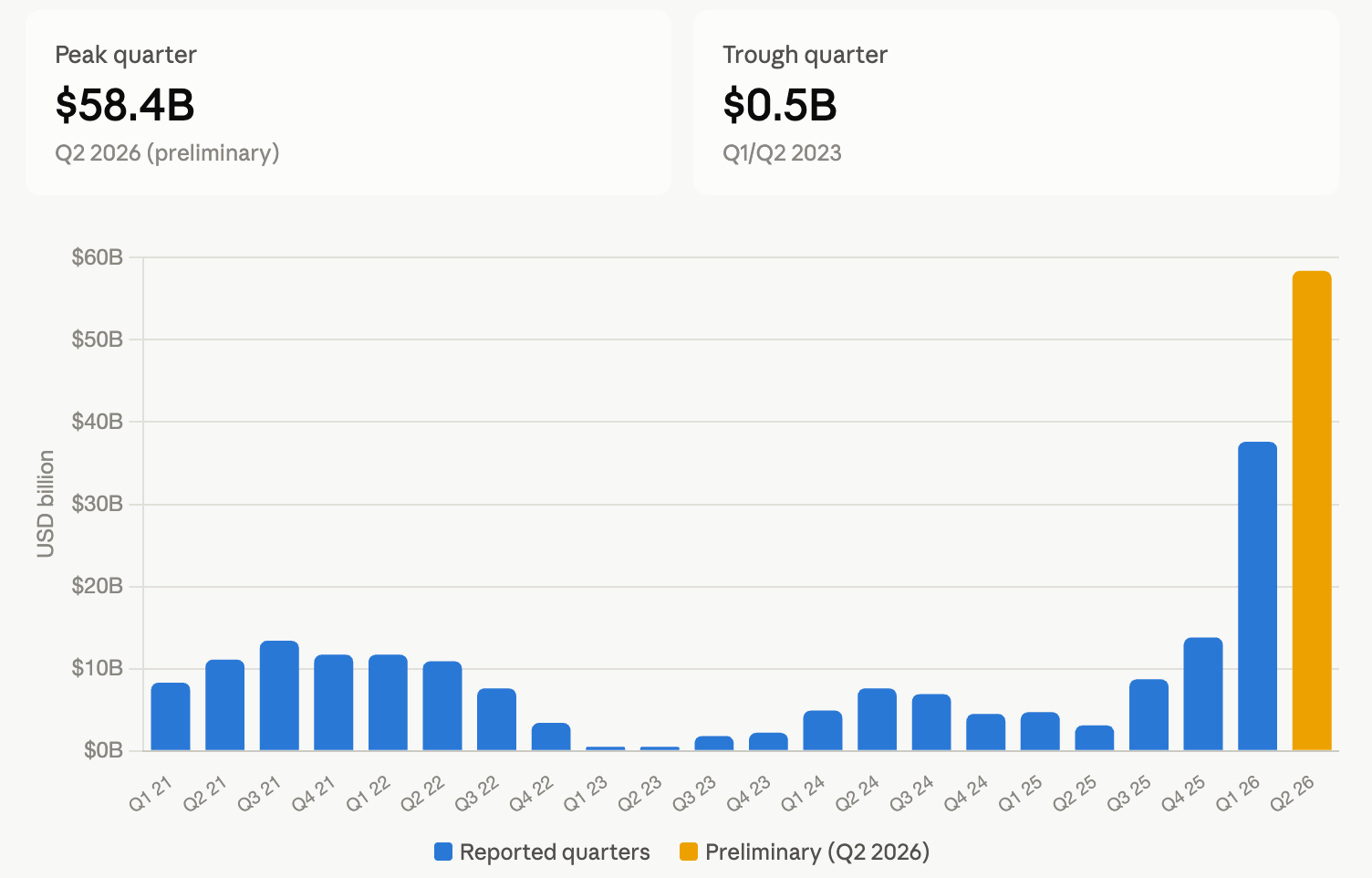
It's that time of year again: quarterly earnings for Big Tech. And you know what that means... time for Wall Street to freak out over CapEx spend related to AI build-out once again. Sure enough, Google went first and upped their forecasted spend pushing the range past $200B for the first time. The market puked. Next up, Meta. They simply raised the low-end of their previous guidance (to $130B up from $125B). The market puked.1 Then there's Microsoft...

This post is for subscribers only

Become a member to get access to all content

Subscribe now
spyglass.org
0
0
0
0
Open post
Spyglass @mg@spyglass.org
· 1mo ago
You Gotta Fight For Your Write

Someone reset the 'Days Without Incident' clock at Anthropic to 0. From, I don't know, maybe 1, at most 2, these days.

Look, when I first saw the news that the company would be "watermarking" text, I didn't think much of it. That's in part because they didn't really explain how they'd be doing it so I assumed, like probably most people, that they'd be embedding some invisible characters in text outputs. But that, of course, would only work for people who directly copy-and-paste text from Claude to elsewhere. If you re-wrote whatever the output was, or used some tool to "wash" the text – AI laundering? – you'd remove such "watermarks". Still, many were up-in-arms about this because it was some level of invasive or sneaky. Others because it was going to gunk up the internet even more with superfluous characters. And some simply because it was going to make using AI to write without being known harder to pull off!

As it turns out, what they're actually doing – or planning to do – to pull this "watermarking" off is instead fairly insane.

Basically, Anthropic has designed a system that will alter the output in a way that allows them to assess the probability that any block of text has been generated by Claude. The key is switching one possible output to another at various points in a way that they suggest would only be perceptible by them, holding the keys to how they're doing this.

While it's true that Google has also been leveraging this same basic idea in the form of their "SynthID" technology for a couple of years, I suspect it hasn't been met with such outrage simply because most people don't use Gemini for such purposes – at least not to the extent they use Claude (or ChatGPT).1

Regardless, Anthropic has now pulled this to the forefront and made it a debate.

Again, at first glance this may not sound so bad. Perhaps even somewhat clever. I'm reminded of how back in my reporting days, I used to insert some subtle tweaks to catch if someone was trying to copy a scoop without properly attributing the information source (me).2 You'd be surprised how often this worked!3

To that end, I honestly don't think I'd be as upset/annoyed if Anthropic was doing this simply as a way to catch (or, if you prefer "identify") people who use AI to, say, write entire thought pieces. Just write the damn thing you lazy sonofabitch. Or don't, but don't put your name on it like you did!

Other tools and services have been popping up to do this, obviously. I'm not really sure we need to police such things, but it is also amusing to know the type of people who do this. Then again, it also opens a can of worms in terms of if such output should be considered as a "valid" form of expression if it's driven by your own input (your prompt)...

The key, I think, is that many people just want to know. They want to know if you used AI to generate what they're reading. And in some situations, like legal proceedings, people may need to know. To make sure they can trust that the actual legwork was done to say, prosecute a case, versus just the prompt work. Which is why the EU passed the law that Anthropic is now trying to adhere to with this! (More on this in a minute.) Should anyone be forced to disclose this? Again, I don't know. I think so, and certainly I'd prefer it, but this area seems pretty gray with a lot of slippery slopes. Should Anthropic be the one enforcing it? Well, like it or not, with this, they are.

Anyway, the far bigger problem I have is that this isn't just about text that people are copying and pasting elsewhere. It's about all text. As in, the kind you're being served up inside of Claude as well – even if it's not meant to be put elsewhere.

Anthropic is admitting that they're manipulating the output in order to implement this system. Again, that's insane. It may sound small or subtle, but it's just an awful decision and precedent to manipulate your product in this way. Even if you don't notice? Especially if you don't notice. This is full on subversion at scale.

But as weirded out as I may be by this, it's nothing compared to John Gruber, who devoted almost 5,000 words to the matter this weekend on Daring Fireball, calling it not "subversion" but "perversion". Here's a taste:

One of my fundamental problem with this is that no two synonyms carry the exact same meaning. “He leaped at the chance” and “He jumped at the opportunity” are very similar sentences expressing the same general sentiment, but they are not the same. The exact words we choose when writing matter. I want any LLM I use to choose the very best, most precise words at every single decision point. An obvious constraint that I accept is time and computation. Within the constraint of executing inference quickly, and at a certain cost per token, I want the best words. This constraint matches human writing. I could surely write a better column by taking longer to write it. I write with a sense of how much care I should put into every word and punctuation choice I make. I take more time with certain paragraphs, sentences, or even individual word choices when my gut feeling says I should.

In other words, these are necessary trade-offs. These factors are all in my interest: speed, cost, quality. Ideally I would like perfect writing, at instantaneous generation speed, at zero cost. None of those things are possible. Computation is not free of charge (and cloud-based LLM inference with leading models is actually expensive). Inference is not instantaneous. And great writing, whether natural or artificial, can only approach perfection.

The idea that anything other than my needs should factor into the generation of text for me is patently offensive.

Incidentally, I happened to write about AI and writing just yesterday, before I started to dive into this situation, noting the import I place on word selection. This Anthropic nonsense throws that notion right out the window. You may as well just buy a Mad Libs and run a random synonym generator.

For all the talk about AI slop, this is AI slop!

And for a company that likes to portray and convey moral superiority at every turn, and to hold themselves as the stewards of AI, it's a bad look. Yes, it's being somewhat forced upon them by the EU, but they don't have to do this everywhere, and yet they are.

They'll say that's just easier, and I'm sure that's true. But it doesn't make it better. That makes it worse. This is a nearly $1T company. They're about to be one of the largest companies in the world. Hell, they already are. Put in the effort to not make your product and service shittier for every single user.

Again, it may seem like a small thing. But small things matter. And they tend to snowball...

Honestly, what Anthropic should do here is tell the EU, just as their soon-to-be Big Tech peers, Apple, Google, and Meta do, that their rules are stupid. As with other such EU rules, they appear at first glance to perhaps be coming from the right place, but they're usually just political grandstanding. Worse, they seemingly don't think through the very obvious second-order effects of such rules.

Also, such rules were set in March 2024. That may as well have been 50 years ago when you're operating at the speed of AI development.

If the EU mandates that the big AI tools have to implement these "safeguards", the people most likely to take advantage of such things are just going to turn to other tools. And what happens when running models locally on machines becomes far more commonplace? There's just no way this actually works. Again, all it will do is make what were the most-used AI tools worse. And that, in turn, may make the most-used AI tools less used. Of course, that often does seem like the EU's basic mandate. So...

I digress. This is all just so nutty. Not that it's happening – again, Google already has been doing this and the EU is mandating it – but that it needs to be explained to these companies why it's such a batshit idea. Again, they're making their products less trustworthy – on purpose. Writing with AI was already contentious. Now it's nuclear.

Why does this need to be spelled out? It's almost as if they have a reading-the-room problem here. And perhaps that is impacting the overall perception of AI. You think?

I'll let Gruber take us home:

This isn’t just about text one might generate with the intention of passing it off as their own natural work. This isn’t even about LLM proofreading of work written by hand. Anthropic is saying that all new Claude models are going to adulterate every single bit of text longer than 200 tokens (~150 words) they generate, including everything it presents to its users to read. So even in a private conversation between a user and Claude, which will never be read by anyone other than the user, Claude will begin making word choices in the name of marking its output in statistically predictable ways rather than maximizing clarity and precision.

Even today’s so-called frontier models are already decidedly lacking in lucidity. Claude, ChatGPT, Grok, et al. are “better writers” than most humans and produce better prose than the median human. But: no shit. Most people are terrible writers. The “average person” is pretty stupid and half of all people are stupider than that. And there are many smart, interesting people who are miserable writers. So as impressive as LLMs are, the bar is low. The best writing I see come out of these models is worse than anything I would choose to read for pleasure. And now Anthropic is saying they’re going to make it worse, on purpose, for purposes that do not benefit me in any way? Even if only slightly worse?

Get fucked.
👇
Previously, on Spyglass...
AI Can Reproduce Writing, But Not the Process of Writing
And that’s the most important part…
SpyglassM.G. Siegler

The Write Stuff
Using AI to write is not quite so black and white…
SpyglassM.G. Siegler

Anthropic’s Heel Turn
It’s perhaps more of an Anakin Skywalker situation…
SpyglassM.G. Siegler
1 It was also framed more around images, video, and audio "watermarking" and less around the text element. ↩

2 And what outrage this caused back then in the blogosphere. Which feels so quaint now. ↩

3 Some companies employ similar tactics for internal memos too. Best not leak! ↩

0
0
0
0
Open post
Spyglass @mg@spyglass.org
· 1mo ago
Thoughts On: OpenAI's Comeback • Hollywood's Ticket Disaster

An OpenAI cover story gets thrown for a loop when their models hack a partner (one which NVIDIA may or may not be buying). And throwing some ice cold water on the blockbuster movie year for Hollywood. Read on for thoughts on...

This post is for subscribers only

Become a member to get access to all content

Subscribe now
spyglass.org
0
0
0
0
Open post
Spyglass @mg@spyglass.org
· 6mo ago

"We cannot miss this moment because we are distracted by side quests." Begun, the Fidji Simo era of OpenAI truly has?

Ever since she was hired last May, my read – and I believe the read of many – was that there was a reason they gave her that secondary CEO title. I mean, it may have taken that to convince her to take the role, but it also perhaps pointed to what the actual role would be. That is: the CEO in all but name. But actually, with the name too.

As with all things OpenAI, it's complicated...

This post is for subscribers only

Become a member to get access to all content

Subscribe now
thoughts.spyglass.org
0
0
0
0
Open post
Spyglass @mg@spyglass.org
· 1mo ago
Apple's EU App Store Armistice

🔗 Apple Announces Changes for Apps in the EU • Apple Newsroom

Peace in Europe for Apple? Well, at least on one front, it seems:

Apple today announced changes to its business terms for apps in the European Union, following close collaboration with the European Commission. These changes resolve Apple’s disagreements with the Commission over business terms and alternative distribution. They also reduce complexity by moving every developer that distributes apps in the EU to a single set of business terms. Developers can sign the new terms today, and changes will go into effect on October 1.

Notably, this isn't a proposal, it's the announcement of actual changes that Apple will implement (starting October 1) after "close collaboration" with the EC. And lest we think Apple is overplaying that last aspect, that group gave a statement to Bloomberg backing up the assertion:

A spokesperson for the commission said it “welcomes Apple’s changes to their business terms, which follow a close dialogue” with the company. “Following today’s announcement, the Commission will monitor Apple’s effective implementation of the new terms,“ the spokesperson said in an emailed statement.

So what are the changes? At the highest level, the biggest ones are the change in app distribution and in-app payment fees.

  • If you distribute through the App Store and use Apple's payment rails for in-app purchases, their cut is now 26%, down from the old standard 30%.
    • But for the "vast majority of developers" – those that qualify for one of the lower-fee programs, it will be 15%
  • If you distribute through the App Store but bring your own payment rails to use in-app, Apple gets a 20% cut.
    • The lower fee here is 10%.
  • If you distribute through the App Store but link-out to the web for payments, Apple gets a 15% cut.
    • The lower fee here is also 10%.
  • If you distribute through a third-party app store or the web, Apple gets a 5% fee for their "Core Technology Commission".

It's actually pretty straightforward. I suspect people will still complain that 26% is too high,1 but again for most developers, it will actually be 15%. This feels like mainly a way to keep the all-important big gaming fees – which make up most of in-app payments, and as such, most App Store fees – mostly intact.

Many will also complain about the 5% "Core Technology Commission" but this seems like a relatively simple way for Apple to retain some level of compensation for ongoing device platform work – aka, the platform which allows all apps to work on iOS, iPadOS, etc.

But to me, the most interesting thing about this is how neatly it lines up with Apple's recent proposal in the US when it comes to the link-out payments. We just went over this, but quickly: as a result of the Epic trial, Apple was forced to allow apps to link out to the web for payments. Apple tried to take a 27% commission for those payments – which actually would have resulted in a higher cut than Apple's standard 30% in many cases – which pissed off the judge, who then threw the book at Apple and said they had to allow for web payments without taking a cut. An appeals court kept the link-out option intact, but said Apple should be allowed to collect some sort of commission. Apple tried to delay all of this while they appealed to the Supreme Court, but eventually they had to make a proposal, this time ideally in good faith. The number they landed on? 15%.

That does not seem like a coincidence. It seems coordinated.

It sure looks like Apple knew this EU deal was coming down the pike and that the bloc agreeing to their terms would bolster the case that these are "fair". The US judge still gets to decide that, and Epic has already pushed back as Apple seeks to negotiate directly. One big reason for pushing? Epic wants to ensure any changes Apple tries to negotiate be put in place for all developers.

With that in mind, the EC framework sure seems like a potential proposal Apple would be willing to make and take. They technically don't have to, but aligning with these new EU rules would simplify/streamline the App Store rules and potentially alleviate some of the long-mounting pressure on those rules – which are far out of date at best and out of touch at worst.

If I'm right, it will be up to Epic to agree and Judge Yvonne Gonzalez Rogers to decide. Both remain clearly pissed off at Apple so there's certainly no guarantee of any such agreement. But again, the EU signing off on this is an interesting signal, if nothing else. Might Apple want to announce such a new deal at a big, upcoming event that every app developer in the world will be watching? We'll see!


Update August 19, 2026: Well it sure doesn't look like Tim Sweeney will have Epic settling with Apple anytime soon! What's most odd about his tweet though is how overtly disingenuous it is – sure, it may not technically be a "settlement", but clearly the EC was in the loop with Apple on these changes and again, they're publicly talking about how pleased they are with them.

Sweeney seems pretty upset about this possible detente in Europe. One read might be, per above, that these new rules would likely keep the rate for gaming commerce flowing fully through the App Store at the still pretty high 26%. Though, of course, Epic would have other options now to route would-be players and payers elsewhere!

He also clearly has the company account tweeting about this and those tweets are also strange in the way they're matter-of-factly interpreting the DMA in a way that the DMA itself doesn't seem to around link-out payments (seemingly conflating it with the current situation in the US, which is obviously different). And again, the EC has already given an on-the-record comment on all of this!


1 Sort of fun/interesting/weird that Apple set it exactly 1% below the 27% which got them into trouble in the first place. Apple would handle the payment processing in this case, so it's different. But 26% is an oddly specific number. Why not, say, 25%? Just optics off that 27% rejection? ↩

x.com
0
0
0
0
Open post
Spyglass @mg@spyglass.org
· 2mo ago

With the impending – well, or possibly imploding – merger of Paramount Skydance and Warner Bros Discovery, there was clearly an odd man out in the big streaming race: Peacock. Thanks largely to recent massive sporting events like the Olympics, it wasn't dying, but it also wasn't thriving. It simply was not in a position to compete with Netflix, Prime Video, Disney+, and soon, HBO Max + Paramount+. So it could keep going, scraping and clawing to barely eek out a profit, as it finally did this past quarter, or it could find a new home.

With the news that Comcast was splitting itself in two – again – it felt like the ground was being laid for just that. But we were all of us deceived. For another option was on the table. A big one.

Here's Lillian Rizzo for CNBC:

NBCUniversal’s Peacock is officially landing on YouTube.

All of the streaming service’s content — including NBC Sports’ portfolio of the NFL and NBA, Universal films like the Minions franchise, and original Peacock and Bravo content like the Real Housewives franchise and “Love Island USA” — will be included in YouTube Premium subscriptions in the U.S. starting early next year.

Google’s YouTube Premium is the subscription version of the streaming platform that offers videos without ads and the ability to download most videos, depending on the subscription tier. The service offers a variety of plans beginning at $8.99 per month. Peacock Premium currently costs $10.99 per month.

While we don't yet know all the details in terms of the financial arrangements between the two sides, on the surface, this is a wild deal. It sure looks like Comcast is selling Peacock to YouTube without actually selling Peacock to YouTube. Yes, it seems like sort of a "hackquisition" but for the media world.

You know, effectively buying something without the headache of actually buying it.

Perhaps that is the point here as well. Would regulators allow YouTube to buy Peacock? Maybe, but probably only if they spun-off YouTube TV? The key would obviously be who actually owned NBC and Universal, but if Comcast kept those, what's the point of owning Peacock? Regardless, any such deal would be bogged down in hearings and challenges for months, if not years. Again, see: Paramount/Warner Bros.

So yeah, this seemingly makes more sense. Certainly for YouTube. Who now quickly gets to offer their Premium subscribers – long held as one of the best deals in streaming thanks to the removal of YouTube ads – a whole new bundle of carrots.

Honestly, it looks like such a good deal @rstephens@www.threads.com YouTube is going to raise the Premium price, pronto.1

As for why you’d now sign up for Peacock stand-alone versus YouTube Premium? I don’t know. We‘ll have to see if there are new pricing tiers, I guess. But again, this just sort of looks like YouTube de facto bought Peacock and is now tying it into their offering.

Yes, it's a bundle. But it's likely bigger and better than your typical bundle because it sure sounds like all the Peacock content will be deeply integrated within YouTube itself. It even sounds more integrated than your typical "Channel" offering, since again, it's included with your YouTube Premium package, no separate subscription required.

All of this also further blurs the lines with the aforementioned YouTube TV. But I suspect Google is fine to simply keep that as the mechanism with which to bleed the other cable companies – including Comcast – dry until cable itself is fully dead. And Comcast, knowing that's coming, smartly hitched the wagon:

The partnership announced Monday also extends NBCUniversal’s multiyear distribution agreement with YouTube TV, the streaming-only TV bundle run by YouTube, as well as distribution of YouTube, YouTube TV and Premium on Comcast’s Xfinity-branded cable TV and Xumo platforms.

It will also see enhance the advertising partnership and capabilities between the two companies, allowing NBCUniversal to monetize advertising for its Peacock content on YouTube’s platform. Advertising has become a key driver of streaming growth across media companies.

So yeah, this seems pretty good for Comcast too, if they're simply reading where all of this is heading and getting ahead of it. And that's sort of the framing here:

NBCUniversal’s partnership with YouTube was formed after Comcast co-CEO Brian Roberts reached out to YouTube CEO Neal Mohan about nine months ago, according to a person familiar with the matter. Following a meeting between the executive teams that took place at Google offices, the two companies began to brainstorm partnerships such as this, the person added.

The biggest question remains how the actual deal is structured. Beyond direct monetization of their content on YouTube, presumably there's a broader revenue share in place too. The bigger question is if there was some sort of up front, lump-sum payment, or ongoing licensing payments. That feels likely, but we'll see. And if so, that may give some level of exclusivity to YouTube? Maybe Comcast can keep their existing partnerships in place as long as they're more of the aforementioned "Channels" or straightforward bundle variety? Maybe YouTube would even prefer that lest they draw the eye of regulators here. But this type of deep integration may be exclusive to YouTube?

Or maybe YouTube is feeling confident enough in their offering that they don't care about any level of exclusivity here. And maybe they should given that they have 125M Premium subscribers and can upsell the over 2.5B – that's billion – monthly active users of YouTube itself. No one can compete with that. It will be interesting to see how YouTube brands this new premium Peacock content and tries to upsell it.

It will naturally move YouTube into more direct competition with Netflix, shocking no one. That "UGC" label, long affixed as an almost Scarlet Letter on the service is fading, fast. YouTube will now get premium shows and movies but without having to directly commission them. Oh yes, and sports:

Live sports nab the biggest audiences for both streaming and linear TV. YouTube has been increasingly getting into the mix acquiring live sports rights. Last year it aired its first ever live NFL game, and since then the NFL has continued to hold talks with non-traditional media companies like YouTube and Netflix.

YouTube has become a platform for both sports leagues and media companies to host highlights and other game-related content in a bid to attract younger audiences. NBCUniversal’s sports-heavy streaming portfolio could complement that effort.

As part of partnership between YouTube and NBCUniversal, NBC Sports will be a production partner for select live sports on YouTube, such as it was for the NFL game last year.

Will this help YouTube attract more NFL games? It certainly can't hurt! And even if they don't, they'll now have access to those on Peacock/NBC! That's on top of the Sunday Ticket which is tied to YouTube TV, but is actually available on YouTube itself as well.

All of this is clearly not great news for Netflix. Not only were they said to be exploring a Peacock add-on option – which still could happen, again presumably as a "Channel" within Netflix as a way for Comcast to continue to hedge – but the bigger issue is that this seemingly vaults YouTube into pole position as the default UI for streaming.

As I wrote just 11 days ago, it felt like that was the real battle brewing between the two – with YouTube now surging ahead. And actually, about five weeks ago, I had an, um, inkling that something like this deal could be the next shoe to drop:

As YouTube TV continues to eat traditional cable's lunch, might we see other regional cable providers in the US hand over the keys to Netflix? Comcast, the largest, would presumably try to do it through Peacock? But Peacock remains a far smaller player. More interesting would be if YouTube tries to get into this game. There's probably too much conflict with YouTube TV, but it increasingly feels like Netflix and YouTube are on a collision course to be the main hub/UI of streaming. I mean, they already are in many ways, but with others' content – including perhaps Peacock and the like.

And here we are. It's beginning to look a lot like Comcast, indeed.

One more thing: This tie-up will certainly help Paramount make the case that they should be allowed to buy WBD. Then again, I’ve felt that way before...

👇
Previously, on Spyglass...
Can Netflix Become (More Like) YouTube Faster Than...
YouTube is poised to unify the streaming championship belts…
SpyglassM.G. Siegler

Netflix Needs a New Shakeup
Outflanked by YouTube, they need a true focus on engagement…
SpyglassM.G. Siegler
Comcast is Unbundling... Comcast
The company can’t stop cutting itself in two, but who is buying? Netflix? SpaceX?!
SpyglassM.G. Siegler

1 Sigh. Though I guess removing one potential bill from the current streaming insanity is worth it. Hopefully literally! ↩

x.com
0
0
0
0
Open post
Spyglass @mg@spyglass.org
· 3mo ago

Last night, I had a 20-minute conversation about black holes. I'm not sure I've ever had such a long conversation about these celestial bodies before simply because despite having read several books on the topic, I've never found myself around anyone who I thought would want to converse in such things. And it wasn't just a fact-based back-and-forth, but more of an actual discussion about more nebulous concepts and ideas. Most importantly, the conversation was natural. As we got into it, it felt like we found a flow in our cadence of speaking. I say "we" but of course there was only one human being involved in the chat. The other entity was ChatGPT.

I have long thought about and written about the notion of interacting with computers using voice. Since I was a kid convincing my parents to buy expensive dictation software and microphones, this always just seemed like the way we would eventually interact with machines – and this was before I really started reading or watching science fiction. It's just obvious, right? In the era long before text messaging came to rule the world, the way we chatted with human beings wasn't via text, it was via voice. Sure, there were letters and the like, but that was more or less a hack to let your words travel long distances, or to the masses, before we had a way to transmit voice.

Obviously, there are upsides to using text. Many of them. And obviously it started as not just the dominant way to "speak" to machines, but the only way. And to this day, it's still the primary way. Depending on the workflow, it can be more efficient. But not always. And again, it was a system we came up with because there was really no option to get machines to "hear" let alone understand voice inputs back in the day. And the output back to you was another matter entirely.

But we're here now. Machines all around us can hear now.

AI, of course, was the missing link in all of this. Back when we still called it "ML", voice recognition finally got good enough for most dictation tasks. But the true "understanding" and ability to reply back to you took the LLM breakthroughs. I first wrote about this aspect just over two years ago when OpenAI rolled out GPT-4o – their first true "omni" model. But again, this was just a continuation of concepts that I was writing about a decade ago. Because again, I had been thinking about this stuff since I was a kid.

So naturally, I've had some real confirmation bias here and it has taken longer than it seemed for vocal computing to go truly mainstream. Yet slowly but surely, it is happening. You see it more and more in the streets and in offices – including, increasingly, doctors' offices – people dictating things to their phones. But despite 15 years worth of promises from Siri and later Alexa, true back-and-forth – actual conversations with a computer – have been lacking.

Some of it is cultural and societal, we've all grown up in a world where the primary input for computers – including smartphones – is text. But the bigger part has remained technical. It was still simply more efficient to use text for most tasks because you couldn't be sure voice would always work. Or voice just wasn't an option for many things. But mostly, it just wasn't natural. A back-and-forth with an AI chatbot was still just exactly that: a back and forth. You spoke and then had to wait for it to respond. Yes, the services starting with GPT-4o hacked together ways to allow you to interrupt to try to speed up interactions, but that often just confused both sides. With GPT-Live, it feels like we're finally overcoming this hurdle, allowing for a truly natural conversation with a machine.

The key to this is what OpenAI describes as a "full-duplex" architecture:

GPT‑Live is built on a full-duplex architecture, meaning it can listen and speak at the same time. During conversations, GPT‑Live can show it’s paying attention with phrases like “mhmm” or “yeah”, engage in quick back-and-forth, or just stay quiet when you need a moment to think. The result is a voice experience that is refreshingly easy to talk to.

And whereas before the voice models were different from the text-based models, now the vocal AI can pull from the same best models when responding.

In my experience over the past day of usage, it's still not perfect – there's too much of those "mhmms" and "yeahs" (which, one presumes, is not just about sounding more natural, but also buying some time to process – the draggggged out "let me checks" – which is a trick that humans leverage as well, of course!), but you can see – and hear! – a world in which this is perfected. Will it be exactly like talking to a human? Probably not, but would we even really want that? I mean, I'm sure some people would for certain use cases, including combating loneliness. And I'm sure services will perfect products and models for such use cases. But I actually quite like talking to a computer, knowing it's a computer, but still leveraging our natural and awesome speech capabilities as humans.

So, in my black hole conversation, I can push GPT-Live deeper and deeper down rabbit holes, whereas in a conversation with a human, this might be weird – or even pushy! And unlike with a human, I can take the conversation anywhere, because these machines have knowledge corpuses that know no bounds, quite literally. Forgive my French: that is fucking awesome.

Sure, it has long been awesome – perhaps the main awesome thing about LLMs in general. But there's something different that unlocks, at least for me, when I use voice to do this. Again, it just feels far more natural.

Yes, yes, there are concerns that what the machine is telling you isn't fully accurate. But actually, there are far greater concerns in this regard in conversations with humans! Great strides have been made in "hallucinations" over the past couple of years, but you should probably still retain some level of skepticism. Especially since, the flip side of the natural element of voice is that when something is said verbally with great confidence, you're naturally more inclined to trust what you're hearing. And AI has historically been the ultimate bullshitter. But again, people are guilty of this too!

Anyway, it feels like we're now fully on the cusp of a true shift in computing. Yes, I've long thought this, but it's step-by-step happening. And these new GPT-Live capabilities seem like they're going to unlock the space to the point where new devices may now be not just possible, but inevitable.

For now, these models and capabilities will be awesome to use on smartphones and laptops. While one aspect of the demo that Siri head Mike Rockwell gave during the WWDC keynote was undoubtedly because voice gives a far better demo than text, it also seems pretty clear that we're about to see millions of people out in the wild hitting a button to chat – vocally – with Siri. Finally.

And perhaps those who get really into this method of interaction start to venture into even more robust models such as those offered now by GPT-Live. And perhaps OpenAI leverages those capabilities to launch their own device sometime in the next several months. And perhaps many others follow suit once it's clear that this is a new path forward for computing.

As I always note in such posts, I'm not saying voice is the be-all-end-all of computing interaction. But I'm saying it's going to slot in as a new, more natural form of working with machines – much like Apple ushered in the more natural touch capabilities with multi-touch with the iPhone two decades ago.

My kids, who have grown up talking to Alexa to play music and get the weather are instinctively going to understand this new world in ways we cannot. That's exciting. And natural. They'll be able to go down rabbit holes talking about black holes or anything else they can possibly imagine. And they'll do so the same way they talk to people, with their voice.


Update July 15, 2026: Well look at that – or read about it, at least. The rumored voice-first OpenAI device...

OpenAI’s Chat Robot
What can Apple say about a device designed for vocal AI?
SpyglassM.G. Siegler
👇
Earlier this week on Spyglass...
Netflix Needs a New Shakeup
Outflanked by YouTube, they need a true focus on engagement…
SpyglassM.G. Siegler

The Most Profitable Company Is... Samsung?
The chip business pushes them past Apple – and even NVIDIA!
SpyglassM.G. Siegler

There Is No Phone
OpenAI is not building a phone. Amazon is not building a phone. And now SpaceX is not building a phone. Are you sensing a trend? The trend is that basically the entire tech industry is rumored to once again be building their own smartphones. But they’re all denying it.
SpyglassM.G. Siegler

0
0
0
0
Open post
Spyglass @mg@spyglass.org
· 1mo ago
The Pixel 'HiLight' is a LowLight

🔗 Pixel 11 Pro's 'HiLight' is Another Half-Baked Feature • 9to5Google

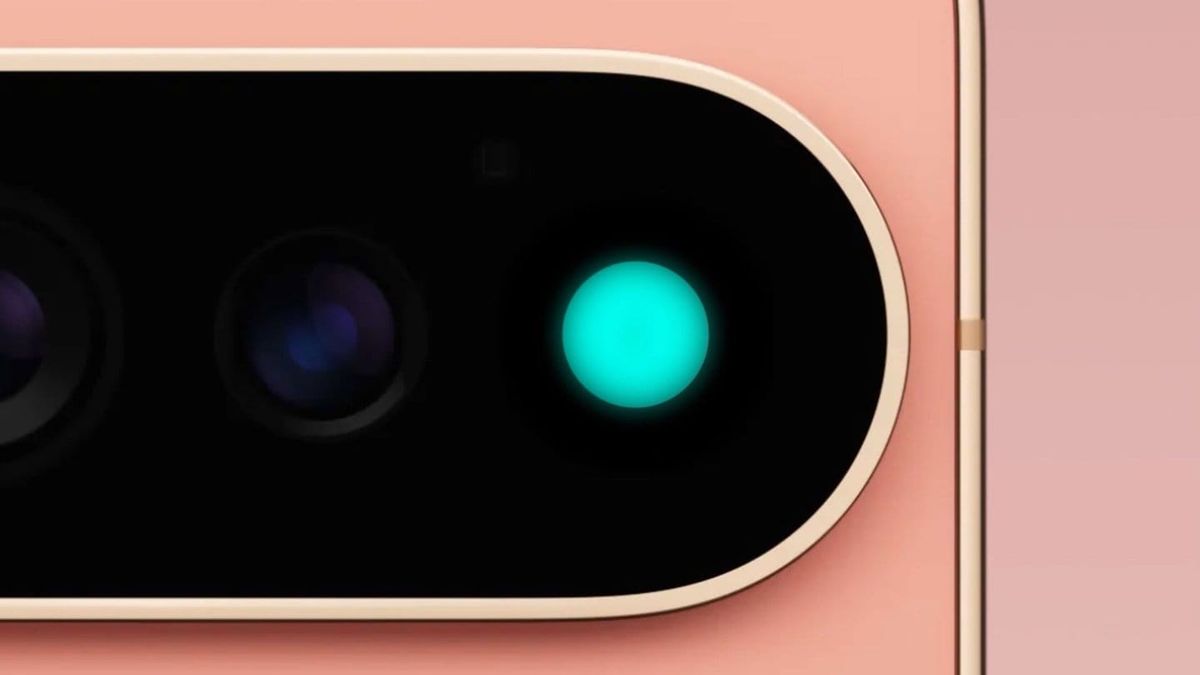
Presentation aside, clearly this was a bit of a muted year for Pixel hardware. Some small upgrades, some actual downgrades, and – undoubtedly related to both – price increases. The one new stand-out feature, hardware-wise at least, for the devices was clearly the 'HiLight' indicator in the camera bump. Much like BlackBerrys of old – which everyone keeps trying to get back to, it seems – this gives you a visual alert to a notification. Unfortunately, it sounds like it's comically under-implemented, to the point of being pointless:

That’s where this year’s “HiLight” feature comes into play. The rear-facing LED is available on all three Pixel 11 Pro models, and somehow it feels more half-baked than the temperature sensor.

This feature currently exists for exactly two functions – to tell you when a favorite contact is calling you, and to indicate that Gemini is active.

That’s it.

It's completely inexplicable that this notification is only for phone calls and not messages. I mean, even BlackBerry did that! Google seems to be messaging that this could come down the road, but how do you not launch with this? Who gives a shit about phone call notifications? The phone functionality is arguably the least interesting element of modern smartphones.

But even better would be:

Also, elephant in the room, why in the world does this not work as a notification LED?!

Our Andrew Romero pointed out just how good this would be. Having the LED customized to the app you got a notification from – reds and purple for Instagram, as one example – would be so good.

I see no reason why, with the right software, you couldn't have a few options. Say, light up "red" if my wife is messaging me somewhere (not just a phone call, but in any app). But also, say, light up "blue" if I get a Signal message. I mean obviously.

The Gemini notification is fine/cute – perhaps mirroring the 'Pixel Glow' strip that Google is trying to make happen on (the still poorly named) Googlebooks? It's probably a good thing to have if you're going to be talking to Gemini a lot and need to know it's active/listening.

Of course, the only time I would ever put my phone face down on a table is if I'm using a case (I worry less about scratches and more just the cleanliness of the surface for a device I'm going to touch so often throughout a day). And my "case" of choice is usually a MagSafe wallet which allows me to put the phone face-up (while making the phone actually stable with the ever-massive camera bump). And this obviously negates anything on the back of the phone.

Also, all of this with regard to notifications is what my Apple Watch is far better for anyway. So really this is just a feature for if you don't wear a smartwatch and often leave your phone face-down on a table. That's probably nice/useful but only if Google adds the obvious other notification integrations and why they're not launching with those is just dumbfounding.

But, to Schoon's point, Google often launches with features for Pixel devices which are half-baked at best. And as such, they usually vanish rather quickly.

9to5google.com
0
0
0
0
Open post
Spyglass @mg@spyglass.org
· 6mo ago

"I'm here in case you succeed."

That's what Colonel Jack O'Neill (Kurt Russell) tells Dr. Catherine Langford (Viveca Lindfors) when she asks why he's a part of the 'Stargate' mission in the 1994 film of the same name. The implication, of course, is that in the unlikely event that the Stargate works, and opens a portal to another world, he's the fall-back option in case something goes wrong.

Well, the stakes are lower, but the tech project named after the movie – the massive AI data center build-out spearheaded by OpenAI, Oracle, and SoftBank – is no less complicated. Case in point: the many fits and starts of the real life initiative. And the latest twist and turn perhaps points to a very fundamental challenge of the project – and the broader data center build-outs in general.

The latest news dropped last week. Last Thursday, Bloomberg reported that OpenAI was backing out of a planned expansion of a data center project in Abilene, Texas. If you've heard of Abilene in recent months it's likely one of two things: either you've been listening to a lot of Ella Langley, or you've been following the aforementioned 'Stargate' project – that's the location of the first such site...

This post is for subscribers only

Become a member to get access to all content

Subscribe now
0
0
0
0
Open post
Spyglass @mg@spyglass.org
· 2mo ago

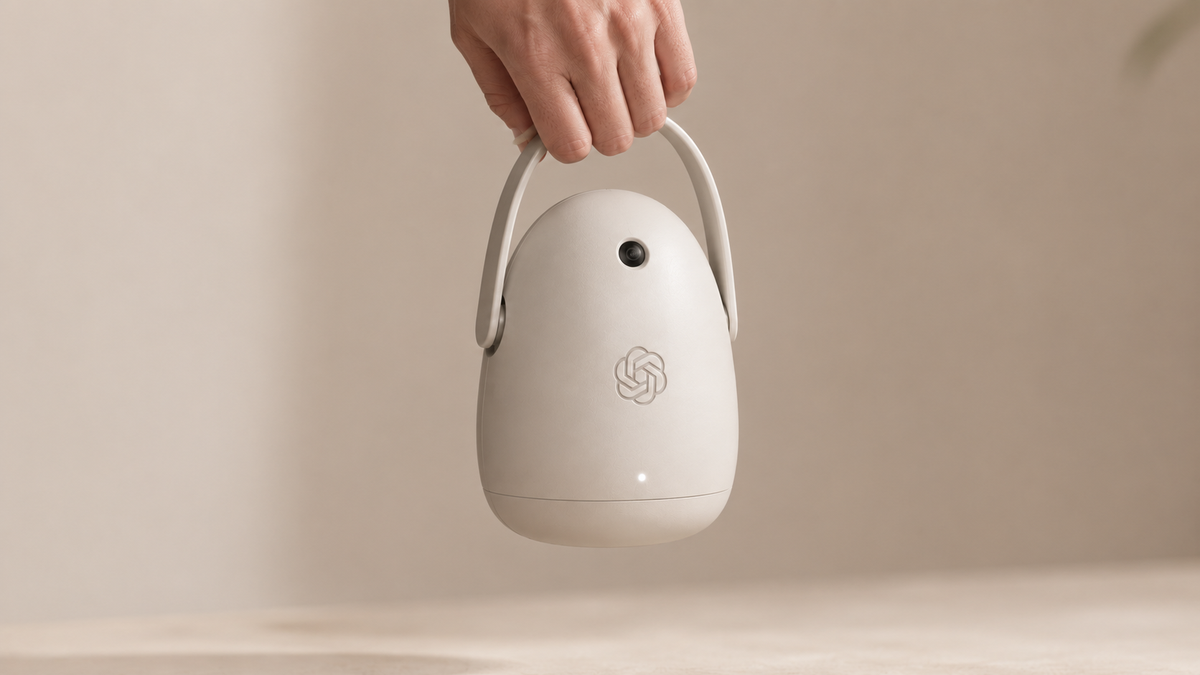
Well, it looks like we won't have to wait for a legal discovery process to uncover what hardware device OpenAI is working on. In what feels awfully like a coordinated leak, Mark Gurman of Bloomberg got a lot of details about what is easiest to describe as an AI-driven smart speaker, but that clearly OpenAI won't frame that way:

OpenAI’s much-anticipated push into consumer devices is slated to begin with a mobile, screen-free smart speaker designed to be a new type of home computer for the AI era, according to people familiar with the matter.

The product — still under development — is meant to serve as a humanlike AI companion that lives in the home, said the people, who asked not to be identified because the project hasn’t been announced. It will help control smart-home appliances, play media, answer questions, respond to messages and tap into the range of capabilities offered by OpenAI’s ChatGPT, they said.

None of this is particularly surprising – in fact, it all sounds largely in-line with the product I guessed OpenAI was building immediately after they announced the acquisition of io, Jony Ive's startup. While many assumed the two companies would team up to focus on building an AI wearable device – which were all the rage at the time, led by the ill-fated (and Sam Altman-backed) Humane AI Pin – my guess was, well, more or less what it sounds like they're gearing up to launch.

Back in May 2025, in a piece entitled 'The Anti iPhone', I wrote:

The problem with a full-on wearable in this regard is that everyone focuses far too much on the whole wearable part. That is, the exterior of the device and how it will work on your body. And then: how can I get the technology to work on that? But I suspect that OpenAI/IO are focused on the opposite: what's the best device to use this technology? Why does it have to be wearable?

To be clear, I suspect that whatever the device is, it will look fantastic – this is an Ive/LoveFrom production, after all – but that's mainly because beautiful products bring a sense of delight to users and can spur usage. I suspect the key to the design here will be yes: how it works. And again, I suspect that will be largely based around voice, and perhaps augmented by a camera.

By October of that year, as some details started to trickle out about the direction OpenAI/io was taking, the focus seemed more clear. "A small, screen-less digital companion for you life," I wrote at the time. Another leak in February 2026 nudged us even further in the direction of a smart speaker-like device.

Back to Gurman's report today:

OpenAI’s success in hardware will hinge on bringing a novel approach to the market — something it aims to do with the smart speaker. For instance, the device’s technology is meant to become increasingly personalized and proactive as it gains a deeper understanding of its owner over time, according to the people.

OpenAI envisions the device anticipating needs, surfacing information proactively and serving as an expert on its user, they said. Though the speaker is designed to stay in the home, it will be easy to move around the house.

The key to this device, of course, will be voice. That is, voice-based AI. The writing has been on the wall there since at least the launch of GPT-4o, but if the intent was to be more than simply a better Alexa or HomePod, it felt like a couple more breakthroughs were needed. And what do you know, with the launch of GPT-Live... here we are! As I wrote just last week (which feels like months ago in OpenAI-land):

Anyway, it feels like we're now fully on the cusp of a true shift in computing. Yes, I've long thought this, but it's step-by-step happening. And these new GPT-Live capabilities seem like they're going to unlock the space to the point where new devices may now be not just possible, but inevitable.

For now, these models and capabilities will be awesome to use on smartphones and laptops. While one aspect of the demo that Siri head Mike Rockwell gave during the WWDC keynote was undoubtedly because voice gives a far better demo than text, it also seems pretty clear that we're about to see millions of people out in the wild hitting a button to chat – vocally – with Siri. Finally.

And perhaps those who get really into this method of interaction start to venture into even more robust models such as those offered now by GPT-Live. And perhaps OpenAI leverages those capabilities to launch their own device sometime in the next several months. And perhaps many others follow suit once it's clear that this is a new path forward for computing.

Inevitable, indeed. Back to Gurman:

The device’s communication abilities will rely on a more advanced version of the ChatGPT Voice Mode — GPT-Live — that OpenAI rolled out this month. The new voice mode is designed to act more like a human. It can listen and talk at the same time, adapt more naturally during conversations, and quickly process information.

Though the new product resembles a speaker, OpenAI internally describes it as the first of its kind: a computer built for AI to help make busy people more productive. It includes a camera and other sensors that help it understand a user’s surroundings and context, as well as advanced AI models beyond those available on conventional smart speakers.

That's a bingo.

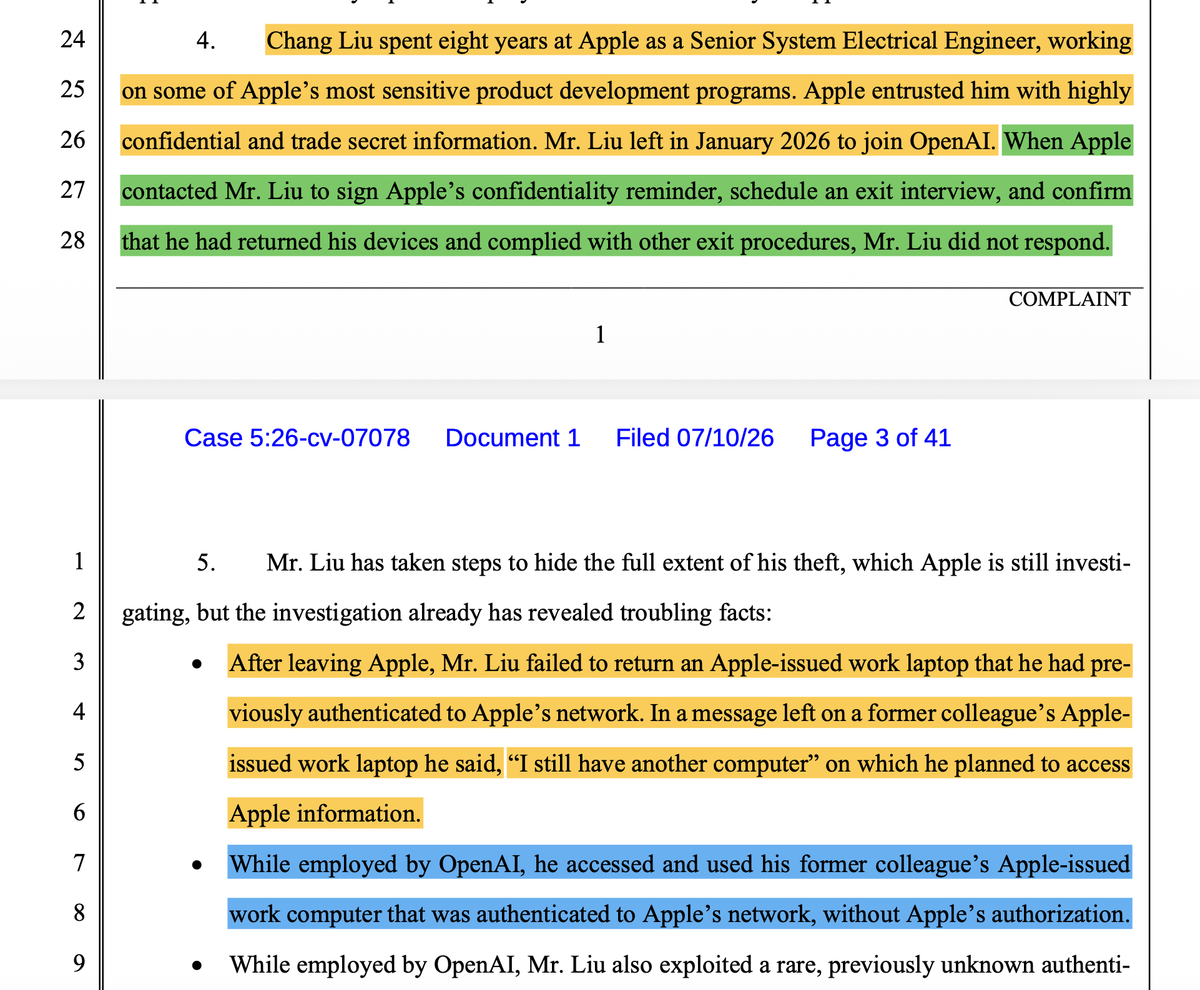
But wait, what's that in the room next to this new OpenAI device? It's an elephant! In the form of a lawsuit just filed by Apple against OpenAI. While perhaps not explicitly about this device, it's obviously going to get roped in here. Because what underpins the entire thing is the notion of OpenAI poaching people from Apple and allegedly stealing their IP and trade secrets to bolster OpenAI's fledgling hardware efforts. To quote Apple, "As a natural result, OpenAI's nascent hardware business now rests on the shakiest of foundations, rotten to its core by its illegal reliance on misappropriated trade secrets."

To hear OpenAI – sorry, Gurman's sources – tell it:

Apple sued OpenAI last week, accusing the company of stealing trade secrets. But OpenAI believes that the device veers significantly from anything Apple has on the market today and that it’s unlikely that it violates trade secrets belonging to the iPhone maker, the people said.

While this would-be device obviously doesn't sound like an iPhone and again, OpenAI is going to frame this very differently than a smart speaker such as the aforementioned HomePod, lawsuit aside, that general space now feels like yesterday's technology because of the previous success of Alexa and the like – still, there are likely going to be some overlaps. The question will be just how many and if any of them crossed the chasm in the alleged information taken from Apple.

Of course, that may also take years to uncover, depending on if/when this actually goes to trial. And that's why Apple is seeking injunctions to stop OpenAI from using their IP right now. So even these next few months are going to be interesting...

And wait, while everyone seems to be focused in on the possibility that OpenAI would infringe Apple's known products, what if this is all really about the unknown/unreleased ones? Certainly the lawsuit makes it clear that the "show and tell" of prototypes was key – i.e. they weren't bringing iPhones to those meetings (allegedly).

In fact, reading today's report, I'm reminded of not just the tabletop/mounted 'FacePod'/'HomePad' that has been rumored for years – and likely delayed by Apple's AI woes – but other potential products that Apple's own published research papers have uncovered. Even better, a video.

In February 2025, I wrote about "Apple's Elegantly Expressive Pixar Lamp":

I don't know that this will be the first such robotic product that Apple launches. It sounds like the first could be a bit more stationery. But this is one that I would bet that Apple will try to launch at some point in the next few years. The only real question is if they'll be allowed to call it "Luxo" or the like. If Steve Jobs were still with us, absolutely that would have happened. Will Disney greenlight Apple using their IP given the Jobs legacy? I mean, you'd have to imagine Bob Iger would see it as a branding win/win, but will Iger still be around at that point?...

Forget the HomePod, or even 'HomePad' (again, this OpenAI device has no screen), this is the device that immediately jumped to my mind. It's a simple robot meant to bring joy and delight into a home by way of expressive actions driven by AI. Apple, of course, didn't have the voice chops to make it work at the time, but now, thanks to Google, they probably do! So I can't help but wonder how much overlap there is between whatever OpenAI is trying to do with this first device and what Apple is doing within their labs... That, I imagine, may be the key to all of this.

At the same time, as I noted the other day, even if OpenAI is worried about any of this – and again, they're telegraphing that they're not – they may feel the need to push forward anyway. This hardware initiative is that important to the future of the company. And I suspect that Ive's team will have built something super compelling:

OpenAI believes the product’s defining feature will be its personality and ability to connect on a humanlike level with users. The speaker incorporates mechanical elements that can move on their own, creating a sense that it is alive and not just an object responding to commands. The machine also will draw on personal information such as emails to better understand its owner.

The goal is for the device to feel like a companion and become a physical manifestation of OpenAI’s ChatGPT.

A cute tabletop robot that does your email for you? Sign me up.

👇
Previously, on Spyglass...
The Anti iPhone
Jony Ive’s antidote to the smartphone obsession he helped usher in…
SpyglassM.G. Siegler
The First True AI Chatbot
As in, actually chatting. As in, with voice.
SpyglassM.G. Siegler

OpenAI’s Digital Assistant Device
Obvious challenges aside, it’s starting to come into focus…
SpyglassM.G. Siegler

“Hello, Computer.”
With AI and an appetite for new hardware, vocal computing seems primed to take off, for real this time…
SpyglassM.G. Siegler

Apple’s Elegantly Expressive Pixar Lamp
Forget glasses, Apple’s Next Big Thing™ may be a robot…
SpyglassM.G. Siegler

x.com
0
0
0
0
Open post
Spyglass @mg@spyglass.org
· 2mo ago

When Apple jacked up their prices across several products last month, there was a curious absence – a big one, the biggest one: the iPhone. As I noted at the time, it seemed like a strategy so as not to shock the system – read: Wall Street – all at once. The iPhone remains the most vital aspect of Apple's business, so while Tim Cook had already signaled – step one – the price increases were coming, pushing them first across nearly the entire product lineup aside from the iPhone clearly seemed like step two in this easement strategy.

Step three would likely be to announce the new iPhone pricing alongside unveiling the new premium iPhone models – including, for the first time, the 'iPhone Ultra', the first foldable, and undoubtedly most expensive, iPhone. And even that was clever/lucky since Apple has long been believed to be breaking up the iPhone launches starting this year, with the "regular" iPhones 18 coming in the Spring of 2027. And that would have been a step four of the strategy, since the buyers of the non-Pro devices are more likely to be price conscious. So Apple would have guided towards that outcome and postponed that pain as long as possible.

Well, as it turns out, this is a five step strategy!

Before that all-important step three of unveiling the new iPhones in September, Apple had a trick up their sleeve: a new way to pay! Say hello to Apple Upgrade:

Apple Upgrade offers 12- and 24-month leasing options for iPhone and Apple Watch, and 24- and 36-month leasing options for Mac and iPad. Leasing prices start as low as $17.99 per month for iPhone, $11.99 for Apple Watch, $24.99 for Mac, and $11.99 for iPad. When customers first enroll in Apple Upgrade, they can further lower their monthly lease payments by trading in their currently owned device through Apple Trade In. Customers can also earn 3 percent Daily Cash back when making their lease payments with Apple Card.

While Apple still didn't raise iPhone prices alongside this move, it's clearly another lever to pull getting ahead of that inevitable increase in a few weeks. Now a $100 or $200 price increase on the iPhone 18 Pro – perhaps soon to start at $1,299? – will look far less daunting when Apple can also tout the option to pay, say, $33.99/month.1

And even better will be for those aforementioned "regular" iPhone 18 models coming in the Spring, which could start at just say, $19.99/month (again, assuming some increase in the monthly price alongside an actual iPhone price increase).

Apple, of course, has long had a way for some customers to pay for an iPhone monthly with the 'iPhone Upgrade Program', but as the name indicates, it was mostly geared around those who upgraded every year and allowed them to save a lot in terms of up-front costs and a bit in terms overall costs for a single iPhone – but with the rub being that they would have to pay in perpetuity!

Given that I upgrade my iPhone each year, I was an early member of this program, but found it a bit of a mess by Apple's standards, at least in those early days. A big part of that is because Apple partnered with a third-party bank on the financing element. For a while, it seemed like Apple would try to bring this all in-house as they slowly but surely grew their payments prowess with first Apple Card, and then their own 'Pay Later' service. But, well, both have been sort of a nightmare. Apple partnered with Goldman Sachs to launch the Card and the two quickly had a falling out and it took well over a year to find a new home with JPMorgan (which is still in process). Meanwhile, Apple Pay Later only made it a year before they pulled the plug entirely, seemingly not enjoying holding the debt on their balance sheet. So much for the Apple Bank!

Apple went back to partnering. And they're doing so here as well, with Klarna. And yes, the iPhone Upgrade Program is going away.2 This is a far more robust offering for more Apple products. Yes, you can still do the monthly installment option with Apple Card, but that's only that card and that's only to fully buy the device over time.

Anyway, as someone who has long been on the lookout for an 'Apple Prime' or 'iPhone Prime' offering – that is, a way to "subscribe" to pay for your iPhone just as you subscribe to Amazon Prime – this is the closest thing yet. Yes, Apple has the 'Apple One' subscription but it only bundles their software offerings, not the iPhone (or any other hardware). Still, it seemed inevitable given the ever-rising costs of the iPhone, as Apple pushed more and more premium models. And now it's here, a true 'Apple-as-a-Service'.

Yes, it would be a bit nicer to rope this into Apple One itself. Or for it to be fully run through Apple without any partners needing to do third-party credit checks and whatnot. But Apple will presumably make this as seamless as they possibly can. Because again, I think it's a big part of their strategy to alleviate (and in a way, obfuscate) the price rises that have been forced upon Apple by the current market dynamics.

One imagines we'll see that familiar iPhone pricing slide during Apple's next keynote – the first undoubtedly to be fully MC'd by John Ternus – but with a new element: "the iPhone 18 Pro starts at just $1,299 or you can sign up for 'Apple Upgrade' and pay just $33.99/month for 24 months (or more if you want a 12 month term). And at the end of that term, you can opt to pay a bit more to buy the device outright, or simply choose a new model! This will be offered in the US to start, but we're working to bring it to other parts of the world soon."3

And just like that, Apple will have kicked 'AaaS' out the door. Curious to see how they account for this – literally. Do they still book the full device price at time of sale, or just the portion covered by the lease? It then perhaps technically becomes Klarna's iPhone for which to collect the monthly installments? Or is it some sort of hybrid?

But that's too in the weeds. For consumers, this will just look like you can buy an iPhone (or Mac, or iPad, or Apple Watch) from Apple for a relatively low monthly fee. And given where Apple's prices are heading, that's going to look awfully enticing to many.


1 Unless Apple already baked-in the upcoming iPhone price increases into these monthly rates? It's possible but probably unlikely? That would be a nice "surprise" though if they don't have to raise these just-announced monthly prices! ↩

2 And with it, sadly, the inclusion of AppleCare in such programs, it seems. That will be extra. Services, FTW (for Apple's bottom line). ↩

3 Which may be a part of why they picked Klarna here, a company headquartered in Stockholm but that operates in the US as well... ↩

x.com
0
0
0
0
Open post
Spyglass @mg@spyglass.org
· 1mo ago
Google (Again) Brings a Comedian to a Tech Keynote

On the plus side, it wasn't as bad as last year. On the minus side, it was still pretty bad.

Look, I'm clearly – clearly – not the intended audience for the 'Made by Google' events. But then again, shouldn't I be? I'm a sort of tech-obsessed user that upgrades my smartphone every year. Yes, that's been an iPhone for the past 19 years,1 but I often tend to buy a Pixel device too because I'm curious! Yes, that's crazy. And yes, I'm not at all a typical user. But with the cards – and devices – played right, I could, theoretically, be someone who moves to a Pixel phone as my primary device one day, right?2

I mean, not if I'm watching this presentation.

Again, Trevor Noah was a far better MC than Jimmy Fallon was last year. But the bar was so comically low – pun actually intended – that almost anyone would have been an upgrade. Sure, my own personal preferences naturally finds Noah funnier than Fallon, but he also just seemed decidedly more chill and at ease than Fallon and, as such, a lot of his jokes landed with less of a cringey thud. Of course those jokes were almost always negated by the Google employees he was playing against as they were clearly far more worried about sticking to the script. And it's hard to blame them, they're not comedians nor actors. But they are asked to be here.

It's a fucking weird strategy for a product unveiling!

Again, clearly I'm not the audience. But who that audience is, I don't know. People who are fans of the various celebrities they showcased, I guess. But even then, is that really a good acquisition strategy? How much are they paying these people to hawk these products and how many purchases will it actually lead to? Clearly Google can measure this. Are they? Or are they just hoping for some kind of halo effect? Are they just hoping for more views on YouTube? What's the ROI?

I would like to give Google credit for trying something different. This is not an Apple keynote. But I gave them credit for that last year. It didn't work, yet they doubled down. Again, Noah is an upgrade over Fallon, but the format just doesn't work. At least for me. And I assume for many. It still just feels like an infomercial.

It's like when Meta has tried to do keynotes with laughably scripted "candid" conversations. But at least those were actual Meta employees who, script aside, were presumably actually excited about what was launching. Here, half of the presenters were actors and/or celebrities. Are they genuinely excited about new Pixel products? Maybe. But also maybe mainly because they're getting paid to be excited about them. Start the countdown to shots of them in the wild using iPhones...

Again, the other half of the presenters were actual Google employees, but they were faced with the impossible task of acting against professionals. For the most part, they were actually pretty good at it, but still failed because it all just looks so scripted. Because it was so scripted! What is the point?!

At least the events are live! (Aside from the many pre-recorded videos Noah would tee-up throughout.) As such, they do feel actually more alive than the last several years of Apple events. But again, sort of in an awkward way here.

Staging aside, there was also this weird undercurrent throughout the event, highlighted by Noah again and again, which boiled down to: we know we promised the last wave of AI was cool, but didn't really do much for you, but this time, it's really cool. Okay, but why would anyone buy that, quite literally, this time?3

Noah veered between seemingly improvising well – as you'd hope! – to awkwardly being forced to come back to the script. And again, that just serves to undermine the entire "performance".4 Is he actually excited about any of this? Even if he is, when we're asked to believe that he knows these random Google product managers well, casually sitting on the couch with them, just to catch up, it just all feels so fake.5

It's like Google doesn't quite understand what actually made Apple keynotes work. It's not the current, slick variety. It's the history behind them dating to when Steve Jobs would be on stage, clearly excited and enthusiastic about what he was showcasing. That's what translates and what people want to see. In that regard, hiring actors to do this is the opposite of the point.


Update August 17, 2026: As for one of the key features of the Pixel devices being shown off/touted...

The Pixel ‘HiLight’ is a LowLight
What was Google thinking here?
SpyglassM.G. Siegler

👇
Previously, on Spyglass...
Google’s Distractingly Smarmy Pixel Event
Next time, let’s not use the talk show host or infomercial set?
SpyglassM.G. Siegler
1 Yes, even for the 11 of those years that I worked at Google. Sorry, Google! ↩

2 I can't decide if it was weird or smart to set up Alex Cooper as the Switcher-in-Residence. If it's legit, probably smart. But again, better not capture any shots of her with an iPhone! ↩

3 Also, it all honestly felt decidedly AI-lite versus what you'd expect?! Then again, maybe that shouldn't be a huge surprise at this particular moment in time? ↩

4 The parts with his fellow South African, Noel, while obviously staged, were also by far the best of the bunch. Fun/funny banter. ↩

5 Which is honestly a bit annoying when say, the ASL demo is so awesome. In ways, this felt like a distraction from the technology. ↩

0
0
0
0
Open post
Spyglass @mg@spyglass.org
· 3mo ago
Getting banned on WhatsApp is both bullshit and a real problem.
A couple years back, I was banned by Instagram. Because I happen to know a few people there,1 I got it resolved and my account back online relatively quickly. But I never got an answer for what actually happened.2 A few months later, I found myself banned again. Again, I pinged some people. Again I was reinstated. Again, I got no explanation other than someone – or something – messed up. Again. While those bans also instantly took out Facebook and Messenger, I was lucky that it left WhatsApp alone. Because, living in Europe, I'm forced to run a lot of my actual life through WhatsApp because it's the service many people rely on here as their primary messaging service. Boy, it would suck if I was banned from WhatsApp. As I just learned first-hand tonight. Yes, that's right, for a third time in as many years, I've been banned by Meta. What for? Do you really have to ask? Nobody knows. My suspicion is that it's directly tied to the claiming of usernames on WhatsApp, which Meta opened up yesterday. After I claimed mine, it seemingly logged me out of my other active instances. And when I went to log back in... boom.3 Banned. No explanation. No warning. Just a note that "This account can no longer use WhatsApp." As with Instagram and Facebook, you can submit a review of the ban and they say they'll look at it and let you know within 24 hours – but no promises. When I did this the first go-around with Instagram, I actually lost the appeal. Why? Nobody knows. Again, it took a personal plea. And I'm insanely lucky to be able to do that. As my replies then and now can attest, many are not so lucky. Many are just banned and never heard from again. At least on those services. This is bullshit. How do I know this is bullshit? Because it literally happened to me! And, in fact, keeps happening to me! And I'll get it fixed again because I just so happen to know people, which is arguably worse bullshit! But hopefully this blogpost, perhaps summoning some spirit from my late friend Om Malik, can help light a fire under Meta to actually fix some of this nonsense. I don't know who is minding the ship over there, but my fear is that no one is. That they've automated the shit out of all of these systems. And that they've laid off the people who used to be in charge of such things and stopped it from happening. And that AI is going to make all of this so much worse. Further, the fact that Meta "hackquired" a company to be able to outsource the management of WhatsApp to India isn't making me feel better about any of this. I'm sure it's unfair, but it also sure looks like Meta is saying that a core social property, a service they acquired with billions of users, is no longer important enough to be run by their core team. [Update: I had written initially that the service would be run out of India, which wasn't clear at first, but apparently CRED founder Kunal Shah will be moving to Meta HQ, which is good, but the main point stands.] They will, of course, suggest the opposite is true. That because the rest of the world is so important to WhatsApp that it should be run by a "hackquired" entrepreneur from that part of the world. But all I see in the news is that Meta was having a hell of a time monetizing WhatsApp after years and years and they think they found someone who can do that. Also, how have those other "hackquisitions" worked out for everyone? What I see is Meta no longer giving a shit about the product or the experience, just the monetization. They're ready to fucking milk it. Why? To try to diversify away from their 98% reliance on advertising. Why? To try to get permission from Wall Street to keep spending on AI. Why? To try to finally find "what's next" now that they can no longer acquire entities like Instagram and WhatsApp. And also because AI will help them automate and supercharge the ads that they so heavily rely upon. And also the content moderation that they hate having to pay people to do. You know, like on WhatsApp. Hold on. I just spoke to a friend who I communicate with primarily on WhatsApp. Apparently, they're sending me messages right now with no indication that I've been banned and that they're not getting through. What the fuck?! I've fallen too far into the Meta org weeds here. Let me just point out that I run a lot of my household through WhatsApp – including childcare. Imagine if there was an issue with a child and someone was frantically trying to get ahold of me and couldn't because I've been banned? Honestly, should that even be legal? Sure, I could not use WhatsApp, but again, I sort of have to. I can't force all of Europe to switch over to iMessage – though I would certainly like to right now! And so it feels like that Meta shouldn't just be able to ban you from a service you use to operate your life – especially since it's tied to your phone number. Maybe that's why they're switching to usernames? But fine, ban me, but tell the person trying to communicate with me – potentially about very important things in my life – that they need to reach me some other way. That these messages will not get through to me. This is fucking insane, Meta. Honestly, I would love to pull the plug on all Meta services in my life. I get little joy out of them anymore and far more pain and annoyance. It's just not clear to me that anyone at Meta really cares anymore, perhaps ever since the ill-fated name change of the company. They just keep searching for what they want to be next – gambling, GAMBLING! – while constantly neglecting what they actually are. Update June 30, 2026: Well, as expected, I was un-banned... for about 5 minutes. I went to log-in to WhatsApp on computer and... immediately re-banned! Update July 1, 2026: Was reinstated this morning. Went to log-in on my computer and surprise: immediately banned again. It's clearly amateur hour over at Meta right now. Or worse, AI hour? 1 I was/am user #28 of the service, having started using it months before it was actually live to the world. I've been verified for years. Still banned with no pings or warnings. ↩ 2 And the wording was pretty wild. So wild that I won't even repeat it... ↩ 3 My best guess would be that I use a lot of different devices and because of WhatsApp's clunky authentication process, they may not like seeing so many machines get logged in so quickly? I'm honestly not sure. But it all seems pretty clearly tied to the username situation. Which, if true, is stupid. Who could have known? ↩
0
0
0
0
Open post
Spyglass @mg@spyglass.org
· 1mo ago
By the Power of Streaming

🔗 'Masters of the Universe' Powers to No. 1 Debut • THR

He-Man has the power! Well, on streaming at least. After (rather predictably) bombing at the box office, Amazon smartly, quickly, pivoted Masters of the Universe to Prime Video and by the power of Grayskull... As Rick Porter (Ri-Porter?) reports:

The movie based on the 1980s cartoon series and toys scored the No. 1 overall ranking in Nielsen’s streaming ratings for July 20-26, its first week of streaming. It debuted July 22 on Prime Video, less than weeks after its theatrical premiere; it has made a little under $114 million worldwide at the box office against a $170 million budget. Masters of the Universe scored 1.17 billion minutes of watch time for the week and was one of just two titles to cross the billion-minute threshold.

Let's not get too carried away, it barely beat The Big Bang Theory, content which is – checks notes – nearly two decades old. Still, that's a show with 281 episodes versus a single movie (I'm still not sure why they bother comparing such things, which is insanely unfair to movies, but I guess time glued to screen is time glued).

Anyway, if the movie can hold well on streaming, it will be interesting if Amazon moves forward with the sequel, which – quasi-spoiler1 – they obviously aimed to do given the tease at the end. There had been some talk that they would despite the box office disappointment, and I think that's perhaps a promising sign that Amazon understands that box office is increasingly just one element of how this can work. To be clear, they would have loved a big box office here, but they've also run this playbook before, salvaging big budget "bombs" on streaming.

The key is to move relatively quickly, as Amazon did, going to Prime Video just six weeks after the opening – notably, skipping any SVOD window.

This is smart. You can take advantage of/recoup some of the theatrical marketing, which is a trick Netflix has stubbornly refused to learn with their anti-theater stance – but that's obviously changing too. Yes, even post-Warner Bros deal blowing up.

It helps that Masters of the Universe was decent. Not great, but not awful. Not as good as Dungeons & Dragons: Honor Among Thieves – seriously! – was, but in a similar tongue-firmly-in-cheek vein. The fact that it looked a little too Thor-y,2 but with worse CGI didn't help. But it seemed to find some footing as it went on.

So yeah, definitely watchable in a nostalgic sort of way. Which, I was the, um, prime audience for. As I've written about – probably far too much – I grew up obsessed with the He-Man toys and cartoon. Did I know that it was created by Mattel as a way to combat Star Wars (after they passed on those toys)? No. Would I have cared? No – have you seen the Castle Greyskull toy?3 It's still awesome.4

I also loved the first Masters of the Universe movie even though it was scary as shit – especially if you're, I don't know, five years old, as I was when it came out. Frank Langella, FTW.

Anyway, the fact that I wasn't there on opening night for this new one probably wasn't a great sign for its box office prospects. Worse, I didn't see it in theaters at all! A big part of the problem is that I now have young kids of my own. It's hard to find time to break away to go see a movie (well, one that's not in their wheelhouse at least). Sure, you do it for The Odyssey and Spider-Man (especially since my wife was interested in the former and my older child interested in the latter!), but Masters of the Universe? Sorry, He-Man. And I suspect I wasn't alone in my demographic – again, perhaps the key demographic here...

But did I watch this new Masters of the Universe immediately when it came to streaming? You bet your Skeletor I did!5

So what might Amazon do here for a sequel, strategy-wise? It's early, but I think the right idea would probably be a wide, but limited theatrical run. Make it a two-or-three-week-only engagement – ideally with IMAX – to try to drive super-fans to theaters. Then go even faster to streaming. And ideally augment all of this with some killer toy sales! You're Amazon for Teela's sake!


1 And I don't mean Orko, who obviously also needs to be a focal point of any sequel! ↩

2 Not helped by the role that Idris Elba plays in both. He's good in Masters, but come on... ↩

3 As the popcorn buckets can attest! ↩

4 I couldn't have been the only kid who was confused that the castle shaped like a skull wasn't the home of the villain with the skull face... ↩

5 The movie also probably wasn't helped by some level of Jared Leto backlash, though the most recent allegations came out well after the movie was already bombing. Also, he was pretty widely considered to be the best part/performance of the movie (not that you can tell it's him). Though shout out to Alison Brie as Evil Lyn! ↩

x.com
0
0
0
0
Open post
Spyglass @mg@spyglass.org
· 1mo ago
Meta’s Complicated AI Context

🔗 Mark Zuckerberg is Buying Meta a Seat at the AI Table. Does He Know What to Do With It? • Fast Company

There's a lot of positive buzz around Meta's AI efforts at the moment – if nothing else, it's impressive the speed at which they've zoomed back at least near the frontier. Can the forthcoming 'Watermelon' model fully get them there? Or set some kind of new mark? We should see soon enough, but more important for Meta will be creating an actual product people want to use AI for. Will 'Hatch' be the consumer harness that matters? The "OpenClaw for Normies" that I've been waiting for?

I remain skeptical simply because of Meta's recent history. When they can't buy, they've had trouble building products that actually resonate of late. It seemed like they found their buy-in here with Manus, but, well, China had other ideas. So the question in my mind is if they controlled the company long enough to effectively clone the IP before they had to give it back?

Anyway, this dive into Meta's history with AI by Harry McCracken gives some important context for the go-forward story. (And I swear I'm not just saying that because I'm quoted twice in the piece.) Mark Zuckerberg certainly gets credit for some early insight into AI being important back in 2013 when he hired Yann LeCun – but this was also because he had just lost the bidding to buy DeepMind. (And in pretty embarrassing fashion, according to subsequent reporting.) This directly led to the creation of PyTorch, the open source deep learning library which Meta absolutely does deserve credit for and propelled the entire field forward.

But as for the "open" strategy with their actual early Llama models, people forget, but that was decidedly more complicated:

While Zuckerberg was selling the world on headsets and smart glasses, a twist of fate helped propel Meta near the forefront of AI labs—at least for a time. In February 2023, Meta announced a new LLM called Llama (for Large Language Meta AI). At first, it planned to share its creation with academic researchers on a case-by-case basis. But a week later, as the world was still wrapping its mind around the three-month-old ChatGPT, a leaked version showed up on the dark web site 4chan. Suddenly, Llama was available to anyone who could figure out how to download and install it. And anyone who did could modify the code to suit their own purposes. Llama’s unintentional release led to fears of it being misused by bad actors. Some of that played out, including the creation of a Llama-powered Discord bot that spewed hate speech. But there was also excitement about the freely available model’s potential to democratize the spread of useful forms of AI.

Meta had been distributing the Llama weights to outside researchers, which is undoubtedly how they leaked, but there was no indication that this was the actual strategy for the general public. In fact, when it happened, everyone was scared shitless that Meta has just recklessly endangered the world! That was overblown, of course, and so it (retroactively – though undoubtedly guided by Meta's previous success with opening up some of their core technologies, including the aforementioned PyTorch) became the strategy:

OpenAI, Anthropic, and Google tightly control their primary models. Zuckerberg realized he could drive improvements more quickly by sharing Meta’s work. The prospect rattled other companies. “Paradoxically, the one clear winner in all of this is Meta,” wrote Google engineer Luke Sernau in an internal memo published by SemiAnalysis. “Because the leaked model was theirs, they have effectively garnered an entire planet’s worth of free labor.” Less than five months later, Meta leaned into that advantage. Rather than vetting users, the company simply released Llama 2 to the public as an open-weight model. (AI purists use this term for models such as Llama, whose training data remains proprietary, making them less than fully open source.)

Then came Llama 3, which was an even bigger success. Meta seemed to be off to the races with Zuckerberg talking up "open" models non-stop on every stage (and every podcast) that he could. Then the record scratch...

Instead of cementing Meta (and "open" models) as the leader in AI, Llama 4 was an unmitigated disaster. The gaming of leaderboards was a symptom, not the cause. While it was easy to blame "open", the reality was that Meta got outflanked by other models using mixture-of-experts (MoE) techniques to train. That was perhaps the biggest revelation of the "DeepSeek Moment", for Meta at least. Well that, and the notion that distillation of models can work quite well – perhaps especially if your model happens to have open weights.1

And so "open" was closed. And Llama was killed. Scale was "hackquired". And billions were burned (on both talent and compute). Again, the initial results look pretty good. But then came the "Kimi K3 Moment" mixed with the "AI Overkill" movement (and the Anthropic heel turn, and ongoing OpenAI backlash), and suddenly "open" was cool again! As such, Meta quickly pivoted back – though not fully this time – just in a way to try to take advantage of the marketing and framing as they try to re-establish themselves externally – and re-align themselves internally.

Back in 2015, Zuckerberg had proudly told me that his success as a CEO had come from the effort he put into “building a culture where people think about the mission in the same way that I do.” Now that synchronicity seems to be gone, at least for the moment. According to a current MSL staffer, employees in the lab regard Zuckerberg’s “personal superintelligence” talk as sloganeering, not a road map for building useful products. One Silicon Valley insider says the richly compensated AI recruits he knows at the company are “mercenaries,” there “to ride this out for as long as Zuck’s interests hold and take as much money off the table as possible.” Morale among longer-serving staffers, who have seen friends and mentors depart by edict or choice, has cratered, says the MSL employee.

"Sloganeering" is a great term. I still think if they nail 'Watermelon' (and can they come up with a better name than 'Muse Spark' for it?) and certainly 'Hatch' these problems will fade away. Success has a funny way of changing perception, fast and clearing up any internal morale issues. We'll see, it's nearly the end of this particular race...

👇
Previously, on Spyglass...
Meta’s Open Weight Whiplash
Zuck returns to his “open” AI arguments at an opportune time…
SpyglassM.G. Siegler

Meta Sets the Table with Table Stakes AI
‘Muse Spark’ sparks the stock, but mainly through imagination…
SpyglassM.G. Siegler
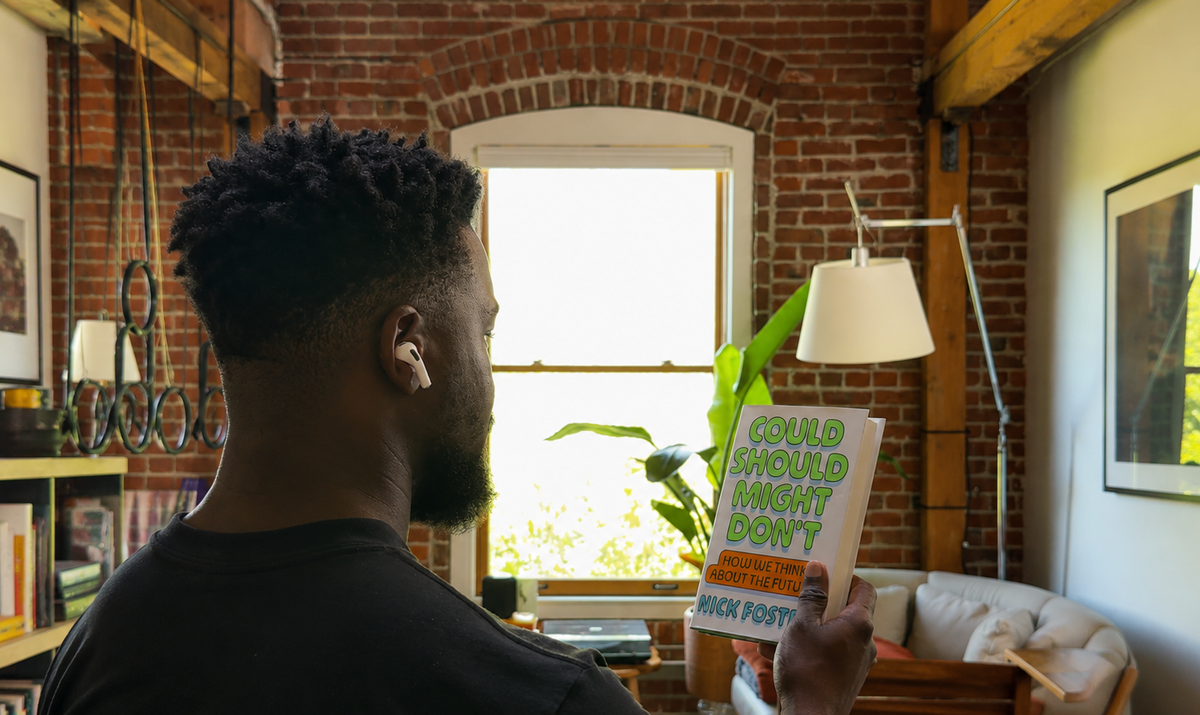
Meta Keeps Missing
Encryption? No. Crypto? No. VR? No. Open models? No. AI? Not so far. Agents? Nothing yet. AR? We’ll see…
SpyglassM.G. Siegler

1 Models which many other Big Tech companies were also happy to use, but not pay for, which was obviously an issue for Meta as well given the costs. It's almost like they needed a cloud... ↩

fastcompany.com
0
0
0
0
Open post
Spyglass @mg@spyglass.org
· 2mo ago

We all know the old saying "don't poke the bear." Less well known is the follow up: "because he might rip your fucking throat out." OpenAI, it seems, may be about to learn this lesson the hard way.

To be clear and fair, I have not seen the lawsuit Apple has filed against OpenAI alleging stolen trade secrets. Nor am I a lawyer. But I do like to think I know Apple fairly well after a couple decades writing about and reporting on the company. And around these parts, I've watched OpenAI fairly closely these past few years. My gut instinct here would be that there's no way Apple files such a lawsuit unless they think they have a strong case on what they're alleging.

I mean, you don't have to be close to the companies at all the sense this: they were, and in fact still are, partners! I mean, this is about to make OpenAI and Microsoft look like the greatest love story of all time. Or at least The Notebook. The Elon Musk situation, yeah it's complicated. Maybe it's like Past Lives or Marriage Story. But now the OpenAI and Apple relationship suddenly looks like Fatal Attraction.

I mean, my god.

The allegations are, um, not great. I'm honestly not even sure where to begin. CNBC seems to have a good summary of key parts of the filing so far:

Apple alleged that OpenAI’s chief hardware officer, Tang Tan, who is a former Apple vice president, has directed Apple employees interviewing at OpenAI to share Apple secrets as part of the interviewing process. Tan is named as a defendant in the suit.

“He has directed job candidates still working for Apple to bring ‘actual parts’ from Apple to their interviews for ‘show and tell’ sessions in which he and his team at OpenAI can elicit still more Apple confidential information,” Apple said in the filing.

Apple alleged that OpenAI coached departing Apple employees in how to evade security processes when leaving the iPhone maker, and that Chang Liu, a former employee who joined OpenAI, stole an Apple laptop. Liu is named as a defendant in the suit.

While Jony Ive is not mentioned in the suit, Tan is just about as high-profile as they come in terms of former Apple folks outside of the SVP level. Which is to say, these are very serious allegations against a very senior person – someone who spent 24 years at Apple.

So why now? I mean, this is clearly a Friday news dump – this crossed the wires just after the market closed. But it also seems timely:

“Recently, significant evidence has emerged suggesting individuals employed by OpenAI wrongfully took Apple’s secret and confidential information regarding our unreleased technologies, processes, and products,” an Apple representative told CNBC in a statement.

It all reads a bit as if Apple has been building up evidence of these allegations for some time and recently got their smoking gun. It's not just nebulous "trade secrets" either, there are specific mentions down to "metal finishing techniques" that Apple apparently invented and protected.

It also comes a little less than a month after OpenAI was rumored to be threatening Apple with a lawsuit over the perceived failure of their deal to bake ChatGPT into the iPhone. As I wrote at the time, even just that threat was clearly not going to go over well in Cupertino. If you're say, upset over Apple's new deal with Google around AI, this is not the way to air your grievances with this particular company. I went on to note:

Just for fun, let's go ahead and layer in a few more things.

First, Apple probably doesn't love the fact that OpenAI acquired the Jony Ive-founded io with the notion of building products that would break the chains that the iPhone has placed upon us. But they really can't love the fact that the team keeps poaching key Apple talent to help with such efforts.

And what if some of those people are also working on an actual iPhone competitor in the form of a phone, or a smartphone-like device?

I'm not saying that's the reason Apple may not have been as receptive to reworking any deal with OpenAI, but I'm saying that if there were such discussions, that dynamic probably didn't help matters!

Again, you poke the bear... it's a fucking bear. It's a move that seemingly so stupid that perhaps OpenAI was well aware that Apple was looking into all of the above and decided to try to get ahead of it? To what end? I don't know. Even with that in mind, it would be pretty stupid.

But even without their own threats of litigation, what did OpenAI think was going to happen when they poached so many folks from Apple – over 400?! – to work under the guidance of Ive no less? At best, Apple was going to hate them. At worst, well, this.

Speaking of, if any of these allegations are even partially true, it's hard to believe Tan or Liu or anyone at OpenAI could possibly be so stupid? Again, this is one side's allegations, and there's always going to be some level of moderation in what actually happened, but... I mean, either these allegations happened or they didn't?

And if they did. I mean, I keep saying "I mean" because I mean, beyond Tan and Liu, OpenAI itself would seemingly be in real trouble. Potential damages aside, this could sidetrack their hardware aspirations for months, if not years. Possibly forever. And seemingly just as they got the right software in place to make such things sing.

This would also, of course, not be a great look for the leadership of OpenAI. Yet another controversy and yet another messy divorce from yet another Big Tech trillion-dollar behemoth. If OpenAI isn't running out of friends, they're running out of people who would potentially work with them. They better hope these allegations are unfounded. But, I mean, this is Apple. And this is Apple going after the highest profile AI startup in the world. A partner of theirs, no less.

“This much is clear, however: at every level, from members of its Technical Staff to its Chief Hardware Officer, and in coordination with business partners, OpenAI has been stealing Apple’s trade secrets and confidential information,” the company said in a legal filing.

I mean...


Update July 13, 2026: Some further thoughts having now fully read the lawsuit...

Reading Between the Apple v. OpenAI Lawsuit Lines
This is clearly about more than one or two people…
SpyglassM.G. Siegler

Update July 15, 2026: But their emails...

Apple’s Email Found OpenAI Well
Well, not well. But it seemingly still found their inbox…
SpyglassM.G. Siegler

And hardware...

OpenAI’s Chat Robot
What can Apple say about a device designed for vocal AI?
SpyglassM.G. Siegler

spyglass.org
0
0
0
0
Open post
Spyglass @mg@spyglass.org
· 3mo ago

Move over Jensen, there's a new profit king in town. Well, in South Korea.

It was just six weeks ago when NVIDIA (once again) reported blockbuster earnings to the tune of $53.5B in operating profit in a single quarter. I had AI use some NVIDIA chips to figure out that this was an all-time record for such profit in corporate America,1 beating out even the longtime profit king, Apple.

Well, that record didn't last long – and again, didn't stay in America. Here's Daisuke Wakabayashi and Jason Karaian reporting for The New York Times:

Samsung Electronics said that its latest quarterly operating profit was nearly 20 times higher than last year’s, spurred by a seemingly insatiable demand for memory chips used in data centers for artificial intelligence.

The preliminary results for April through June, announced by the South Korean tech giant on Tuesday, underscore how the staggering investments that companies are making to build computing infrastructure for A.I. continue to propel earnings for memory chip makers to record levels.

Samsung said it generated an operating profit of 89.4 trillion South Korean won, or roughly $58 billion, in the second quarter. That was well above the 4.7 trillion won it earned in the same quarter last year, and more than it earned in 2024 and 2025 combined. The company’s revenue also more than doubled in the quarter, to about $112 billion.

No, that's not a typo, let alone many of them. Samsung's operating profit jumped almost 20x year-on-year. $58B. More than it earned in 2024 and 2025, combined.

Crazier still, it could have been more! From the Reuters report on the numbers:

Samsung posted better-than-expected earnings despite bonus-related provisions, as memory prices rose sharply," said Lee Min-hee, an analyst at BNK Investment & Securities.

Without those provisions, its operating profit would likely have exceeded 100 trillion won, analysts said.

100 trillion won is over $65B.2

Yes, per South Korean market reporting norms, the numbers are preliminary (with final ones due on July 30). Still. As recently as 2023, Samsung had reported $5B in operating income – for the year. Yes, this one quarter is over 10x all of 2023. Of course, that year was an outlier. Why? Memory chips! It was a downturn in that market – just three years ago – that ate nearly all of Samsung's profit. Now, of course, it's those very same chips which are fueling these incredible numbers.

Outside of 2023, normally Samsung makes between $25B to $50B a year in operating profit. Again, they just topped that in a single quarter. Because whereas Samsung used to be a consumer electronic company – and like Apple, mainly a smartphone company – now they're mainly a memory chip company.

If Apple has spent the past 20 years trying to figure out what, if anything, can move their fiscal needle after the iPhone, well, Samsung stumbled into it!

And I do mean stumbled because up until very recently, their chip division was a massive problem for the company. They simply could not compete with the likes of TSMC as a fab and SK Hynix on memory. Now, thanks to massive supply constraints, all three are amongst the most valuable companies in the world.3

Maybe, just maybe, Apple should get more into the chip business? They are for themselves, of course. But that doesn't make money (at least not directly) as much as it saves them money (and yes, helps to differentiate their products). Imagine if Apple had a memory chip business? I'm sure Tim Cook wishes that was an investment he had made a decade or two ago right about now...

Of course, the business will undoubtedly bust again at some point. And even with these incredible numbers, Samsung's stock is actually down around 10% at the moment because analysts were expecting even larger numbers! So there's probably no champagne at Samsung today despite these results – especially lest someone think the cork pop is the sound of the AI bubble bursting.

👇
Previously, on Spyglass...
NVIDIA’s Profit Crown
Jensen Huang just took the throne from Apple, at least in the US…
SpyglassM.G. Siegler
The Market Shifts Apple
Apple used to bend suppliers to their will. The world has changed.
SpyglassM.G. Siegler

The Trillion Dollar Business Staring Apple in the Face
Apple needs a new hit product. Well, needs is relative. They want a new hit product. And Wall Street clearly wants them to have it. The new iPhones are a hit. But eventually Apple needs that new product. Services are doing great, but that’s not a singular sexy product.
SpyglassM.G. Siegler
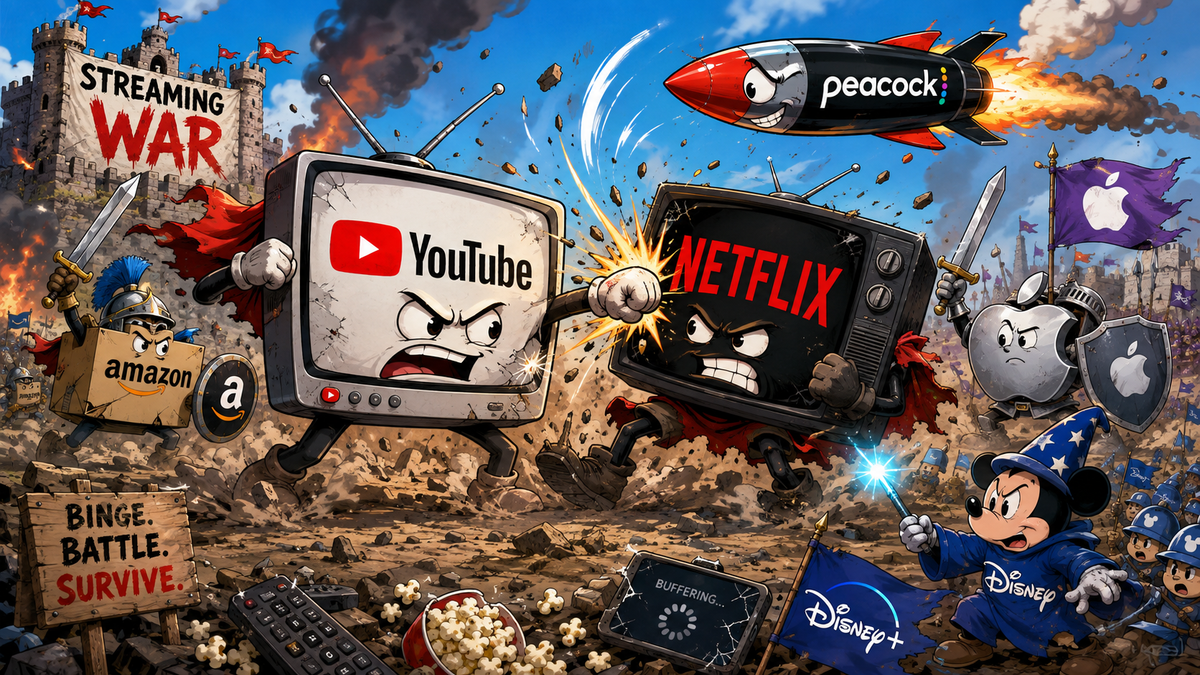
1 And I note "corporate America" simply because Saudi Aramco muddies this picture a bit – specifically one quarter in 2022 when the war in Ukraine led to an oil price spike that boosted their operating profits to the moon – perhaps to nearly $100B. Of course, much of that money immediately flows back to the government, so it's a... different world. ↩

2 Is that employee profit share agreement about to be renegotiated again? ↩

3 To be clear and fair, Samsung's fab business is still somewhat problematic, and perhaps lost money in this incredible quarter due to the aforementioned bonus payouts. But it's without question a good strategic business for Samsung to be in at the moment. Just ask Intel! ↩

spyglass.org
0
0
0
0
Open post
Spyglass @mg@spyglass.org
· 1mo ago
Can Someone Finally Architect Personal Assistant AI?

Sometimes I feel like I'm The Architect in The Matrix. You know, the guy in the room full of monitors in Reloaded who seems exasperated to have to explain to Neo that this is not the first Matrix nor is he the first version of 'The One'...

As the hype builds around AI "personal assistants", there's a real sense of deja vu. Basically since the dawn of technology, this has been viewed as the holy grail, certainly for consumer-facing services. From Apple's 'Knowledge Navigator' concept video to Microsoft 'Bob' to Clippy to Cortana to Copilot and everything in between, one day, such technology is just going to do all the tedious tasks for us.

Sadly, that day never comes. Often for a whole host of reasons, but ultimately, the technology simply isn't good enough. While it might be able to execute a demo or two, it quickly breaks at basically every other seam. It doesn't even seem to really matter what the underlying technology is, if it works at all, nothing can scale. Enter AI, the latest iteration of 'The One'.

Once ChatGPT cracked the code on chat-based AI, the talk quickly started shifting to "agents". That is, the prospect that the AI would be able to autonomously do things for you in the very near future. But on the way to this – yet again – inevitability, a more enterprising use case got in the way: coding. While OpenAI was focused on various consumer use cases, Anthropic found product/market fit with Claude Code (and Cursor, to some degree, largely powered by Anthropic's models).

OpenAI didn't seem to realize what a big deal this would be at first – to their credit, seemingly neither did Google! – but if Anthropic's surging business didn't quickly prove it, zooming past OpenAI in valuation certainly did. And that's because coding is both a big market, but also because it seems like Claude Code was the entry point to broader agentic uses. Thus, 'Cowork' was born.

OpenAI quickly reoriented with Codex, while SpaceX bought Cursor (after merging with xAI, of course). Google and Meta are also rushing towards this opportunity. But it seems like it's going to be hard to dislodge those big three in coding specifically. So the talk is now once again shifting back to the original and forever goal: personal assistants. That is, consumer-oriented agents.

This too required a wake up call, in the form of a lobster. When OpenClaw exploded out of the cage – perhaps to the point where Apple was selling out of Mac minis! – it was clear there was something to the notion of personal agents. Of course, that was always clear – again, see the past 50 years or so of computing – but the difference is that the technology may be right this time. May.

While OpenClaw was cool and fun, I quickly pointed out the challenges in getting mass consumer adoption for such projects. Allow myself to quote... myself (because it's a good line, if I do say so myself):

"People tend to fall in love with great movements but end up marrying great products."

OpenClaw was a movement, we still needed that great product.

All the powers that be were off to the races again. Meta (smartly) tried to jump ahead by buying Manus. But China had other plans. NVIDIA tried to layer on top of OpenClaw, recognizing the obvious security issues, with 'NemoClaw'. But despite the Jensen Hype Machine out in full force, we were still left searching. Amazon, Apple, Google, and Microsoft all had their talking points ready, if not exactly their products. As did Anthropic and OpenAI.

To their credit, SpaceXAI may have actually been the first of the big players to move here. Their Grok Bot is getting a lot of buzz in beta testing. Still mainly around work-oriented tasks, but it looks and feels awfully consumer-y. And it comes just as a handful of startups, notably Instinct and Town, have entered the chat. It took approximately 13 seconds for them both to achieve unicorn status. Why? Personal assistant AI, baby!

Of the two, Instinct seems to be getting the most love right now, as it's more consumer-focused and thanks to its unique onboarding flow and super proactive nature. That, in turn, has led to some inevitable backlash around security and trust. Regardless, we seem to be in a full-on race once again towards the mythical personal assistant.

Any day now, we should see 'Project Hatch', hatch. That is, Meta's 'OpenClaw for Normies'. Amazon is clearly cooking up something similar, as is Microsoft as they work towards their inevitable "Super App" – seemingly a key ingredient in this race. Apple is on the verge of launching Siri AI – for real this time – with many of these capabilities. And Google has 'Gemini Spark' – because everyone must have some sort of 'Spark' AI product – rolling out in phases. Meanwhile, OpenClaw is back with version 2.0 of their offering, which they promise has learned from the lessons of complicated onboarding and the like.

So the stage is set. But will it actually work this time? Are we really going to get viable personal assistant technology? Products that are actually useful? For certain tasks, I think so. But for many things, it's still hard to see it.

Obviously a lot of it will depend on the underlying technology. The models. While Anthropic and OpenAI maintain their leads in terms of agentic flows, SpaceXAI and Meta are clearly gunning for them with new releases due soon. But the question could ultimately come down to how much it matters to control the whole stack, as it were – the model and the harness – versus having the best harness which can leverage the best models, no matter who they're made by.

This has become more interesting in recent weeks with the surge of Chinese "open" models. While they may not be quite at the frontier, they're close. And they're currently offering such closeness at fractions of the American prices. (Or, of course, given the open weights, you can download the models yourself, if you have machines powerful enough to run them locally.) As things stand right now, there's certainly a case to be made that being model agnostic may be advantageous. And that would point to the startups here standing a chance.

While OpenClaw's founder was already "hackquired", the open source project lives on, though some seem skeptical of how at-arms-length it can actually be from OpenAI given that relationship. Or NVIDIA, given that relationship. But OpenRouter has certainly showcased how you can drive immense value in such an approach. And while they too were acquired, the fact that it's Stripe, a company not directly in the AI model space, seems like a good situation in terms of maintaining a "Switzerland"-like status.

On the flip side, OpenAI just terminated their contract with Cursor after the SpaceX deal, showcasing the risk of playing up this agnostic nature. And while Anthropic was quick to note their continued support of Cursor, you may recall when they helped torpedo OpenAI's Windsurf deal by pulling their models...

I point that out because it seems quite likely that Instinct and Town will have offers to sell soon, if they don't already. And depending on the acquirer, it could help or hurt or both (Cursor) their chances of truly winning the space.

There's also the question of if owning even more of the stack will matter. By that I mean, the actual devices on which these services are used. Beyond being able to tailor the models and software to run more efficiently, there's the privacy angle here as well. Obviously, Apple, Google, Samsung, and to some degree Microsoft are best positioned in that world. Though Meta and OpenAI would argue that new devices are needed for these new use cases.

Is voice the unlock to all of this?

It is interesting that seemingly no one has the absolute combination of model (that they fully control), harness, and hardware... At least not yet!

Maybe that doesn't matter. There's certainly a case to be made that all that will actually matter in the end is a killer product. Again, a few of the current offerings have interesting elements, but no one has nailed the true "personal assistant" experience. And while you can finally at least squint to see elements of it, it's still hard to see how anyone will in full.

Even if we get comfortable having these agents handle our email, will we ever fully offload say, travel? From research to booking. Certainly the former, but the latter still feels like a minefield of options and edge cases. Also, that's the example that is always cited forever and ever around such technology. But how much does that actually matter to the "average" consumer anyway? How many trips are they really booking in a year? Regardless, that use case does not pass the "toothbrush test".

I keep coming back to the idea that the first killer use cases may be more "fun" in nature. Letting agents do (lightweight) tasks for you that result in absolute delight. Opening up your to-do list and getting more comfortable over time with the technology taking over – again, assuming it can. It will be baby steps, not one big handover.

Is a startup well positioned without the baggage of other products weighing them down? The models protected OpenAI and Anthropic, what's the moat here? Is being 'Switzerland' enough? OpenAI has a strong product delight history. Meta always talks a big game and billions of users – not to mention WhatsApp – but some major trust issues, and they keep missing. Google has all the data – and Gmail! – but also some trust-in-themselves issues. Can Apple actually do it this time? No but seriously.

There's a long way between even just the technology and being a fully trusted and useful personal assistant. And we've been promised such things many times, for decades. There needs to be a killer product and a killer use case. Ideally many, but let's start with one?

To quote The Architect, "Hope, it is the quintessential human delusion, simultaneously the source of your greatest strength, and your greatest weakness."

matrix.fandom.com
0
0
0
0
Open post
Spyglass @mg@spyglass.org
· 1mo ago
Pushing or Pacing or Pulling Back From the AI Frontier?

This is a strange moment in time for AI. I mean, things are always sort of strange simply given the breakneck speed at which the technology is evolving. But that's the thing about right now: we're sort of paused? At least at the all-important frontier.

We're used to a race. The various parties racing don't like to frame it that way publicly, but come on. It's a race. To AGI. Or RSI. For talent. Or the best models. Or to the models that simply score best on various tests. But in the past few weeks, it almost seems like it's more of a caution flag situation, to extend the metaphor. When the yellow flag is out in an F1 race, drivers must slow down and get behind a safety car. No overtaking is allowed. All drivers adhere to this for the integrity of the race – and so no one gets killed in moments of uncertainty...

This post is for subscribers only

Become a member to get access to all content

Subscribe now
0
0
0
0
Open post
Spyglass @mg@spyglass.org
· 2mo ago

Let's give OpenAI some credit, once they realize they made a mistake, they act quickly to correct it. Today's case in point: with an update, ChatGPT now features ChatGPT once again. No, that's not a joke, and yes, it does speak to a very obvious self-own.

To quickly recap: the strangest thing about the "Super App" update to ChatGPT a week ago was that they completely buried the actual chat functionality. It was shoved into the sidebar and made into a sub-feature of the service. A service which, mind you, was still called ChatGPT. But instead of that brand front-and-center, the new app launched into something confusingly called 'ChatGPT Work'. As it turned out, ChatGPT Work wasn't ChatGPT for Work, but OpenAI's Claude Cowork competitor. And even though this new app was clearly an extension and expansion of Codex, their Claude Code competitor, that too was now a secondary option.

There were several other UI issues to boot – and many of those remain. But first and foremost, OpenAI just needed to make this new ChatGPT app far less confusing and jarring to actually use. And now they have: gone is 'ChatGPT Work' front and center at start, back is simply 'ChatGPT' with our old, trusted chatbox asking you to simply 'Message ChatGPT'.

To be clear, 'Work' is still there, but it's now a secondary tab in that main ChatGPT area – just as it is on the web, which as I noted last week was the far better UI. Also back are your 'Projects' and 'Recents' (recent chats) in the sidebar. 'Temporary Chats' too! Again, OpenAI basically made ChatGPT ChatGPT again.

Albeit a more bloated and less performant version. Still no GPT-Live. Baby steps.

Codex is here too, in that same main drop-down. You can also set it as the default if you're coming up from the old Codex app (which auto-updated into this app). It's still the same non-native, now-Electron-y app that those users are used to. That still sucks for users of the old ChatGPT Mac app (this version seems to use a shit ton of virtual memory), but you can also still use that for now as 'ChatGPT (Classic)'.

And everything now apparently syncs between desktop, mobile, and web. Why it didn't in the first place, I don't know. This all felt a bit rushed out the door. In case you haven't heard, OpenAI has had one hell of a week.

Anyway, all of that is in a positive direction. But it also begs the question as to why on Earth OpenAI didn't realize all of this obvious stuff before launch? Perhaps beyond being rushed to get the first "Super App" out the door, it seems like a situation where the team was far too focused on simply cloning Claude. Specifically, what Anthropic had done with the Claude desktop app. This new ChatGPT app was – and remains– largely that.

And you could argue it's even more like that now because it actually opens into chat mode, just like Claude does. As I noted, this was perhaps the most confusing thing of all. OpenAI cloned Claude except for this one key bit of functionality. Now they have that too. Clearly, they were too Codex-pilled.

We all get why. Claude Code (and Cowork) has been killing it, rocketing Anthropic into not just a viable OpenAI competitor, but into a more highly valued company bringing in more money. OpenAI's answer, Codex, was clearly showing progress in combating that turning of the tides, so they decided to go all-in, chat be damned.

The problem is that pesky one billion or so ChatGPT users that OpenAI seemingly forgot they had. Obviously they didn't forget, they just view that user base as far less valuable than the ones focused on coding and other agentic angles. And yeah, I mean it is literally less valuable of a user base when it comes to bringing in money right now. I might argue that longer term, if OpenAI really believes they can crack the AI advertising nut, having the widest base of users would be far more valuable, but it's still unclear if that will happen.

In that light, we can see the dilemma. But there were also probably about a dozen better ways to do this roll-out – as highlighted by how fast they're fixing these things – and they just missed the mark. While they undoubtedly knew there would be some backlash, they probably didn't realize there would be this much. Again. All that points to perhaps a disturbing trend where OpenAI doesn't really understand their user base. Which you almost can understand given how they clearly stumbled into ChatGPT in the first place. Still, here they are with those billion users. A problem that all of their competitors would love to have. But still a problem if you want to fundamentally change what you are as a product..

But those are bigger, existential issues. All I wanted was chat back in the ChatGPT app. Front and center. And I got it. It's not perfect. It's still bloated. But at least it's usable again now and not a confusing mess of ideas out of the box.


Update July 18, 2026: Some good/fun pushback from John Gruber who thinks I'm going too easy on OpenAI for quickly fixing some (but hardly all) of the issues:

MG Siegler: ‘OpenAI Makes ChatGPT ChatGPT Again’
Link to: https://spyglass.org/chatgpt-brings-back-chatgpt/
Daring Fireball

Two excerpts to call out:

The only good solution is to pretend this last week didn’t happen and go back to calling ChatGPT “ChatGPT” and Codex “Codex”. If they want to give one of them a new name, don’t call ChatGPT “ChatGPT Classic” — instead rename Codex “ChatGPT Codex”. There, done. All problems solved.

This occurred to me after I published, but while Gruber (in another post) analogizes this to the whole 'New Coke'/'Coke Classic' fiasco in the 1980s, what if a more modern analog is when Netflix unveiled 'Qwikster'. The year was 2011, and the company really wanted to go all-in on their streaming efforts and viewed the DVD-by-mail business as yesterday's news. The problem was that to millions of their loyal users it wasn't yesterday's news, it was the service they still knew and loved and used. Worse, they saw it as a ploy to raise prices.

The stock crashed, millions quit, and Netflix had to backtrack, fast.

It was the one huge mistake Reed Hastings made in his tenure as CEO of Netflix and now it's a literal case study in what not to do. That was a worse situation, but mainly because software can be fixed faster than physical/logistics changes to your business. Also, Netflix was a public company at that point, OpenAI, famously, is not (yet). One has to wonder what the market reaction would have been to this ChatGPT shitshow...

But it's also worth noting that overall, Hastings wasn't wrong with the call, he was just too early – which I noted was a possibility here as well in my original post. Regardless, Hastings didn't read his room correctly, just as OpenAI didn't here. That said:

The Codex app is clearly capable of amazing things. But the reason that there are a billion users of ChatGPT but only a few million users of Codex — by OpenAI’s own accounting — is because ChatGPT is simple and focused and based on a single coherent concept: chat. The frustration of the eggheads now running product at OpenAI is obvious: how come these hundreds of millions of morons using ChatGPT aren’t running Codex instead? Somehow they thought they could fix this by giving Codex the ChatGPT name. This is like if Apple had gotten rid of the Messages app on the Mac and replaced it with Xcode, which they renamed to “Messages”. Now they’ve put an “iMessage” tab in the Xcode sidebar and re-released the Messages app everyone knew and loved as “Messages Classic”.

OpenAI separated itself from its competition — especially Anthropic — by being good at product. Now their product decisions are being made by people who don’t understand why Apple makes both iMovie and Final Cut Pro, or GarageBand and Logic Pro.

I'm compelled by the idea that there should be a 'Pro' version of ChatGPT and a simple version for consumers. Which, yes, is how it basically was with Codex! Sure, it's more work when it comes to upkeep, but it feels like we're still a ways away from everyone wanting to use all the agentic capabilities. Especially since it's so bloated and convoluted. Could they even get a billion users had they started here? I doubt it!

I know OpenAI hopes that's not the case, that everyone will want to switch to Codex – aka New ChatGPT – but that's projecting fueled by their own business needs. A very stupid – and dangerous – way to do product development, obviously.

👇
Previously, on Spyglass...
The ChatGPT “Super App” Sort of Super Sucks
Even if it’s ultimately the right call, the new Mac app is a mess…
SpyglassM.G. Siegler

“Chat is dead.”
As OpenAI morphs ChatGPT, there are opportunities and risks…
SpyglassM.G. Siegler
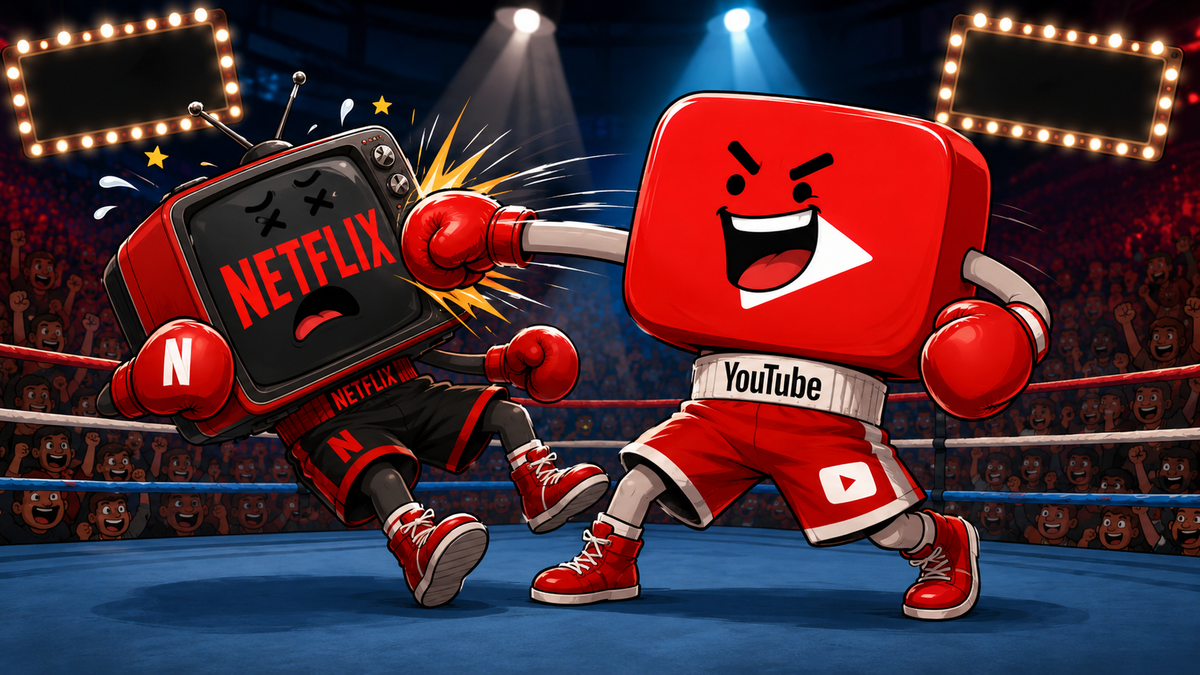
OpenAI Moves Fast and Breaks ChatGPT
The GPT-5 roll-out backlash is a product story as old as time…
SpyglassM.G. Siegler

x.com
0
0
0
0
Open post
Spyglass @mg@spyglass.org
· 3mo ago

OpenAI is not building a phone. Amazon is not building a phone. And now SpaceX is not building a phone. Are you sensing a trend?

The trend is that basically the entire tech industry is rumored to once again be building their own smartphones. But they're all denying it. But all of the denials sound misdirecting at best and misleading at worst. Because of course they should be building such a device. As should Meta (again). And Microsoft (again). And everyone else who aims to control their own destiny. Because right now, Apple, and to a lesser extent, Google, does. And that's going to continue, perhaps well into the Age of AI.1

So the argument is really one of semantics. OpenAI isn't building a phone, they're building... something else. Amazon isn't building a phone, they're building... something else. SpaceX isn't building a phone...

This post is for subscribers only

Become a member to get access to all content

Subscribe now
spyglass.org
0
0
0
0
Open post
Spyglass @mg@spyglass.org
· 2mo ago

As someone who has been writing daily – both professionally and for pleasure – for the past quarter century or so, I'm always trying to dial in the perfect routine. Not writing at all, while obviously the easiest, is also the worst. But writing too much, in my experience, can also be bad. Your brain gets fried and the output suffers – it's not fulfilling for you, the writer, or your audience (if you have one – or hope to keep one).

Anyway, while the Ernest Hemingway method was famously to write first thing in the morning, often around 500 words (which was the inspiration for an old site of mine), and quit while there was still fuel in the tank and then go about his day, I've personally found my natural inclination is to write more words – and more often. So of course when I saw an encapsulation of Ian Fleming's days making the rounds on @elizabethklinck@www.threads.com, it resonated.1

To be clear, the image below is a simple schedule recreated from an interview the James Bond author gave to Playboy in 1964.2 I don't know why it's going around again this week other than it's summer time and it's awesome.

It's just about 5pm here,3 I'm just out of the pool, you know what that means...


1 And, of course, the whole "spy" motif as part of the inspiration for this very site. ↩

2 Other accounts of his writing routine and schedule vary slightly. ↩

3 Though I'm in Italy at the moment, not Jamaica (as Fleming often was at his estate, "Goldeneye"), which honestly feels even more like Bond. And, in fact, the opening of the mostly unfortunate Quantum of Solace was filmed right near where I am at the moment [via Daring Fireball]... ↩

x.com
0
0
0
0
Open post
Spyglass @mg@spyglass.org
· 2mo ago
How a bungled email from Apple’s lawyer soured talks with OpenAI months before Apple sued
A lawyer for Apple apologized for mixing up two OpenAI employees with the names Wang and Chang.
NBC NewsDavid Ingram

Email. Why did it have to be email?

The bane of our existence is also the bane of Apple's and OpenAI's. I'm not saying what seems to be a mix-up conveyed across the protocol would have stopped the lawsuit between the two, but were the sides actually able to connect in a civil and more humane manner – like, say, over the phone – it may have de-escalated tensions before they reached a boiling point.

An unrequited message from Apple to OpenAI is framed as a kicking off point for the whole situation in Apple's own filing. Obviously, it's meant to showcase an effort of good faith on Apple's part to resolve the matter. But it was curious that Apple said that OpenAI never responded. I focused in on this as odd in my post on the topic a couple days ago:

As for timing, it would seem sort of wild that Apple knew about Liu having some level of access to what they viewed as their information in February 2026 (a couple weeks after his departure to start at OpenAI) but didn't bring about this lawsuit until nearly six months later. While they note that they reached out to OpenAI about a potential issue (and never heard back), it's not clear who at OpenAI they reached out to (nor is it clear who at Apple reached out). Was it simply to Liu himself or someone else? Was it a low-level "heads up" ping between IT departments or something that was elevated much higher? This may remain unclear until/if there's actual discovery.

Well, now it's more clear who reached out to whom between the two thanks to reporting by David Ingram for NBC News:

Apple alleged in a lawsuit last week that OpenAI “never responded” to its concerns this year about what Apple believed was trade secret theft. But emails reviewed by NBC News show that’s not the full story: OpenAI did respond in February to Apple’s initial outreach. The communications became bogged down and, according to OpenAI, abruptly stopped after an outside attorney representing Apple mixed up the names and email addresses of two OpenAI employees who had the last names Wang and Chang.

All that is to say, Apple's email did find OpenAI well!

Well, not well. Because the note (from Apple's outside counsel) clearly led to a back-and-forth that ultimately pissed off both sides. To be fair, that's pretty standard for email – especially between lawyers. And yes, this all seems a bit silly. But clearly someone – obviously likely OpenAI – sent the emails to NBC in an attempt to show that Apple is being disingenuous at best in their accusations. And setting the stage that they're perhaps even lying about at least one element!

It is weird that Apple explicitly notes in their lawsuit that OpenAI did not respond to that February outreach when they clearly did. But I imagine Apple would argue semantics here, that OpenAI perhaps never responded to the actual issue: the Apple access/information/property that the former Apple/current OpenAI employee, Chang Liu, had. (Aside: I'm confused by the notion that Apple is said to have mixed up the last names of the employees, when Chang is the first name of a central figure here? Are there other employees here or is that itself a mix up?)

Will OpenAI try to argue that Apple was simply asking about the wrong person so they had no obligation to look into it? Clearly there was a back-and-forth that led to Apple's outside counsel apologizing for mixing up the names. But did OpenAI really use that as pretense to simply stop any communication on the topic?

To add another wrinkle to this, OpenAI has now elaborated on their initial, comically simple comment on the matter that, "We have no interest in other companies' trade secrets." (Um, of course they ave interest! That doesn't mean they want to steal them, but suggesting they're not interesting is funny.) The new statement, given to Bloomberg has a bit more meat on the bone:

"While we take these allegations seriously, we’re not aware of any evidence that this complaint has merit. We believe in fair competition and allowing people the freedom to work wherever they choose, and we’re focused on building innovative technology that empowers people everywhere."

There's a lot going on there in such a short statement. "We're not aware of any evidence that this complaint has merit" is just the sort of semantics gymnastics you would expect from a statement actually cleared by lawyers. That's not to say there's not any evidence, they're simply not aware of it, you see. And the evidence they're talking about is not necessarily about the alleged crime itself, but rather for the complaint. All technicalities, of course, but all undoubtedly framed that way on purpose.

The bit about the "freedom to work wherever they choose" is all about framing this as Apple trying to stifle the free movement of people between companies – a problematic practice that the company has a long, contentious history with.1 As I wrote in my post, this will be a key point because both companies are based in California.

Speaking of, the sheer number of people who have moved from Apple to OpenAI would seemingly help make Apple's case here. Would a jury buy that so many people leaving from one company to another wasn't a coordinated effort? That itself wouldn't be illegal – thanks California for no non-competes/non-solicitation rules – but how/why those people came over with regard to IP and trade secrets would obviously be at play here. I mean, that's more or less the entire case!

OpenAI is likely to frame this as Apple simply being pissed off about the AI startup poaching so many of their employees – 400+! – though given the evidence Apple seemingly has against at least Liu, I'm not sure how well that will actually hold up. But perhaps the argument is used to help the other defendant, Tang Tan?

Anyway, yes, email will be front and center to all of this. Not just the back-and-forth between lawyers, but it will obviously be key if the case progresses to the point of discovery. Apple already divulged they have some potentially problematic emails from Tan and others. We're undoubtedly going to get a lot more – on both sides!

Let this be a lesson to us all: never email.


1 I actually had a scoop back in 2009 that Apple and Google had agreed not to poach each others workers, something they had settle with the DoJ over (and agree no longer to do), alongside four other companies, back in 2010. ↩

0
0
0
0
Open post
Spyglass @mg@spyglass.org
· 1mo ago
Meta's Poke on the Wrist

🔗 Meta to Pay Up to $17.1 Billion in Landmark Settlement Over Social Media Addiction Claims • NYT

On one level, it's just math. $17.1 billion is less than $200 billion (the amount the states were seeking in damages). And certainly less than $1.4 trillion (the amount Meta claimed they could be on the hook for if they lost such a case – which happens to also be roughly their current market cap). Meta generates $17.1 billion in revenue every 26 days or so. Yes, Meta makes more money in a month than these settlement damages.

Also, those damages will be paid out over a decade. Also, also, they may not even be $17.1 billion, but instead more like $12 billion unless TikTok and YouTube also agree to similar settlements including damages and product changes! Oh and need I mention that Meta's market cap jumped about $50 billion on the news of the settlement?1

So yeah, this is one of those losses that seems like a win.

Yes, yes, technically it wasn't a loss at all, just a settlement without admitting any wrongdoing. But come on. Unlike the (pointless) antitrust case against Meta, which they rode through to the (easy) victory in the end, the company clearly read the writing on the Facebook Wall here. Money aside, optically, this was doing yet more damage to Meta's brand and reputation. Every story every day was equating their products to the new tobacco. And Mark Zuckerberg was about to have to take the stand. The media frenzy would have turned into Shark Week, with Zuck as the chum.

Oh would you look at that, a new trailer for The Social Reckoning just dropped. What an inconvenient coincidence!

So yeah, the settlement was a no-brainer. To the point where I'm honestly shocked the states agreed to it. Yes, $17 billion seems like a massive headline amount of money, and the payouts to each state ranging from hundreds of millions to billions (depending on population) will be meaningful to their budgets. But it's simply not a meaningful amount of money to Meta.

Far more interesting are the product changes that Meta is promising alongside the settlement. "Night Mode" and "School Mode" implemented at a service-level sound fine on paper, but in practice, are they actually going to work? A big part of the abbreviated trial was all about how such tools don't really work. Yes, the default positions will help, but how hard will it be for little Timmy to ask a parent to click this thing for them while they're busy on a million other things?2

Even more interesting is Meta's jiu-jitsu maneuver to turn this whole thing against their main rivals. The states will all now obviously be heavily incentivized to go after each of them to maximize their payouts. Meanwhile, Meta gets to frame themselves as the leader in teen safety here. As Casey Newton writes in Platformer:

Whether American teenagers should be harassed after 10 p.m. by engagement-baiting push notifications ought to be a matter for Congress, not the social media cartel. But with characteristic gall, Meta is seeking to position its game of prisoner’s dilemma with YouTube and TikTok as moral leadership.

The wolves are leading the call to stop other animals from attacking the henhouse! With an "open letter" running in national newspapers! This is some real Don Draper-level shit. Anthropic, eat your heart out.3

Naturally, such moral leadership only applies to the US, it seems.

So Meta can get back to work with the money printer largely intact. And this matters as that money needs to flow directly into their AI buildout. And potential damages aside, had Meta lost this case, it would have undoubtedly further spooked investors away from helping Meta to fund that buildout.

Yet risks remain, as Jyoti Mann and Aaron Holmes of The Information point out:

But unlike the big tobacco settlement, which effectively shielded firms from most future lawsuits by states and individuals, Wednesday’s agreement doesn’t resolve the thousands of open lawsuits brought against Meta by consumers, school districts and other parties. Also unlike individual lawsuits against tobacco firms, which didn’t ultimately succeed, individual lawsuits against Meta have already resulted in verdicts that found Meta liable.

At the same time, it also doesn't set any sort of precedent for other cases. That's certainly another reason to settle (if you think there's even a chance you're going to lose). As is this from the same piece:

However, the agreement includes a provision that it shouldn’t be cited against the company in other cases, noted Eric Goldman, associate dean for research and professor of law at Santa Clara University School of Law. That avoids giving plaintiffs in Meta’s other lawsuits a straightforward argument that the company has already acknowledged the allegations against it.

And so Meta walks away with what looks like a poke on the wrist. For now...

Not exactly the same, but some parallels here pic.twitter.com/5YGWHexCuw

— Arpit Gupta (@arpitrage) August 26, 2026
👇
Previously, on Spyglass...
Big Techbacco
The growing risk that these companies are viewed as a cancer…
SpyglassM.G. Siegler
The Meta Points of Meta’s Trial
The FTC’s weak case collides with Meta’s miscalculations…
SpyglassM.G. Siegler

Judge Rules FTC Wasted Everyone’s Time with Meta Case
Highlighting how Big Tech antitrust is broken in our current era…
SpyglassM.G. Siegler
1 Though yes, it came back down after a down day for the market – but still ended the day up $15B. Pretty close to the settlement amount! ↩


2 To the US-only point, how much do you want to bet that there will be some VPN workaround? Too complicted for kids? Come on. What about changing the time on the device? You laugh now... ↩

3 But really, how long until the AI companies use a similar playbook? ↩

x.com
0
0
0
0
Open post
Spyglass @mg@spyglass.org
· 1mo ago
So Much For the 'PervPods'

🔗 Camera AirPods Code Reveals Image Capture Resolution, Status Light, Person Detection, and More • MacRumors

As if a leaked video of the AirPods with Cameras – which I wish they'd call 'EyePods' but I'm guessing they're going to call 'AirPods Pro 4 with Visual Intelligence' – wasn't enough, some leaked code also within the release candidate of macOS Tahoe 26.7 now seems to give away a few more intriguing details about the device. Namely, how the cameras may actually work.

And actually, this leak could be somewhat useful to Apple because the last one – again, the video of them in action – had people concerned that Apple was about to release some surveillance tech for the masses. Which is a nicer way of saying "PervPods", as the internet has so wonderfully coined.

Apple, of course, prides themselves on their reputation with regard to user trust and security. Two traits which Meta, Apple's would-be main competitor in the nascent AI wearable space, decidedly lacks. Was Apple really going to risk throwing away such trust to put some cameras on your ears? This latest leak points to how Apple is clearly trying to get around this issue. As discovered by MacRumors forum member mactracker and summarized by Tim Hardwick, a few key bits:

AirPods support periodic image capture but not video: The cameras take internal still frames for Visual Intelligence to process, rather than "taking pictures" or recording video. In "active" mode, the framework can request a synced pair of images, or it can receive a capture rate, where pairs of stills are continually sent at the specified rate.

I repeat: no video. In my column last week I suspected exactly this scenario. While Apple will downplay the "picture taking" capabilities of such a device, the reality is that they have to capture some sort of image to make their systems work. But video seems a bridge too far, at least for now.

Active and passive capture modes use different resolutions: In "active" mode, likely triggered by the user via Siri, the AirPods capture a 640x640 image and return a processed 1024x1024 image. "That's about 0.4 megapixels of sampled image data, and a little over 1 megapixel for the output frame," mactracker explains. In "passive" mode, they capture a 320x320 image that can return a 320×320 or 512×512 output. "These are capture-specific resolutions, and the physical sensor's native resolution may be larger," adds mactracker.

640x640 is a comically small, low-resolution image. Technically, it's 0.41 megapixels. For comparison, the main camera on the iPhone 17 Pro is 48 megapixels. That's a full two orders of magnitude. Yes, the processing pushes that image to just over one megapixel – a threshold that was state of the art in... 1991.

Interestingly, the "passive" mode cuts such small resolutions in half. Now we're talking early web graphics sizes for images. The kind of images that wouldn't completely clog a 14.4 baud dial-up modem.

In other words, if people intend to use these AirPods as surveillance tech, it's going to be pretty shitty surveillance tech. There are literal kids toys that will take far better images. A Fisher-Price spy cam would do an infinitely better job.

Some processing happens directly on AirPods: The code mentions "peripheral inference," or on-device detection of whether a person is in view.

If true, given the sheer literal size of the AirPods, this would be insanely impressive. But again, those image sizes help! And this will certainly help that privacy narrative if you don't have to send all of those images – even if their comically low resolution state – to your iPhone. Or worse, the cloud.

Each AirPod likely has a capture indicator light: The framework contains code that allows it to remotely control a hardware indicator and its brightness, suggesting the AirPods have a light to let other people know when they are capturing still images.

Yeah, I also assumed this would be the case, as it's sort of the bare-minimum privacy norm if you have any sort of capture capabilities on a wearable. And this points directly to an issue Apple still could have here...

While they'll downplay any talk of "capture" and certainly not frame these as "cameras", the reality remains that – assuming the above capabilities ship – both categorizations are technically true. Apple can and will talk up the low-resolution and on-device work, but some people will still just hear and see wearable cameras here. And while I suspect that society will eventually grow numb to such tech, just as we have with cameras capturing/recording most things thanks to our phones, it's going to take some time.1

In that regard, perhaps it's good that these newfangled AirPods were apparently delayed until 2027 (despite the leak). Apple can let Meta keep taking the early backlash as the industry still grapples with 'Glasshole' scars.

👇
Previously, on Spyglass...
Apple Versus the Glassholes
Leveraging AirPods as their first true AI wearable should help ease Apple into a tricky market…
SpyglassM.G. Siegler
I Am the Great Glassholio!
Things are going well for Ray-Ban Metas... time to meddle!
SpyglassM.G. Siegler
EyePods
AirPods with cameras aren’t to take pictures, but to let Siri “see”…
SpyglassM.G. Siegler

1 With the AI element of all this just further exaccerbating the issues... ↩

macrumors.com
0
0
0
0
Open post
Spyglass @mg@spyglass.org
· 2mo ago

Everyone remembers Steve Jobs’ 'Thoughts on Flash' open letter, written in 2010, because it absolutely eviscerated Adobe and effectively started the long, slow death of one of their key technologies at the time. But a few years before that, Steve Jobs had other “thoughts” — on music, and digital rights management specifically.

The result of 'Thoughts on Music' was a much faster outcome.1 Within two years, DRM vanished from iTunes and the industry at large. It was a masterstroke by Jobs with Apple facing growing pressure — especially in Europe (sound familiar?) – to open up iTunes and cede control over the industry. But with his essay, Jobs shifted the blame and focus to the record labels (many of which were European-controlled!), knowing it was unlikely to dent the all-important (at the time) iPod sales.

Anyway, this is the framing that pops into my head when thinking about the open letter from many of the biggest players in tech calling for 'open weight' models to underpin America’s AI leadership. The situation is far different — obviously, given the geopolitics at play here if nothing else — but this feels a bit like the same type of rallying cry that’s going to be hard for the industry to ignore.

And unlike with DRM, this isn't just one leader of one powerful company calling for change, it's nearly all of them.

In fact, two of the three big players in AI that weren’t initial signatories, OpenAI and Google, almost instantly got on board once they saw the weight behind this movement. Both would point to the fact that they offer “open” models already — in fact, they’re both pointing to that very fact. Still, it’s impossible to ignore their initial absence. Either the other players kept them out of the loop to send a message, or they kept themselves out of the loop to try to avoid the outcome.

There are a few other elephants that seem impossible to ignore in this particular waiting room — notably, Amazon — but the big one is obviously Anthropic.2

While it’s easy to see everyone just getting in line and saying, “yeah of course the US should be leading in open models”, it’s hard to see Anthropic saying the same. Because from Dario Amodei on down, they’ve railed against the notion in the past.

Why? Security, of course.

Critics will say it’s a fig leaf to cover their obvious conflict as the de-facto leader in closed AI models at the moment.3 But it’s still a pretty decent sized fig leaf! Each day seemingly brings new major security risks uncovered (or created) by AI.

Of course, others would use the “offense is the best defense” argument here and they might be right too, if for nothing else than it feels like this genie may already be out of this bottle. So perhaps that’s the notion that causes Anthropic to bend here, if they do. But they’re undoubtedly going to hold out as long as they can.

And they now find themselves with an unlikely ally in this regard: the US government!

Yes, their old nemesis is now the one that seems most aligned with locking down the models rather than going the other way. They have their own reasons, of course. Security is still one of them, but geopolitics and negotiating leverage loom large as well.

Everyone is conflicted here. NVIDIA has been leading the US open weight charge of late because they obviously don't want one (or two) model(s) to rule them all and gain the leverage they now enjoy over the industry. Jensen Huang also undoubtedly believes the "open" route will help remove at least some of the political pressure on their hardware. Is this the path to fully unlocking the Chinese market? Probably not, but if the US fully locks down models, NVIDIA is unlikely to ever grow their business there. (It is worth pointing out that NVIDIA is not open sourcing CUDA, even though that’s exactly what Alibaba is doing in China with their would-be competitor in AI chip software.)

Microsoft now seems all-in on the idea of being a “Switzerland” for models, and Satya Nadella clearly doesn’t want to see OpenAI and Anthropic simply run away with the market — which is more than mildly awkward given the ownership stake Microsoft has in each! I mean, they still own around 25% of OpenAI!

Speaking of awkward, how weird is it that no sooner does Meta spend hundreds of billions of dollars to shift their focus away from open weight models, do such models become ground zero for this debate? They’re signed on to this letter, but their actual actions are mainly in the closed camp for now. Was this another big mistake for Meta?

Perhaps a key thing worth pointing out: the letter doesn’t suggest open weights is the only path forward, simply that the US shouldn’t ban them or even just dissuade the building and use of them. In this world, the closed models still have their place, but the question left unanswered is what that place is relative to the open models and vice versa.

In some ways, this has been the debate in AI from the get-go. Again, Meta bet on open before they switched to closed. Alibaba did the same in China, before they just shifted back to open in light of President Xi Jinping’s recent outlining of China’s stance. That stance is obviously that stance because they’re not at the forefront of the frontier at the moment, otherwise it would probably be a very different stance!

So yeah, conflicts all around. Still, the shift towards "open" has a groundswell, at least right now. But the main reason seems decidedly capitalist: cost.

The price of frontier AI keeps growing more untenable — both to use and to build, as Google can attest this week with the hit to their stock price on the news of yet another jack up in CapEx. Meanwhile, everyone from the biggest enterprises like Microsoft to the smallest startups are feeling the token burn. If someone can come up with the “good enough” open model… unfortunately, it seems like it was a Chinese company, Moonshot, that just did it with Kimi K3.

But even that is not so straightforward! Because these models are only open weight and not fully open source, what exactly goes into making them, and what they’re going to output for certain queries is… largely unknown. And potentially problematic! Further, there’s the fundamental question of just how much they relied on distillation from the closed frontier models. And if those go away, you have a real chicken-and-egg problem.

This is all angling towards a world where frontier models remain closed but are perhaps used to distill open variants that are closer to the cutting edge after some set period of time. Yes, this is essentially what OpenAI, Google, and others have been doing, but if it’s more formalized and streamlined, everyone might feel better. Especially if those models can then legally be used to distill others – at least in the US. It would keep some power in the hands of the frontier, while trickling down more flexibility with some regularity.

But who knows, that’s just a guess this week. After one hell of a week of news.

Still, the vibes right now are clear. Everyone seems to be falling in line quickly behind this notion of not only protecting "open" models, but pushing for the US to combat China to take the lead in their build and spread. Well, everyone except Anthropic.4 And their strange bedfellow here, the US government. And that obviously matters – especially when the stakes are higher than, say, DRM.5


1 It's really weird/sad/annoying that Apple no longer hosts these pivotal posts on their site. You'd think they would embrace the history and importance?! ↩

2 Other notable ones missing include Oracle, Intel, Databricks, Snowflake, and yes, Apple. Though none of those, aside from perhaps Apple (thanks to Google), really make their own large models at the moment. To that end, SpaceX/SpaceXAI (and Tesla) also weren't initially included in the list, though Elon Musk quickly voiced his support publicly as well. (As has Marc Benioff, though Salesforce hasn't officially signed on.) ↩

3 The same rationale Apple turns to time and time again, I might point out. ↩

4 And it's still not entirely clear that OpenAI is fully on board with this given that their apparent actions behind the scenes suggest otherwise! ↩

5 Man, does the industry miss Steve Jobs' voice and gravitas right now... ↩

x.com
0
0
0
0
Open post
Spyglass @mg@spyglass.org
· 1mo ago
YouTube and Netflix Head to War

🔗 YouTube Offers Creators Millions to Not Work With Netflix • Bloomberg

YouTube and Netflix have seemed like they were on a slow-motion collision course for years. Now things are speeding up. Here's Lucas Shaw:

YouTube is offering millions of dollars to popular channels if they upload their videos to the site exclusively for a certain period of time, in an effort to halt Netflix's pursuit of its biggest stars, according to people familiar with the conversations.

The payment would come in a couple of different forms. YouTube has discussed directly financing some programs, and it has also offered to allot a portion of major brand deals to creators. Though YouTube hasn’t finalized deals with any creators, it is close an agreement with several partners, said the people, who declined to be identified because the negotiations are sensitive and ongoing.

These are carrots. But there are also sticks:

Creators who do sign deals with Netflix face consequences, YouTube has said, according to the people. YouTube will be less likely to feature them in marketing campaigns or at events if they release videos on Netflix at the same time. YouTube would also exclude those creators from collecting a share of proceeds from some major brand campaigns.

Clearly, Netflix's various efforts to pick-off top YouTube talent to "take them pro' as it were, is pissing off YouTube. A number of other services from Facebook to Twitch to dozens of startups have tried to do this over the years, but these moves might seem to suggest that Netflix is getting some traction here.

Or that YouTube really doesn't want them to.

To me, a few things are going on here. First, YouTube made the jump from the computer to the couch and took over the living room. This clearly freaked out Netflix because not only did they overrun their home turf, they did so, fast. YouTube did something similar to the podcast industry and seemingly singlehandedly took video podcasts from a niche to arguably the most important element of the industry. Spotify, the former leader there – oh, Apple – had to respond, and did by partnering with Netflix. At the same time, both services started ramping their efforts in more "traditional" television like awards shows and yes, sports.

The latter has pretty much every player in tech fighting because it's obviously the most important element – the NFL in particular – when it comes to actual viewership and the all-important appointment – read: live – viewing. And that matters, of course, for ads. The area where YouTube, thanks in no small part to parent Google, dominates. But Netflix has been ramping here fast. And because they have more premium content, it's an easier sell straight from television in many ways.

So yeah, Netflix has been shifting towards YouTube just as YouTube is shifting towards Netflix. But the real prize for both is to be the one main hub for content. What's "UGC" and what's "professional" is blurring, fast. Both want it all because both want to be the UI that unites all content, including from partners.

It's a two-horse race. But lately, YouTube has seemingly been kicking Netflix's ass – I wrote about this just a month ago (with the url slug "netflix-vs-youtube"). Acquiring Warner Bros may have changed that narrative but, well... YouTube's Peacock deal was just salt in the wound.

So again, it's interesting that YouTube feels the need to respond here – with both carrots and sticks. I'm still waiting for Netflix to pull their next rabbit out of their hat – buying IMAX? Universal? Could they make another run at Warner Bros if the Paramount deal collapses under its own weight?

Anyway, killer picture of Neal Mohan here. Who looks like the Terminator. With a target.


Update August 25, 2026: Some further thoughts on where all this is headed in this week's From Afar column...

Begun, the Bundle Wars Have
The battle to control streaming has shifted…
SpyglassM.G. Siegler

👇
Previously, on Spyglass...
Can Netflix Become (More Like) YouTube Faster Than...
YouTube is poised to unify the streaming championship belts…
SpyglassM.G. Siegler
Spotify & Netflix Gun for YouTube’s Eyeballs
The video podcast partnership may portend a bundle…
SpyglassM.G. Siegler
The Grand Netflix Hollywood Unification Theory
Warner Bros/HBO is phase one of Netflix’s bigger play here…
SpyglassM.G. Siegler
YouTube Beats AI to Disrupting Hollywood
‘Backrooms’ and ‘Obsession’ have pried the filmmaking gates open, AI may blow the bloody doors off…
SpyglassM.G. Siegler
Netflix Needs a New Shakeup
Outflanked by YouTube, they need a true focus on engagement…
SpyglassM.G. Siegler
x.com
0
0
0
0
Open post
Spyglass @mg@spyglass.org
· 3mo ago

Happy Muse Spark 1.1 Day to those who celebrate. Which clearly includes Mark Zuckerberg, who is seemingly so giddy about the latest work out of his Superintelligence Lab that he's even tweeting for the first time in years. And just as with the first 'Muse Spark' – still a silly name – model, the early results sounds promising. Still not full-on frontier, but inching closer in certain regards like image generation and perhaps coding and some other agentic workflows.1

Anyway, with "Watermelon" – their true frontier model shot – seemingly still growing on the vine, performance isn't really the key today. I mean, a certain level of performance remains table stakes, but there are two other areas to focus on in today's announcement: charging for the API and the price they're charging.

Zuckerberg sat down with Kurt Wagner for Bloomberg to talk about it:

“Since this is not an open source model, this is I think the first time that we’re doing a real serious API,” Zuckerberg said, referring to the application programming interface used to access Meta’s AI. “And the pricing is going to be very aggressive and attractive.”

We've been over Meta's shift from open source – many times – so I won't belabor it, but it is wild just how casually Zuck has shoved it aside given his rhetoric over the past few years. But hey, good leaders know when they need to change direction, even if it's a 180 and makes previous statements seem a bit silly. Far more interesting is the fact that they're charging for the API and again, the pricing.

To the first point, despite endless efforts to diversify their business over many years, Meta's revenue remains completely dominated by advertising. To the tune of something like 98%. As I've noted before, it's a great problem to have – but it's still a problem. And you can tell Meta knows this not only by all the efforts over the years to branch outside ads, but just the efforts in recent weeks to move to sell premium subscriptions (many of which are tied directly to AI usage) and the rumored (but obvious) move to launch a Cloud offering.

This API would be a part of that Cloud offering, so consider it a first step. And it's an important one because Meta is obviously coming very late to this game. So how do you enter such a crowded field? Price:

Meta will also introduce a new Meta Model API system, which will be used to collect fees from developers. Its API pricing is roughly 25% of the cost advertised by other top models from OpenAI and Anthropic PBC. Developers will be able to use Meta’s model for free, but only up to a point; they’ll be required to pay for access after reaching a certain token threshold, Zuckerberg said.

“The pricing from some of the other labs is very extreme and has very high margins,” Zuckerberg said, underscoring that his strategy is to get Meta’s technology in front of as many people as possible. “We think that there’s a real ability to be able to offer frontier or very high-level intelligence at a much more affordable cost.”

Yes, this is Zuck's "your margin is my opportunity" moment, echoing the old famous Jeff Bezos quote.

Now, I assume the AI rivals would all say that they're not being overly aggressive on margin and that the cost is simply what they think can get them to some level of sustainability. Of course, while Anthropic may or may not be close to such a level, OpenAI famously is not. That's why they're raising $122B venture rounds. Mind-boggling numbers which, by the way, still won't be enough to take them to that sustainable level without some major tweaks to their model and/or spend. And Meta just made that a lot harder today.

In a way, it's more like "your lack of an underlying business to support your AI build out is my opportunity". Because, yes, Meta's ads cash machine allows them to execute such a strategy. OpenAI also supposedly wants to drastically cut prices to eat up market share, but again, how are they going to pay for that?

At the same time, Wall Street would also like to know how Meta is going to pay for this. Because as great as the ads business is, at the end of the day, the amount being spent on the AI build out is going to eat into their profits and then some. That's undoubtedly part of the reason why Zuck is throwing them the 'Meta Cloud' bone.

Also, it helps to have full founder control and voting shares and you can more or less tell Wall Street to Zuck off.

But actually, Zuck is also making the case in this interview for why he feels like Meta had to (re)build their own frontier models:

“If you really want to build the best experiences for people, you have to be able to shape the underlying technology,” the Meta CEO said. Controlling the technology is going to let Meta “deliver exactly what we think is going to be the best experience.”

Fair enough, though Apple would argue they're building the exact best experience they want by paying Google to distill their models. So couldn't Meta just have done that or something similar?

Zuckerberg is not convinced that the technology will ultimately become a commodity — that is, that all of the various AI models will essentially do the same thing and be more or less indiscernible from one another. He pointed to Mythos, the latest model from Anthropic, which raised national security concerns in the US, as an example of how companies are already gatekeeping aspects of the technology instead of sharing it widely.

“The capabilities are not actually getting diffused or made broadly available to everyone,” Zuckerberg said. “Anthropic is sort of keeping a model for themselves and releasing a kind of simpler version of a model. And there are all these reasons for why they may or may not be doing it. But that at least does not suggest to me that the world is either heading in, or is guaranteed to head in, a direction where this ends up being something that is widely available.”

In other words, if they relied too much upon someone else's models, Zuck knew they would run into the situation where those models could go away for any number of reasons. While perhaps no one thought it would be the US government who would pull them back, the point stands. Zuck has years of scar tissue from being beholden to Apple (and to a lesser extent, Google) in mobile. He wasn't about to let someone do it to Meta in AI. Costs be damned!

Wall Street should probably appreciate that. But won't. But they will appreciate charging for the API – even if it means undercutting prices – because of what it signals: the potential for a more diversified Meta and one that may yet figure out how to pay for that AI build-out...

One more thing: Of all the juicy Zuck quotes, this must be the most succulent:

“That is a pretty interesting milestone because I think this may be the first time, at least that I can remember, that Meta’s models are better than all of the Google models,” he said.

Ouch! You think this is being passed around Mountain View today?

To throw Meta a bone, here's Muse Spark's version of the above prompt. I tried to do one with smartglasses, but he looked like the Unabomber.
👇
Previously, on Spyglass...
Meta’s Inevitable Cloud
Their need to diversify the business meets the AI build out concerns…
SpyglassM.G. Siegler
Meta’s “Open”-ish New AI Models
Sure feels like the same proprietary playbook everyone else follows…
SpyglassM.G. Siegler
Meta Sets the Table with Table Stakes AI
‘Muse Spark’ sparks the stock, but mainly through imagination…
SpyglassM.G. Siegler

1 That's assuming we can trust the numbers that Meta is putting out there which, after the Llama 4 debacle, we should probably still wait for these to be verified by others. ↩

x.com
0
0
0
0
Open post
Spyglass @mg@spyglass.org
· 1mo ago
The Write Stuff

🔗 Big AI Labs Don’t Get What People Want • Wired

A number of interesting parts in this interview of Tim O’Reilly — including kicking off with the distinction between actual open source and all the current buzz (again) around open weights — but the ending bit about AI and writing stands out:

Steven Levy: When I edit this interview I will boil down our long conversation to a shorter one, but I won’t use AI to do it. And of course, the writing in the introduction will be all mine. It’s actually our policy.

Tim O'Reilly: I think that's a legacy thing that's going to go. My ability to have a thought partner in AI when I'm writing is very powerful.

SL: AI does your writing for you?

TO: No, no. I use it for brainstorming, and sort of just functional writing. When I interview somebody for an hour, I go to AI and say, “Turn it into something I can use.” I don't have the time to write up all those interviews.

I’ve already said (and written) my piece about using AI to write. To quickly summarize: quality aside, I personally don’t see the point because most of what I get out of writing is from the process itself. From thinking to choosing what words to use — and just as importantly, what words not to use. It’s a bit like having a robot run a marathon for you. What’s the point?

But I also say that as someone who loves writing. Many people do not, and so I also think using AI is fine for certain types of low-stakes writing, like many types of email. But if you’re actually putting your name to something more substantive, forget the audience, you’re just sort of cheating yourself.

Anyway, what I really want to remark on here is the idea of using AI to brainstorm. In the past, I may have written this off as well. But actually, with the rise of the very good AI voice technology — namely, GPT-Voice — I actually have found going back and forth with AI quite useful in helping to think through some ideas. And actually, it’s less about the content coming from the AI, it’s just the fact that I'm having a conversation and it’s drawing ideas out of my brain.

I’ve long found that some of my best ideas to write about come out of conversations. And while it’s obviously great to have those with people, people aren’t always immediately available to have a conversation with you. And again, if I’m being honest, it’s less about what the other person is saying and more that the chat is fleshing out my own ideas. In a way, I’m sort of “using” the human on the other end. Why not use an AI for that?

Again, I’ve found it quite interesting these past few weeks. These conversations with AI have spurred some ideas in my brain that I’m not sure I would otherwise have had. And to me, it's the actual speaking that's key to that. Saying things out loud forces your mind into places – at least it does for me.

SL: Aren’t you worried that AI will eventually supplant human writing?

TO: AI is literally a medium, in the same way that written words are a medium, or paint or music is a medium. When I talk to an AI or design art with it, I get something different out of it than you do, in the same way that Michelangelo and Van Gogh got completely different things out of paint. The idea that you can't write with AI will seem as curious as the idea that you can't make a good portrait or landscape with a camera. There will be people who are masters at expressing their ideas by summoning words from LLMs. People used to ride horses. Now, few do. We're in the early days.

I’m honestly not sure if I agree or disagree with this. I think I mainly agree but it’s also still a bit hard to see now. Because so much of what I see as the output still seems to mostly follow the same general patterns. I do expect that will change as models continue to improve, but perhaps I’m just not good at prompting when it comes to producing output that could pass as good writing.

On the flip side, I think the people who view any kind of AI-aided creation as an abomination are sort of silly. AI is a tool. The latest in a string of technological tools which will never end. What people inherently actually don’t like is the way this tool came about — by ingesting much of the internet. That is, words written by humans. Yet, in a way, humanity has done something similar throughout history, from cave painting on down, but this new level of “learning” has been done at a scale that no human can match. And, in fact, without other humans on the receiving end. It feels unnatural because it is unnatural, but that also depends on what your definition of “natural” is.

One more thing: when asked if open source can break the Big AI hold:

I don't predict the future. But I will say the world is proceeding the way that I hoped it would. What if the big frontier models end up like mainframes or supercomputers—aimed at really hard problems, which are not actually the thing that gets diffused throughout society?

Lost in all the aforementioned open weight debates is the notion that the frontier models may end up being overkill on a number of fronts — including, importantly, price and performance. Beyond some of the "open" players catching up on the latter, the real takeaway of this particular era may be the realization that we don’t need the absolute frontier for many tasks. And, in fact, more nimble, tailored models may be better suited for certain – maybe even most? – jobs.

The question there is whether the best of those come from — are distilled from — the frontier. And who gets to distill...

👇
Previously, on Spyglass...
AI Can Reproduce Writing, But Not the Process of Writing
And that’s the most important part…
SpyglassM.G. Siegler
Tasty AI
Is AI “taste” a quixotic task?
SpyglassM.G. Siegler
The First True AI Chatbot
As in, actually chatting. As in, with voice.
SpyglassM.G. Siegler
wired.com
0
0
0
0
Open post
Spyglass @mg@spyglass.org
· 1mo ago
Thoughts On: NVIDIA & Perplexity • Fable’s Stalled Growth

Why might NVIDIA want to buy – sorry, "hackquire" – part of Perplexity? And why might Fable's growth be stalling for Anthropic? Read on for thoughts on...

This post is for subscribers only

Become a member to get access to all content

Subscribe now
spyglass.org
0
0
0
0
Open post
Spyglass @mg@spyglass.org
· 2mo ago

I can now confirm, the pubs were in fact crazy on Saturday night as I watched my Conflicted Cup – aka, the World Cup semifinal between England and Norway (I, of course, live in England but my maternal heritage is full-on Norwegian). It was close, but England pulled it out in the end – an end that occurred shortly before 1am local time, which was especially fun.

Anyway, while there was a sports angle of my usual tech talk with Alex Kantrowitz this month thanks to the VAR situation in said World Cup, for the most part, we stick to tech. Namely, 'The Summer of Super Apps', which ended up being a timely chat since just days later, we got the first such app in the form of OpenAI's updated – but hardly upgraded – version of ChatGPT.

Spoiler alert: it's a mess.

So do we really believe Microsoft will be able to pull this off? I mean, at least they're coming at it from a place where they needed to change their strategy, OpenAI runs a real risk here of ceding the consumer space – the area of AI they've unquestionably dominated to date – potentially to Meta or even Apple! At the same time, OpenAI clearly feels the need to combat Anthropic and so it's hardly surprising that the new ChatGPT looks a lot like the Claude Mac app. Well, it is surprising in that it's sort of a UI nightmare when we're used to OpenAI making actually delightful product experiences, for the most part. Everyone is also chasing the notion, if not exactly the product, of OpenClaw for agentic AI.

Meanwhile, Google, which rather remarkably feels behind again at the moment, still has the biggest surfaces to naturally insert AI (well, more naturally than Meta at least, whose user base will undoubtedly largely reject such insertion). Is it wild to think that Google may turn to Chrome not just to spur Gemini usage (which they've been doing, of course) but to turn it into the "Super App"? Would they dare?! Talk about risk – from both the user base and regulators!

Does 'Bring Your Own AI' come into play in all this? That could be a new can of worms!

Apple, though, does suddenly feel well positioned again. Perhaps best positioned even! Thanks, of course, to the iPhone. It sort of feels like we're going to see a lot of people over the next year transition into a mode where they walk around and talk to Siri – actually talk to her, not yell at her, angry with her previously poor responses. But here OpenAI may have a real opportunity thanks to their focus on superior voice-based AI. You'd think that's an opening for a new product category – or categories – but well, there's a potential new massive hiccup there as of a couple days ago.

Also, don't sleep on "Visual Intelligence".

If it all plays out this way, Apple will obviously feel very good about their CapEx strategy. Which is to say, they'd be positioned well in AI without having spent hundreds of billions of dollars. And it's sort of starting to feel like Microsoft is moving more in this direction too. Or, at least, focusing on finding paths towards cheaper AI – both for themselves and for their user base.

Lastly, stick around for Alex's VAR rant – are we trusting the robots too much and literally taking the fun and majesty out of the game?

0
0
0
0
Open post
Spyglass @mg@spyglass.org
· 1mo ago
Thoughts On: Bill Gates, Doomer • The Mac Mini Morphs

Uh, Bill Gates sounds a lot like... Dario Amodei in writing up his thoughts on where he thinks the world is headed with regard to AI. It's a good essay, worth the read, but it's certainly not going to help the AI perception problems! (And it's also worth wondering why he is weighing in right now...)

Also, the Mac mini lives! But not the version you remember. It has been reborn as Apple's AI PC. Read on for thoughts on...

This post is for subscribers only

Become a member to get access to all content

Subscribe now
spyglass.org
0
0
0
0
Open post
Spyglass @mg@spyglass.org
· 2mo ago
Apple’s M6, M7 and M8 Chips Show How AI Is Reshaping the Company
So maybe the Apple Car project wasn't a total crash...
Bloomberg Mark Gurman

While the high-level itself is interesting – that Apple is seemingly doubling and tripling down on the AI aspects of their Apple Silicon efforts – one part of Gurman's newsletter this week stood out:

Apple had been planning major neural-processing upgrades for the M7 family and ultimately decided those improvements were important enough to justify accelerating the next generation rather than completing the M6 lineup. Those changes go into high gear with the M7 Ultra. I’m told the processor dramatically upgrades AI performance, bringing it closer to the class of dedicated AI accelerators such as Nvidia Corp.’s Blackwell.

Uh, is this suggesting that Apple is about to make a chip that's comparable to the chips that are fueling the Age of AI and have turned NVIDIA into the most valuable (and profitable and perhaps important) company in the world? Well, no, not exactly.

If I'm reading Gurman's (too-simplistic) line correctly, I believe it just suggests that the M7 Ultra may have performance that's comparable in some ways with NVIDIA's Blackwell. Which chip? Unclear, there's the B100 and B200 model, as well as other variants like the 'GB 200 Superchip' which is a GPU paired with a 'Grace' CPU. It's undoubtedly not about to touch the actual Blackwell racks that NVIDIA sells – which run from hundreds of thousands to millions of dollars – but still, just matching the chips would be impressive for AI workflows.

Specifically, he also undoubtedly means inference (seemingly hence "accelerators") and not training of AI models, as again, there's almost no way for a "single" chip (even two or more fused together as Apple does with their 'Ultra' models) to match the processing power of what NVIDIA's systems can offer. The power required alone (see also: every headline about data center power consumption) would make this a completely unfair comparison. As would the current state of memory bandwidth between the two types of chips – which stands at about an order of magnitude difference, which also obviously matters for token generation, I might add!

That said, because Apple's chips use unified memory, they actually do have a potential inherent advantage here for running AI models. The problem has been that the amount of memory they utilize is just so much smaller than what NVIDIA's overall systems call to, so it has historically only been good for smaller, local models (see also: Apple's Siri AI hybrid strategy). But if the M7 Ultra is able to jack up available memory to 1.5TB as the story mentions, that could very well compete with a Blackwell when in comes to inference for LLMs.

But even with the current memory crunch issues aside – and those may very well not even be alleviated by the time such a chip is ready – the huge caveat here is that this M7 Ultra chip is slated to launch in 2028. Blackwell is doing all of this in 2026 and it's not like NVIDIA is sitting still. They already have their next generation of chips seemingly ready to roll and then will presumably have a generation after that ready to roll too. Further, the AI labs are also not sitting still and so today's state of the art models are likely to be quite a bit larger in 2028 too...

Anyway, my point is that this almost throwaway sentence sounds insanely impressive – and it would be in many ways – but there's also likely quite a bit of nuance to it.

Still, if Apple is this focused on ramping up AI capabilities for their chips, it is fair to wonder if this won't be yet another huge advantage the company has in the future thanks to Apple Silicon. Again, Apple is clearly already focused on the hybrid approach of doing some AI work on-device while offloading the bigger stuff to the cloud. If they can bring more and more of that work on device...

And that mixed with the current trend of companies balking at the AI compute costs and mixed with the notion that perhaps some of their frontier models are increasingly going to be paired (or distilled) down because they're overkill for a lot of AI workloads... and yeah, Apple could be sitting pretty in a few years.

Perhaps also why NVIDIA is building their own AI PC chips in the form of 'RTX Spark' alongside Microsoft. The battleground changes but the combatants remain the same...

One more thing: the above is obviously all about computer-grade chips, but what about servers?

The chip may also ultimately be the basis of a coming overhaul to the AI server strategy. Apple plans to soon deploy a more powerful server based on the M5 Ultra under the internal code name J246, but engineers are already developing another new server chip for launch by 2029 that is built around the M7 Ultra’s capabilities.

This, of course, points to a world in which Apple doesn't need to rely on Google Cloud (running NVIDIA chips, no less) for that offloaded work. But might it also point to another world in which Apple, like Google and Amazon before them, start selling their chips to others to use? Or what about their own actual 'Apple Cloud' business? Let's not get ahead of ourselves, but everyone is doing it these days...

👇
Previously, on Spyglass...
They’re Building AI PCs, Will Users Come?
Developers will, but at what cost? And can NVIDIA, Microsoft, and Google push Apple aside there?
SpyglassM.G. Siegler
Meta’s Inevitable Cloud
Their need to diversify the business meets the AI build out concerns…
SpyglassM.G. Siegler
The Trillion Dollar Business Staring Apple in the Face
Apple needs a new hit product. Well, needs is relative. They want a new hit product. And Wall Street clearly wants them to have it. The new iPhones are a hit. But eventually Apple needs that new product. Services are doing great, but that’s not a singular sexy product.
SpyglassM.G. Siegler
bloomberg.com
0
0
0
0
Back
313k7r1n3
Elektrine

Tor hidden service

elekhj7afj4qnrr4yd3bkzslsyo5jgfxw3orgjkhlcxifueodybyiiad.onion

I2P eepsite

j6b6cyk6gjmepjih7jjadxgxvvf3lzzujljuu2v4biemzpg3naya.b32.i2p

Platform

  • Email
  • Chat
  • Timeline
  • VPN
  • DNS

Company

  • About
  • Contact
  • FAQ
  • Lite (no JS)

Legal

  • Terms of Service
  • Privacy Policy
  • Transparency Report
  • Report Abuse
  • Warrant Canary
  • VPN Policy

Support

  • support@elektrine.com
  • Report Security Issue
Mail client setup IMAP mail.elektrine.com:993 POP3 mail.elektrine.com:995 SMTP mail.elektrine.com:465
© 2026 Elektrine. All rights reserved. Server: 07:23:31 UTC