Hi! Do you have thoughts on how your feed should be organized 🤔? We are researchers at the University of Washington exploring end user tools for social media feed curation. We're conducting a study to learn more about the factors users take into consideration when evaluating the saliency of content in their personal feeds. This study will take approx. 30–45 mins and you'll receive a $15 gift card for participation. Learn more and sign up here! https://forms.gle/QcmcaP6tcsAmmUX6A
Remote
Kevin Feng
@kjfeng@hci.social
PhD student at the University of Washington. https://kjfeng.me
0 Followers
0 Following
22 Posts
Joined May 11, 2022
Open post
Replying to
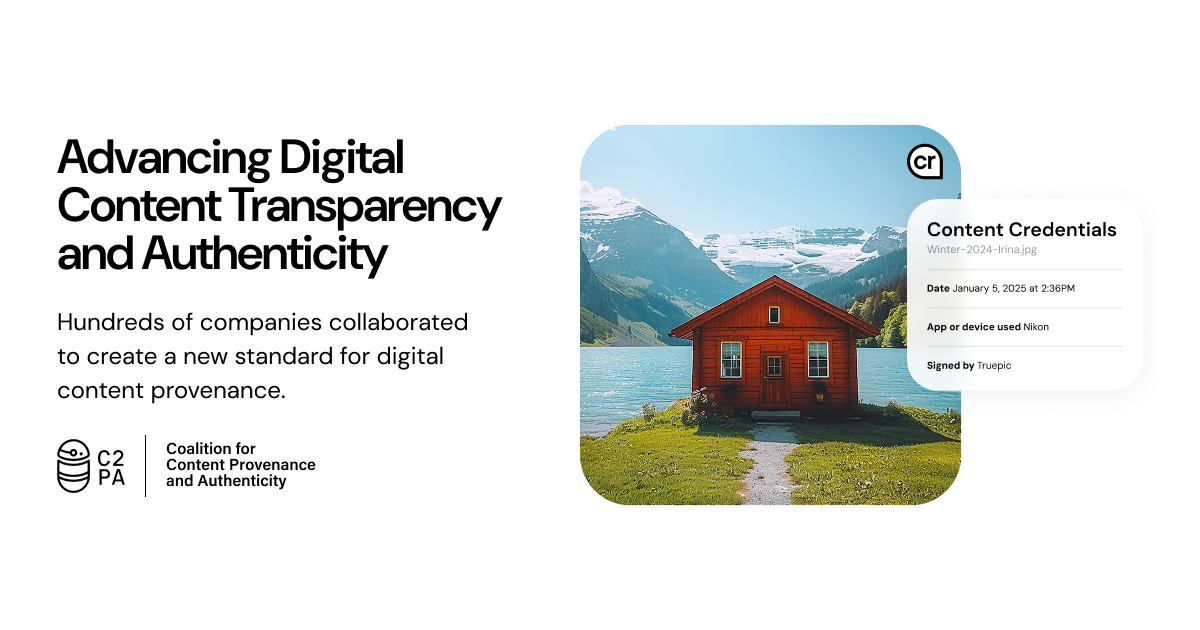
We partnered with folks at the Coalition for Content Provenance and Authenticity (C2PA) and Adobe's Content Authenticity Initiative (CAI) to create "provenance-enabled" prototypes of Twitter-like feeds, simulating UX outlined in the C2PA provenance standard. We then populated these prototypes with diverse content and deployed them to 595 ppl in the US and UK. 2/n
3
1
0
0
Open post
Replying to
We found that exposing users to provenance info lowered trust and perceived accuracy of content that had major visual edits (e.g., composing two images together). In many cases, provenance nudged users closer to what the images and videos originally set out to represent. 3/n
3
5
0
0
Open post
Replying to
In an AI age where media can be created & manipulated seemingly at a snap of a finger, provenance is a promising approach to empowering users to make informed decisions about media online. We're excited by the novel interactions & impact that provenance standards can bring. 7/n
3
1
0
0
Open post
Are you a researcher in CS or a CS-adjacent field who uses planning docs to organize your research? Want to try our new AI agent-powered system for working with research planning docs in a paid user study? Details and sign up here! https://forms.gle/TGzKFaFYs6x7kvSy7
1
0
0
0
Open post
Replying to
@hci@micro.blogs.princeton.edu thanks so much for having me, it was a lot of fun!
1
0
0
0
Open post
Replying to
But—there's a catch. Enabling provenance adds another dimension of credibility: how valid is the actual provenance info? We tested different states of provenance credibility and found that they had a significant impact on users' credibility ratings of *the content itself*. 4/n
2
1
0
0
Open post
Replying to
For example, a perfectly authentic image can be seen as less credible because someone tampered with its provenance info, making the info invalid w/o affecting the image visually at all. This new method of altering perceptions of an image makes provenance a double-edged sword. 5/n
2
3
0
0
Open post
Replying to
We think it's important to disentangle concepts of media vs. provenance credibility going forward with thoughtful design choices and user education. We also see potential areas of collaboration with the computer vision community to better manage & display provenance info. 6/n
2
2
0
0
Open post
Replying to
@socialfutureslab @Mor Also keep an eye out for our forthcoming paper that dives deeper into many of the ideas I talked about 👀
1
0
0
0
Open post
Replying to
It was a blast to see this work come into fruition with C2PA and Adobe's CAI, and ofc, @axz. Check out the fantastic initiatives that made this work possible:
C2PA: https://c2pa.org/
Adobe's CAI: https://contentauthenticity.org/
8/8
1
0
0
0
Open post
Replying to
We conducted a task-based design study with 27 UX practitioners where they designed a proof-of-concept food classifier app while using Google's Teachable Machine to train, test, and tweak ML models as part of their UX workflows.
Even though the models were super simple and may not end up in a production-ready app, their interactive experimentation with ML was important in 3 key ways: 2/n
0
1
0
0
Open post
Replying to
- Tying ML capabilities and underlying data to user goals. Participants could quickly validate or reject assumptions they had about ML, experience model limitations first-hand, and reason about ML alignment with user needs to identify new design potential. 3/n
0
1
0
0
Open post
Replying to
- Envisioning affordances to enhance user interaction with ML. Participants took inspiration from Teachable Machine to visualize model outputs to users. To increase predictive accuracy, they designed UIs for users to provide higher-quality data + feedback to the model. 4/n
0
1
0
0
Open post
Replying to
- Surfacing ML risks and potential harms. Participants actively engaged in considering ethical issues of using ML for food classification, as well as in user-facing apps more generally. Some concluded that ML was not an ideal solution in this particular design problem. 5/n
0
4
0
0
Open post
Replying to
Zooming out, we found that participants—even those with zero prior ML experience—were able to surface insights that aligned with previously established human-AI interaction guidelines. This is commendable given the relatively short timespan (< 2 hours) of our study. 6/n
0
3
0
0
Open post
Replying to
We also noticed that participants' mental models of ML aligned closely with that of interactive machine teaching. However, IMT aims to help end-users build models. How can similar concepts help reason about ML UX? We introduce research-informed MT as a conceptual guide. 7/n
0
1
0
0
Open post
Replying to
Overall, the benefits of interactively crafting simple ML models alongside UI designs are plenty. We see exciting potential in tools that allow UX practitioners to rapidly create and experiment with ML as a design material right there in their design tools. 8/n
0
1
0
0
Open post
Replying to
As a closing note, this was a fun first project of grad school and my first paper as a sole student author! Very grateful for my advisor David McDonald for showing me the ropes of research and the many engaging discussions throughout. See you all in Sydney! 🇦🇺🦘 9/9
0
0
0
0