Elektrine
Log in Register
Paige Chat Timeline Gallery Friends Email Drive DNS Private DNS Domains VPN Kairo Nerve
Remote

Zeke Hausfather

@hausfath@fediscience.org
mastodon 4.6.9
  • Open on fediscience.org

Climate scientist, IPCC/NCA5 author, temperatures, carbon removal, mitigation/energy systems. Climate research lead at Stripe, also Carbon Brief and Berkeley Earth.

4681 Followers
108 Following
50 Posts
Joined November 10, 2022
Open post
Zeke Hausfather @hausfath@fediscience.org
· 1w ago
Replying to
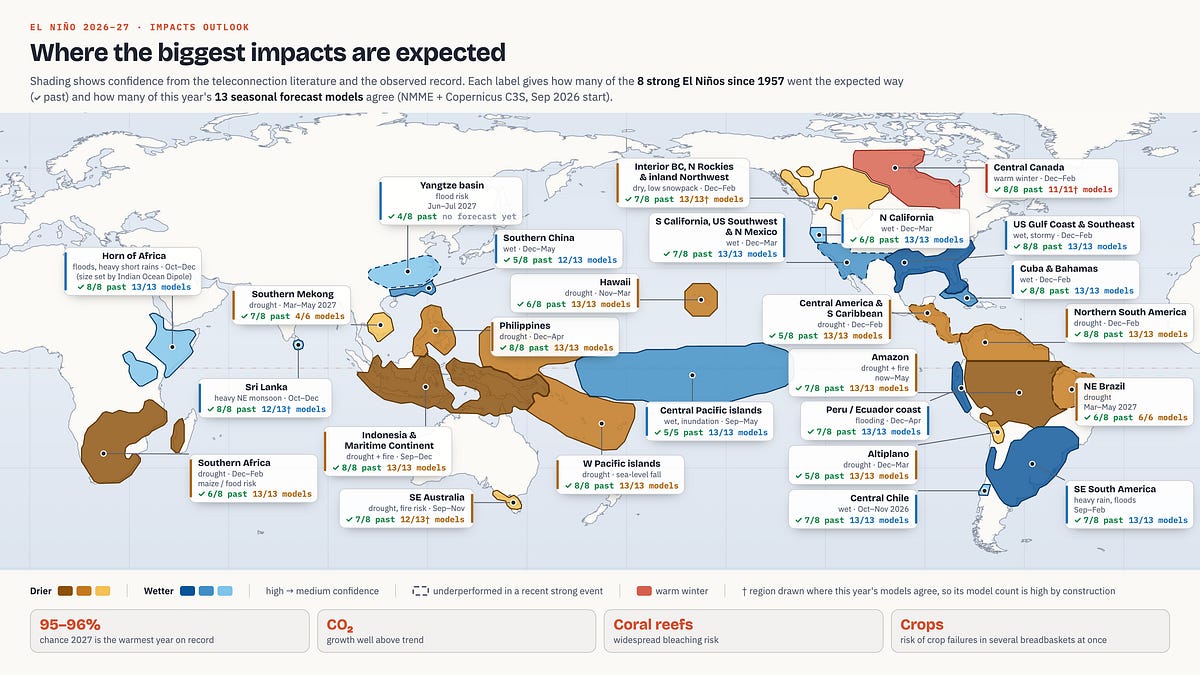
Check out my full analysis of expected impacts of the 2026-27 El Niño over at The Climate Brink: https://www.theclimatebrink.com/p/the-impacts-of-this-years-record
The impacts of this year’s record-shattering El Niño
theclimatebrink.com

The impacts of this year’s record-shattering El Niño

El Niño will drive severe drought from Indonesia to the Southern Africa and northern South America, with wetter winters from the US Gulf Coast to Southern South America.

10
2
14
0
Open post
Zeke Hausfather @hausfath@fediscience.org
· 1w ago
Replying to
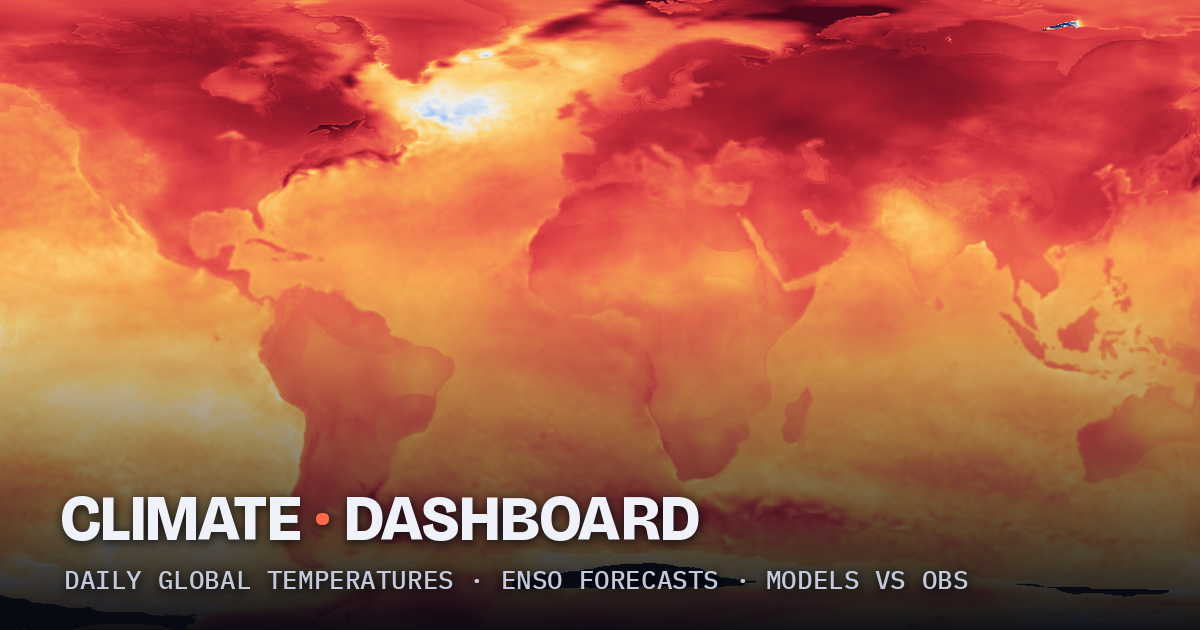
Additionally, I've added a fully interactive version of these maps to my Climate Dashboard, where you can see the up-to-date predictions from different models as well as explore impacts during past strong events El Niño events: https://dashboard.theclimatebrink.com/#impacts
Climate Dashboard
dashboard.theclimatebrink.com

Climate Dashboard

Daily-updated global temperature tracker: ERA5 daily data, multi-model ENSO forecasts, annual projections, and climate models vs. observations.

10
2
7
0
Open post
Zeke Hausfather @hausfath@fediscience.org
· 1w ago
Replying to
Europe has some of the weakest teleconnections of any region, with few consistent signals during past El Niño events. Impacts there depend more on the development of the North Atlantic Oscillation, though models lean wet for the UK and central Europe this winter.
9
2
9
0
Open post
Zeke Hausfather @hausfath@fediscience.org
· 1w ago
Replying to
In Africa we expect to see sharp reductions of rainfall in the southern part of the continent, which threatens a maize crop on which tens of millions depend. Around the horn of Africa there is likely to be heavier rains and flooding during the short fall rainy season.
6
3
0
0
Open post
Zeke Hausfather @hausfath@fediscience.org
· 1w ago
Replying to
We expect drought in northern South America, over the Amazon (with corresponding high fire risk), and in Northeastern Brazil. There will be heavy downpours and flooding in Peru and Ecuador, and wetter conditions in Central Chile.
5
5
1
0
Open post
Zeke Hausfather @hausfath@fediscience.org
· 2mo ago
I'm not sure folks have realized just how crazy the second half of 2026 and 2027 will be for global temperatures – on the back of a record-smashing El Niño event. Here is my latest estimate of where both years will end up compared to global temperatures since 1850.
141
10
195
5
Open post
Zeke Hausfather @hausfath@fediscience.org
· 1w ago
Replying to
I looked at three different lines of evidence: the literature on El Niño teleconnections, what occurred during the past 8 strongest events since 1950, and the predictions of this year's event from 13 different dynamical models initialized in September.
4
7
4
0
Open post
Zeke Hausfather @hausfath@fediscience.org
· 1w ago
Replying to
In North America we expect to see wet winters from the Gulf Coast to Cuba. We also will likely have a wetter conditions in the Southwest, particularly in Southern California. Central America is likely to have drought conditions in countries south of Mexico.
4
4
1
0
Open post
Zeke Hausfather @hausfath@fediscience.org
· 2mo ago
The rise in Niño 3.4 region sea surface temperatures over the past few weeks has been nothing short of astonishing. We are now hotter than any days during the 1997/1998 super El Niño event, and we are still many months from the peak.
87
0
121
1
Open post
Zeke Hausfather @hausfath@fediscience.org
· 2w ago
Replying to
So while we think we are heading toward ~3C today, we could really end up at 4C if we role 6s on the proverbial climate dice. Its more useful to treat climate outcomes as a set of risks – the odds of the world warming by 2C, 3C, or 4C over time – rather than a deterministic outcome.
6
1
8
0
Open post
Zeke Hausfather @hausfath@fediscience.org
· 1w ago
Replying to
Many of the most reliable El Niño impacts are clustered around the tropical Pacific. Drought in Indonesia, the Philippines, the western Pacific islands have shown up in essentially every strong event since the 1950s, and this year’s models agree.
2
6
0
0
Open post
Zeke Hausfather @hausfath@fediscience.org
· 2w ago
Replying to
These arise from two factors: carbon cycle feedbacks – how the biosphere and ocean's ability to absorb carbon changes as we emit more and the world warms, and climate sensitivity – how the interplay of feedbacks like water vapor, clouds, snow and ice, etc. respond to warming.
4
1
3
0
Open post
Zeke Hausfather @hausfath@fediscience.org
· 2w ago
Replying to
We hear a lot about central outcomes of climate change. For example, under the new "medium" scenario (e.g. current policies continuing), the world warms around 2.9C by 2100. But these numbers mask some massive uncertainties in how the climate actually responds to our emissions.
3
2
2
0
Open post
Zeke Hausfather @hausfath@fediscience.org
· 2w ago
Boosted by @Dragofix@veganism.social
Replying to
And on the path we are on today those odds are deeply worrying. Its virtually certain we reach 2C by 2100. By 2150 we have a 77% chance of being above 3C, a ~30% chance of being above 4C, and a 6% of >5C warming: https://www.carbonbrief.org/explainer-the-cmip7-emissions-scenarios-and-how-they-explore-future-climate-change
Explainer: The CMIP7 emissions scenarios – and how they explore future climate change - Carbon Brief
Carbon Brief

Explainer: The CMIP7 emissions scenarios – and how they explore future climate change - Carbon Brief

Every few years, climate modelling groups run a coordinated set of simulations that explore climate change in the future. Carbon Brief unpacks how the new scenarios were designed and how they differ.

3
0
6
0
Open post
Zeke Hausfather @hausfath@fediscience.org
· 2mo ago
2026 is on track to be the warmest (~35% chance) or second warmest (~63%) year on record, while 2027 is very likely (92% chance) to be the warmest on record on the back of a growing super El Niño event. For more, check out my new Carbon Brief State of the Climate Q2 update: https://www.carbonbrief.org/state-of-the-climate-rapidly-developing-el-nino-raises-chance-of-record-warm-2026
carbonbrief.org
35
0
47
1
Open post
Zeke Hausfather @hausfath@fediscience.org
· 1mo ago
Replying to
As always, you can treat real-time updates to this El Niño event (and the dynamical models of it) over at the Climate Dashboard: https://dashboard.theclimatebrink.com/#enso
Climate Dashboard
dashboard.theclimatebrink.com

Climate Dashboard

Daily-updated global temperature tracker: ERA5 daily data, multi-model ENSO forecasts, annual projections, and climate models vs. observations.

6
0
8
0
Open post
Zeke Hausfather @hausfath@fediscience.org
· 3mo ago
Replying to
Europe has been warming at a much faster rate than the world as a whole: roughly twice as fast as the global average, and 40% faster than the global land average.
37
6
60
0
Open post
Zeke Hausfather @hausfath@fediscience.org
· 2mo ago
Fires in France have now burned over 91,000 acres, by far the most of any year since the satellite record started in 2006. Current area burned is about 34x larger than this date in a typical (median) year:
13
0
17
0
Open post
Zeke Hausfather @hausfath@fediscience.org
· 2mo ago
Replying to
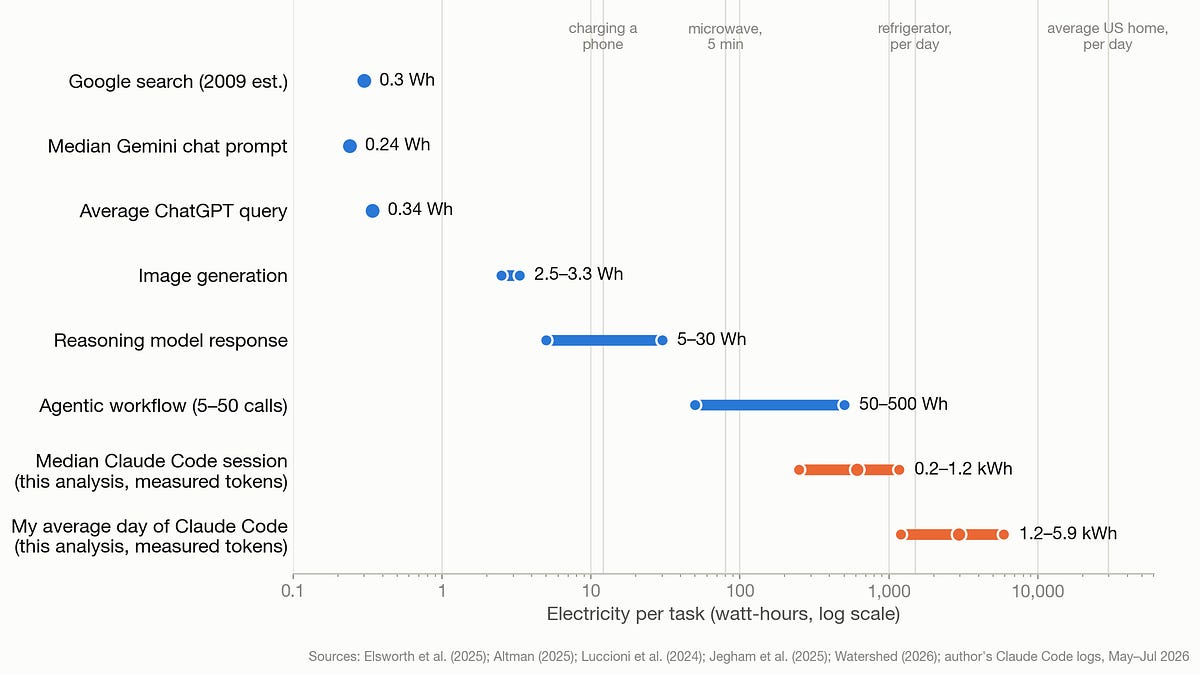
Annualized, my agentic AI energy use is around 1.1 MWh, and is responsible for as much emissions as a clothes dryer or half a round trip flight from SF to NYC. Not enormous compared to my overall footprint, but far from trivial!
7
0
6
0
Open post
Zeke Hausfather @hausfath@fediscience.org
· 2mo ago
Replying to
Check out the full analysis over at The Climate Brink: https://www.theclimatebrink.com/p/the-real-energy-use-of-agentic-ai
The real energy use of agentic AI
theclimatebrink.com

The real energy use of agentic AI

Agents use about 600x more energy than simple AI prompts

6
0
6
0
Open post
Zeke Hausfather @hausfath@fediscience.org
· 2mo ago
Replying to
2027 is now expected to reach 1.7C in my model – exactly where Hansen predicted it would land (albeit in the GISTEMP dataset) back in December 2025:
7
2
5
0
Open post
Zeke Hausfather @hausfath@fediscience.org
· 2mo ago
Replying to
The biggest lever we have is to decarbonize electricity – and push AI companies to invest more heavily in clean energy like solar+storage, advanced nuclear, enhanced geothermal, etc. Using energy isn't inherently bad, its all about the impacts of producing that energy.
5
0
2
0
Open post
Zeke Hausfather @hausfath@fediscience.org
· 2mo ago
I've previously done 2026 and 2027 global temperature estimates for the Earth's surface, but a lot of people also seem interested in what will happen in the lower troposphere (TLT). Historically TLT has had a much bigger response to El Niño and La Niña than we see on the surface:
5
0
4
0
Open post
Zeke Hausfather @hausfath@fediscience.org
· 4mo ago
Replying to
This one was somewhat novel; I can't recall seeing a visualization designed like this before (but let me know if any of you have!).
14
2
12
0
Open post
Zeke Hausfather @hausfath@fediscience.org
· 2mo ago
2026 El Niño models continue their inexorable march upwards. CanSIPS (which used to be among the cooler ones!) released their August runs today, and now show a Nov/Dec peak of 3.6C (CanESM5) and 4.2C (GEM-NEMO). For reference, the prior record El Niño peaked at 2.8C.
5
1
6
1
Open post
Zeke Hausfather @hausfath@fediscience.org
· 3mo ago
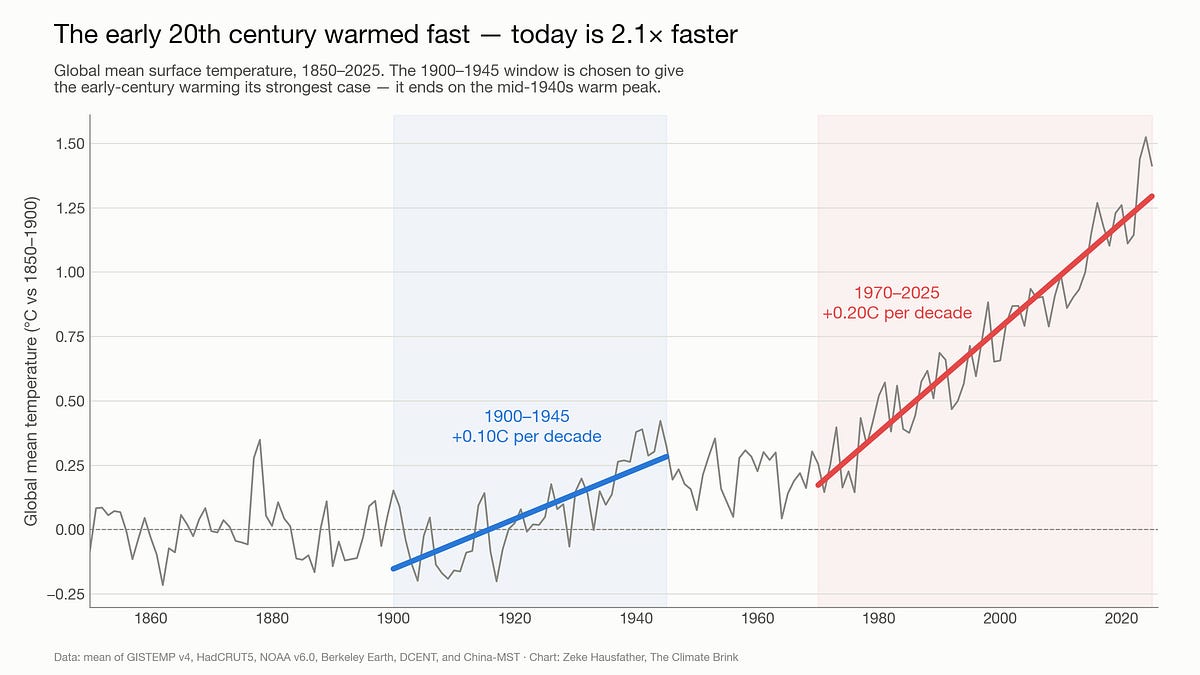
Folks skeptical of human-driven warming like to point to a period of somewhat less rapid warming from 1900-1945. In a new analysis at TCB, I dig into the different factors driving it, and find that humans, natural factors, and variability all played an important role: https://www.theclimatebrink.com/p/what-drove-the-early-20th-century
What drove the early 20th century warming?
theclimatebrink.com

What drove the early 20th century warming?

Human activity, natural forcings, and internal variability explain the global temperature rise between 1900 and 1945

8
1
5
0
Open post
Zeke Hausfather @hausfath@fediscience.org
· 2mo ago
Replying to
The 2026/2027 El Niño event has already grown faster than any prior events (at least on an ONI basis). Here its observed and projected future evolution compared to the strongest prior El Niño events in recorded history.
7
6
6
0
Open post
Zeke Hausfather @hausfath@fediscience.org
· 2mo ago
The Niño 3.4 region of the tropical Pacific has been hovering above 2C for the past week. This is the threshold for a very strong ("super") El Niño event, and it was reached more than a month before the prior record set during 1997/1998:
6
0
10
0
Open post
Zeke Hausfather @hausfath@fediscience.org
· 2mo ago
Replying to
I took a look at my own Claude Code use over the past 8 weeks to calculate agentic energy use. Using three different methods I find that the typical agentic prompt uses 180 watt-hours (45 to 360 Wh). This adds up to around 3 kWh per day, around the energy of running two fridges.
3
0
4
0
Open post
Zeke Hausfather @hausfath@fediscience.org
· 2mo ago
The claim that "pink elephants cannot fly" is not an evidence-based claim because studies have not ruled out the possibility that pink elephants can fly. 🙄
4
0
6
0
Open post
Zeke Hausfather @hausfath@fediscience.org
· 2mo ago
Replying to
Currently 13 out of 14 dynamical models expect a record setting event based on the Niño 3.4 region sea surface temperature anomalies (ONI), with overall odds of a record sitting at 91% across all 667 model ensemble members.
3
4
1
0
Open post
Zeke Hausfather @hausfath@fediscience.org
· 2mo ago
Replying to
Credit where credit is due: my projections have moved increasingly toward Hansen's over time, on the back of what appears increasingly likely to be the strongest El Nino on record later this fall. Year to date temperatures remain less exceptional (third warmest on record).
2
3
2
0
Open post
Zeke Hausfather @hausfath@fediscience.org
· 3mo ago
Replying to on fediscience.org
This warming has been fastest in the winter months – driven in part by greater absorption of sunlight with less winter snow cover – but has been rapid year-round:
4
1
4
0
Open post
Zeke Hausfather @hausfath@fediscience.org
· 2mo ago
Replying to
If we instead look at the new relative oceanic niño index (RONI) that subtracts out warming across the tropical oceans, 11 of 14 models predict a record strong 2026/2027 El Niño event, with odds of a record sitting around 77%.
2
3
0
0
Open post
Zeke Hausfather @hausfath@fediscience.org
· 2mo ago
Replying to
One potential silver lining: net-zero needs ~3x more clean electricity, and the main barriers are permitting, transmission, interconnection, not tech. If AI's capital and urgency fund firm clean power and grids, it could help clean the grid. Behind-the-meter gas, and it won't.
1
0
1
0
Open post
Zeke Hausfather @hausfath@fediscience.org
· 2mo ago
Replying to
The bad news is that usage is more than outpacing increases in efficiency (Jervons Paradox in action!), and AI compute demand is rapidly rising with no end in sight. While we can try and avoid using agents for trivial things, behavior changes will only go so far.
1
0
1
0
Open post
Zeke Hausfather @hausfath@fediscience.org
· 2mo ago
Replying to
So what can we do about it? The good news is that AI chips are getting massively more efficient, with the energy use per unit of intelligence falling in half every two years:
1
0
1
0
Open post
Zeke Hausfather @hausfath@fediscience.org
· 2mo ago
Replying to
I'd still argue that this doesn't tell us all that much about bigger questions like climate sensitivity – its just not really possible use short surface temperature trends to constrain it much. But there are other lines of evidence that do point in that direction.
1
2
0
0
Open post
Zeke Hausfather @hausfath@fediscience.org
· 3mo ago
Replying to
But in summer months, we've seen the hottest summer days warming nearly a degree faster than the monthly average temperatures in Western Europe:
2
1
4
0
Open post
Zeke Hausfather @hausfath@fediscience.org
· 3mo ago
Replying to
If we look at RONI – which differences tropical sea surface temperatures from the ENSO3.4 region temperatures – we see an event reaching 3.3C in December, and are about 0.2C warmer than the June forecasts.
1
0
0
0
Open post
Zeke Hausfather @hausfath@fediscience.org
· 3mo ago
Replying to
This is a pretty generous approach to attributing temperature to solar forcing, as it uses an instantaneous equilibrium response of 0.5 to 1.2C for each w/m^2 increase in forcing (equivalent to a climate sensitivity of 2.0 to 4.7C). Using a proper climate model gives a somewhat smaller response:
1
0
1
0
Back
313k7r1n3
Elektrine

Tor hidden service

elekhj7afj4qnrr4yd3bkzslsyo5jgfxw3orgjkhlcxifueodybyiiad.onion

I2P eepsite

j6b6cyk6gjmepjih7jjadxgxvvf3lzzujljuu2v4biemzpg3naya.b32.i2p

Platform

  • Email
  • Chat
  • Timeline
  • VPN
  • DNS

Company

  • About
  • Contact
  • FAQ
  • Lite (no JS)

Legal

  • Terms of Service
  • Privacy Policy
  • Transparency Report
  • Report Abuse
  • Warrant Canary
  • VPN Policy

Support

  • support@elektrine.com
  • Report Security Issue
Mail client setup IMAP mail.elektrine.com:993 POP3 mail.elektrine.com:995 SMTP mail.elektrine.com:465
© 2026 Elektrine. All rights reserved. Server: 03:00:56 UTC