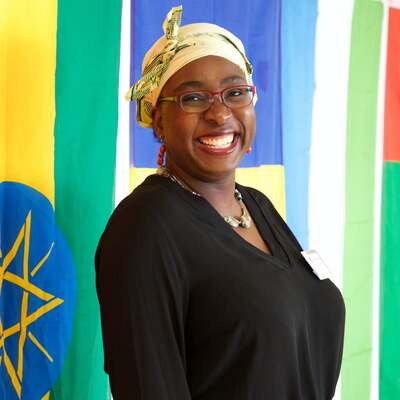
Prof Foluke Adebisi
mastodon 4.7.2African woman, lawyer, teacher, poet. Singer of songs, writer of words.
Decolonisation and the rush to adopt GenAI are driven by fundamentally different logics, means and ends. What happens when a project aimed at reclaiming humanity, time and collective flourishing meets a technology built on extraction, automation and prediction?
https://folukeafrica.com/being-human-once-more-some-reflections-on-decolonisation-and-genai/
I argue here that Black-centred speculative fiction is not just entertainment but a vital method for imagining our way beyond the racial and colonial structures that Euro-modern law struggles to overcome. As such, it should be an integral part of legal education.
https://folukeafrica.com/law-racial-justice-black-centred-sci-fi-imagining-an-antiracist-future/
I finally found a YouTube video that pronounces my name correctly! Try it out. It's only 3 syllables. Did you get it right?
How to pronounce FOLUKE
39 DAYS TO GO!
How do we teach the histories and legacies of race, empire, and colonialism in law? What would legal education look like if race, empire, and colonialism were treated as central rather than peripheral to the study of law? Join us for the launch of the Critical Legal Pedagogies of Race and Empire Network as we explore new approaches to teaching, research, and collaboration.
Register here: https://www.eventbrite.co.uk/e/launching-the-critical-legal-pedagogies-of-race-and-empire-network-tickets-1993600465659?aff=oddtdtcreator
One of the reasons I started writing a blog was to address my deep dissatisfaction with the way Africa is studied or talked about outside the continent, especially. This is mostly marked by absence. But when it is not, most interlocutors ignore the impact of external interference.
https://folukeafrica.com/how-we-study-africa/
A 10-minute review of Soundtrack to a Coup d'état (2024)
This essay explores African history, collective memory, and why Africa's past is central to understanding our shared world. It also includes an African history quiz.
How much do you know about Africa before colonisation? Take the quiz and share your score.
https://folukeafrica.com/african-history-quiz-i-pre-colonial-years/
One thing I want to add to my professional bio is that I probably have the longest titles in academia:
Exhibit A: Black/African science fiction and the quest for racial justice through legal knowledge: How can we unsettle Euro-modern time and temporality in our teaching?
Exhibit B: Seeking the university that is ours: understanding, unpacking and unsettling Black students' racialised (un) belonging in UK law schools
Exhibit C: The Sea Casts Its Net of Justice Wide: A Speculative Judgment for What Has Been Left to the Waters of Despair
There are also a dozen longer ones that publishers adamantly refused to countenance.
I remember a professor who read some of my writing on West Africa was quite shocked to discover that Timbuktu exists...
Sankoré, the famous mediaeval mosque-university at Timbuktu (in present-day Mali), was set up around the twelfth century.
https://folukeafrica.com/timbuktu-site-of-1st-african-university/
30 Days to Go!
In 30 days, we'll be launching the Critical Legal Pedagogies of Race and Empire Network.
How do law schools teach the histories, legacies, and afterlives of race and empire? What innovative approaches are emerging to address colonialism, racialisation, and global inequalities in legal education?
Join us for the launch of a new interdisciplinary network dedicated to conversation, collaboration, resource-sharing, and research-informed teaching on race and empire. The event will bring together academics, students, researchers, and practitioners to explore the future of critical legal education.
14 September 2026
2:00pm-5:00pm (UK time)
The Moot Court, University of Bristol Law School (with online participation available)
Featuring opening and closing keynotes from Professor Foluke Adebisi and Professor Joel Malesela Modiri.
Whether you're already working in this area or just beginning to think about how race, empire, colonialism, and global justice shape legal education, we'd love to have you join us.
Reserve your place: https://www.eventbrite.co.uk/e/launching-the-critical-legal-pedagogies-of-race-and-empire-network-tickets-1993600465659?aff=oddtdtcreator
I argue that we cannot celebrate 60 years of the passing of the Race Relations Act as a win for racial justice because such gains remain fragile, contested and continually threatened. With the incited rise in racial violence, what exactly are we celebrating?
https://folukeafrica.com/what-is-there-to-celebrate-60-years-after-the-passing-of-the-race-relations-act-1965/
Does anyone remember watching this movie? There’s Something Wrong In Paradise (1984) https://nostalgiacentral.com/movies/movies-l-to-z/movies-t/theres-something-wrong-in-paradise-1984/
"'We are all already here, and that answers the question of whether or not we belong.'"
https://www.ted.com/talks/olutimehin_adegbeye_who_belongs_in_a_city
This #blogpost is a reflection on the simple premise of the Critical Legal Pedagogies of Race & Empire Network: we need spaces to think together. To reverse the "colonial disconnect", we need to intentionally build relationships and imagine otherwise worlds.
"We cannot address this crisis if progressive critical thinkers and social critics act as though teaching is not a subject worthy of our regard. The classroom remains the most radical space of possibility in the academy…." – bell hooks
Using the Turkish series Vatanım Sensin as a lens, I explore what it means to love a country and why so much contemporary patriotism seems to depend on fear, exclusion, and the manufacture of enemies. Can you really love a country if you cannot love another person?
https://folukeafrica.com/lessons-on-love-patriotism-and-revolution-from-vatanim-sensin/
I decided to make a video version of my text review of the documentary, "Soundtrack to a Coup d'état".
Soundtrack to a Coup d'Etat is an archival essay film examining the lead-up to the 1960 assassination of Congolese leader Patrice Lumumba and the exploitation of the Congo's resources. Utilising a fast-paced, non-narrative style, the film highlights the intersection of Cold War geopolitics, CIA-backed covert operations, and the role of "Jazz Ambassadors" in the decolonisation era. The film is available to stream via Kanopy.
In my review (link in the comments), I reflect on the key players in Lumumba's assassination, the meanings of modernity and decolonisation, the denial of time and humanity, the politicisation of memory, the disUnited Nations and why we must tell our own stories. The video summarises these points.
https://www.youtube.com/watch?is=iVPHwQ4lKv7XOV6z&v=Lvq1A89uRdA&feature=youtu.be
A 10-minute review of Soundtrack to a Coup d'état (2024)
Resharing this essay in which I reflect on what it means to be labelled an "activist" as an academic, why racialised scholars are often described this way when others are not, and whether the distinction between scholarship and activism can ever be a good-faith one grounded in our scholarly purposes. https://folukeafrica.com/activist-or-academic-or-both-the-quandary-of-scholactivism-for-the-minoritised-in-the-ivory-tower/