Elektrine
Log in Register
Paige Chat Timeline Gallery Friends Email Drive DNS Private DNS Domains VPN Kairo Nerve
Remote

danie10

@danie10@squeet.me
friendica 2026.05-1595
  • Open on squeet.me
521 Followers
25 Following
19 Posts
Open post
danie10 @danie10@squeet.me
· 2mo ago
Replying to
Yep neither are perfect, but Apple is better in regard to processing more data on the device, versus in the cloud like Google does. Google offers more integrations but that in itself makes data accessible too. That said Apple's standard cloud sync does have the keys accessible be Apple, and have been handed over to law enforcement, which they are obliged to do. I had to give up Apple though the second time I tried it as some apps were crippled by Apple, for example, Truecaller cannot manage the phone dialler like on Android, so it was just not able to block the many spam calls i got, and it was driving me mad. Similarly my phone recording apps would not work on Apple. I suppose it boiled down to how Apple locked down some of those features and would not let 3rd party apps access them properly. Even though I had an iPhone and watch, I never used the Apple apps, as they would not work on Linux or elsewhere - it was a lock-in I tried to avoid, and yes, did make it much easier to move off Apple again. That said, Google has also been starting to lock things down like making side-loading apps more difficult, this proprietary API that banking apps tap into. This moves away from what Android was originally about. I really wish we could get proper Linux phones that could run secure banking apps etc. That would be a first prize.
0
0
0
0
Open post
danie10 @danie10@squeet.me
· 2mo ago
Replying to
@p yep I never understand businesses / owners expressing politics as they will always alienate part of their customer base. But yes both apps use open source dictionaries.
0
0
0
0
Open post
danie10 @danie10@squeet.me
· 7mo ago

A vibrant illustration featuring blue glasses and a stylized eye against a bright yellow background, adding a whimsical touch.
“Outdoors, the app works within 32 to 50 feet; indoors in crowds, that drops to 10 to 32 feet — enough range to identify a person wearing smart glasses in your vicinity. Nearby Glasses works by flagging Bluetooth SIG assigned numbers, unique alphanumeric codes identifying devices based on their brand. Assigned numbers are mandatory for devices utilizing Bluetooth, meaning that gear made by companies like Luxottica Group SpA — the firm manufacturing Meta’s Ray-Ban Smart Glasses — is at least somewhat identifiable for anyone who knows where to look.”

So, yes not perfect, as you may get false positives if someone is for example walking around the mall wearing their Oculus Rift headset. But it is interesting to see some pushback happening against Big Tech’s smart glasses. But this early is still in early release, so I imagine it will mature more still.

See futurism.com/robots-and-machin…
#Blog, #privacy, #smartglasses, #technology

gadgeteer.co.za
0
3
0
0
Open post
danie10 @danie10@squeet.me
· 45mo ago

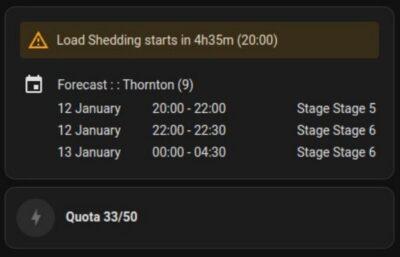
A card displaying the time to next load shedding in hours and minutes, and lists the three upcoming schedules and what stage of load shedding they are, with a start and end time for each one.
Yes I know the EskomSePush mobile apps will give either a 15 minute or 55 minute warning ahead of the scheduled load shedding window for a zone area in South Africa, but sometimes you need a custom time alert eg. 23 minutes, or you want it to announce it over your smart speakers, or to add other conditions.

The now ever-changing load shedding schedule in South Africa has started to make things pretty complicated to plan around. If it was just fixed at say Stage 4 or 5 then we’d all know what we’re doing when (or not doing). But too many cakes are now flopping.

EskomSePush has been rising up as one of the most dependable load schedule apps in South Africa, and they have an API that can be used too. The API is free to use for up to 50 requests per day. The API allows easy integration with something like Home Assistant (or even a Python or other app you want to create).

I’ve tested two integrations, and whilst the first one was a bit more manual, the one linked below is way easier to get going with. Yes, you do still need to get your free API code, but the integration has a wizard that will guide you on the process.

The only thing you then really have to do is to create your dashboard cards. I copied the examples they have on the GitHub project. Note though that one entity is called with ‘cape-town’ in it’s name, and it needs to be ‘capetown’ if you are in the Cape Town area. And the code example uses a Joburg area name, so that also just needs to be changed to what ever your area is. And then you can have fun with it.

I’m just displaying the upcoming schedule with the time to the next load shedding, and have set up an audible alert before load shedding starts, so we can turn the shower hot water on if required. But another option is to even send an alert to a Telegram group, so you can have a lot of neighbours subscribing to your Telegram channel for early warnings. Another idea is to check the duration of the upcoming load shedding slot, and give a different warning for the 4-hour ones. The options are endless!!

See github.com/wernerhp/ha.integra…

You can also see what all I’m doing with my own Home Assistant at github.com/Danie10/gadgeteerza…

#technology #SouthAfrica #loadshedding #EskomSePush #HomeAssistant
#Blog, ##eskomsepush, ##homeassistant, ##loadshedding, ##southafrica, ##technology

gadgeteer.co.za
0
1
0
0
Open post
danie10 @danie10@squeet.me
· 6mo ago

Screenshot of Dangerzone 0.10.0 app interface for selecting or dragging suspicious documents to analyze.
Dangerzone works like this: You give it a document that you don’t know if you can trust (for example, an email attachment). Inside a sandbox, Dangerzone converts the document to a PDF (if it isn’t already one), and then converts the PDF into raw pixel data: a huge list of RGB colour values for each page. Then, Dangerzone takes this pixel data and converts it back into a PDF.

It has been independently audited and apart from the obvious use by journalists and similar professions, even every day users can be most often targeted by attachments that carry payloads of malware. This is exactly how bad actors bypass firewalls, and secure messengers like Signal.

I would not necessarily put every document I receive through this process as it does at least double or triple the size of the file (converts every page to an image). But from anyone you don’t know, this is a useful tool to have ready to use. Everything is processed locally on your machine, and it will install on Linux, Windows, and macOS.

See dangerzone.rocks/category/unca…
#Blog, #opensource, #security, #technology

Dangerzone — An Open Source App To Safely Open Suspect PDFs, Office Docs, Or Images
GadgeteerZA

Dangerzone — An Open Source App To Safely Open Suspect PDFs, Office Docs, Or Images

Dangerzone works like this: You give it a document that you don't know if you can trust (for example, an email attachment). Inside a sandbox, Dangerzone

0
1
0
0
Open post
danie10 @danie10@squeet.me
· 5mo ago

Laptop displaying a Pinchflat webpage comparing Galaxy S26 Ultra and Pixel 10 Pro XL, with a small potted plant and forest backdrop.
“Pinchflat can technically download individual videos, but its strength lies in archiving entire channels and playlists at a time. For starters, Pinchflat lets me add channel and playlist URLs as sources, and I can modify the indexing frequency, download cutoff days, and retention settings. On conventional YouTube downloaders, I’d have to pull new videos manually every so often, while Pinchflat can archive fresh uploads after detecting them with its indexing algorithms.”

Personally I have been using TubeArchivist for this, but there are some key differences between the two:

  • Pinchflat acts like a “Sonarr for YouTube.” Once you set up a source (channel or playlist), it downloads the videos, names them according to your template, and saves the NFO and poster images. It uses low resources.
  • You install the TubeArchivist Jellyfin Plugin. This plugin talks to the TubeArchivist API to pull in metadata, thumbnails, and watches progress. TubeArchivist has its own dedicated web UI to browse your YouTube collection and is a bit heavier on resources (Requires Redis, Elasticsearch, and the App container).

See xda-developers.com/this-app-tu… or github.com/kieraneglin/pinchfl…
#Blog, #Jellyfin, #opensource, #selfhosting, #technology

gadgeteer.co.za
0
0
0
0
Open post
danie10 @danie10@squeet.me
· 3mo ago
“Strava has been a big part of my fitness workflow for one big reason. I don’t really care about leaderboards or social features, but it acts as a great hub between devices, apps, and services. I use an Apple Watch and I also use a Garmin, and Strava lets me bridge all of these together. That setup has become a lot harder to maintain after Strava removed access to its free API tier for most consumer use cases. Since I also dabble in a range of other wearables that don’t really sync directly, this has understandably made it harder than I expected to get my fitness data synced to a common place. That pushed me to look for alternatives.” Strava has been incredibly useful to so many athletes, but that reason is because there is a mass of users using it (ever tried getting someone to leave Facebook for Nostr?) and it has a good API allowing more crowdsourcing of data from other apps. But we are all on borrowed time with Strava as it is a proprietary platform and is apparently filing for an IPO soon (remember when Facebook had open APIs to embrace all the 3rd party networks, and then starting shutting that access down?). So we don’t know the full implications of this yet, but Strava will become more restrictive as things go forward. As the linked article points out, you could self-host Endurain for similar stats for yourself, but if you are into sharing exercise stats, wanting to see similar stats, and following friends, then FitPub does look pretty good (see fitpub.social/timeline). But, of course, like with Facebook, your own friends won’t be on it! If they are anywhere on the Fediverse though, which uses ActivityPub protocol, then they can still follow you. The challenge is to get your exercise data in easily (no complicated file syncing etc). From what I see on Pebble watches you could use an app called GadgetBridge, Garmin users are best off as Endurain natively syncs with that service, Polar uses could sync to intervals.icu and there are hooks to then pull into FitPub. Apple users may be able to use Ride Journal which can sync to FitPub. The post mentioning the Strava API changes is at forum.intervals.icu/t/strava-a…. See xda-developers.com/strava-kill… #Blog, #exercise, #health, #opensource, #openstandards, #technology
0
0
0
0
Open post
danie10 @danie10@squeet.me
· 3mo ago
“A sealed scroll from the Roman town of Herculaneum, which was destroyed by Mount Vesuvius’ eruption nearly 2,000 years ago, has finally given up its secrets, thanks to a combination of machine learning and high-resolution CT scans. According to the research paper, the ability to make out the entirety of the scroll was thanks to high-resolution phase-contrast X-ray microtomography performed at the European Synchrotron Radiation Facility in France – an improved imaging technique over prior methods used to capture prior images that were analyzed in the prize competition.“ I’ve actually experienced something similar, although nowhere near to this achievement. I was pushing some old family photos through AI and asking it to repair, colourise, etc the photos. One photo was a front view of an old family home that had been demolished to make way for a new road. AI clearly showed a man in the garden (my great-grandfather). When I look again at the original, I could just make out the faded image of the man. I had completely missed that when looking at the original. Obviously the achievement with the scrolls is even more impressive as it is deciphering the faded writing in a closed and very fragile scroll. See theregister.com/offbeat/2026/0… #Blog, #AI, #technology
0
0
0
0
Open post
danie10 @danie10@squeet.me
· 3mo ago
“South African-born pioneer of the British tech industry David Potter, the man behind the iconic Psion pocket computers, passed away on 28th June, six days before his 83rd birthday. Potter was the founder of the company of the same name, a pivotal firm in the British technology industry from the 1980s to the 2000s. Psion supplied software for the early computers from Sinclair Research, the ZX80 and the ZX81, including a Flight Simulator that you can play online. In 1982, Psion supplied the bundled software with the Sinclair ZX Spectrum, and the later, the XChange suite for the Sinclair QL, later available for DOS under the name PC-Four.” I fondly remember my Psion 5, and actually even the offices I bought it from in Cape Town, right next to the Kenilworth racecourse. But the linked article is very interesting to read, as I did not realise the connection with Sinclair Research (the ZX81 was my first commercial computer I ever bought). And of course Symbian became famous also with Nokia. Another thing I never knew, was how the name Psion came about. A spoiler is that P stands for Potter, but as a tech nerd the name was clearly not very glossy PR stuff we think of around Apple products etc today. But Potter certainly deserves to be called a pioneer of early IT. He innovated in the years when small start-ups all competed with each other, and there were no multi-million Dollar buy-outs or takeovers, and unlimited cash let you dominate the industry. See theregister.com/personal-tech/… #Blog, #obituary, #Psion, #technology
0
0
0
0
Open post
danie10 @danie10@squeet.me
· 3mo ago
“Earlier in May, the Texas Attorney General’s office sued Meta for deceiving users on the level of security offered by end-to-end encryption on WhatsApp. E2EE is used as a catch-all term to describe secure messaging features across a lot of different apps, but these apps each apply different implementation standards and the level of security is never the same. You should not assume that all your communications are safe from interception just because your messaging app supports E2EE.” Worth reading because too many just assume if the packaging says E2EE, it’s all good. In some cases you must actually enable E2EE for specific chats, and in the case of Meta the WhatsApp metadata gets shared elsewhere. Seems Signal is still the best out of the mainstream centralised account-based messengers. There are though many decentralised and completely private messengers, but good luck to finding any of your friends there, or convincing them to switch to anything different. See lifehacker.com/tech/end-to-end… #Blog, #privacy, #technology
0
0
0
0
Open post
danie10 @danie10@squeet.me
· 3mo ago
“So far, around 5,000 staff are using their new FOSS tools for chat, video conferencing, and groupware, but the plan is to roll it out to more than 50,000 public employees. It is also using OpenProject. For now, the plan is to keep Microsoft client OSes, changing the groupware tools first. This is not a Linux migration… yet.” Which is the best-practice way of implementing such a migration. Start with the applications, and test out cross-platform alternatives on your existing OS. Once those are bedded down and are working, it is much easier to switch the OS out on user machines. The admin side of the organisation has to test out updates, backups, networking, etc for the OS migration later on. I was part of such an exercise back in 2007 or so, I as an early adopter in a government agency, I was running full Linux, with LibreOffice back then, and Zimbra email. It was fully possible as I know I did it for many months and that included remote VPN access into the network, and daily document interchange with other staff. It just comes down to the will power of the CTO or CIO. Digital sovereignty adds a bit of impetus and will power to that equation. Having myself just transitioned off some cloud subscription services to alternatives, ye sit took a bit of effort and paradigm change, but all my processes are still working, and I’ve saved a mint of money. Our problem is, like being with a bank or insurance company, we are afraid of change. Believe me, it is often very worth it! See theregister.com/software/2026/… #Blog, #digitalsovereignty, #germany, #opensource, #technology
0
0
0
0
Open post
danie10 @danie10@squeet.me
· 2mo ago
“The reality, of course, is that attempts to integrate AI into education have been consistently disastrous. As it turns out, a technology that spits out a confident mixture of fact and fiction without challenging the user to track down or digest information on their own isn’t conducive to particularly effective schooling.” Yep, lack of context has been its Achilles heel. And because of this novel length books, taking over many jobs, proper education, etc are completely beyond it. It has improved a lot, but at a tremendous cost for resources. The limitations are also becoming better understood. AI certainly has some good uses when applied to what it does well. I recall another post about two months back where the crux of improved workplace productivity, was where humans were paired with AI, with humans providing the context and the guardrails. See futurism.com/artificial-intell… #Blog, #AI, #technology
0
0
0
0
Open post
danie10 @danie10@squeet.me
· 2mo ago
“Barely a month goes by without an AI laboratory declaring its latest model the smartest ever built. For anyone simply trying to keep up, or trying to pick a tool that drafts a decent e-mail, fixes broken code or turns a prompt into a usable image, the noise is deafening. This is the first instalment of TechCentral’s AI Barometer, a recurring, evidence-based snapshot of which AI models and platforms lead in the tasks people actually use them for. No vibes and no vendor marketing: every verdict below is drawn from public, independently run benchmarks and leaderboards, each chosen because it tests the use case in question. The scores were checked in the first week of July 2026 and, given the pace of releases, some will likely have shifted by the time you read this. That churn is precisely why the barometer exists.” This is certainly something that is needed as the constantly shifting array of choices is just too much for any one person to comprehend. A lot depends on what you want to do, how much VRAM you have, etc. And then there are the myriads of settings that can be applied to a model. This barometer keeps to online cloud models by the looks of it, but it is scenario based which would certainly help those who just want to pick what online service to use. Of course, online also has a choice of subscription vs API usage, and the two are usually costed separately. API usage is often pay as/when you use so you can experiment between different services without lock-in. Although there is a cost to that, is i a lot cheaper than buying a GPU with a lot of VRAM today. The only thing I can say for certain is, there is no one model that is best at everything, and there is no one set of settings that is best at everything when it comes to AI models. It will all be a lot better in another year or two. See techcentral.co.za/ai-barometer… #Blog, #AI, #benchmark, #technology
0
0
0
0
Open post
danie10 @danie10@squeet.me
· 2mo ago
“Vital Signals thinks its Signal Ring is accurate enough to replace traditional blood pressure cuffs for the almost half of U.S. adults who live with high blood pressure. The new wearable is thicker than the average ring, not unlike Oura’s older smart rings, but its on-the-spot and continuous blood pressure monitoring laps competitors like Samsung, Apple, and Whoop—if you’re willing to pay $399 to use it.” The other big differentiator though is that no blood pressure cuff calibration is required. I remember my Samsung Watch regularly requiring calibration. And of course, no monthly subscription does mean this is a very attractive offering. Only thing is it is still on pre-order so we have also not actually seen it field tested by 3rd parties yet. See gizmodo.com/vital-signals-new-… #Blog, #bloodpressure, #health, #technology
0
0
0
0
Open post
danie10 @danie10@squeet.me
· 2mo ago
“Period tracking is a simple job that plenty of apps can do. But most apps these days—including those that track health data—store information about you on their own servers and sometimes even share that data with advertisers. The Mozilla Foundation has tested several of the most popular period-tracking apps, and it identified one as better than the rest at keeping your data private: Euki.” It is really sad when something that tracks personal health metrics has to be specifically protected from oppressive governments. But that is where many are today, and this app at least offers a way to keep that data private and secure (like it should be). The data stays local. Remember anything going to a cloud, where you did not set your own encryption key, is likely not actually private. The objective test is, if you forget your password, and it can be rest or restored for you in any way by the service provider, then it is not your private data. See lifehacker.com/health/euki-per… #Blog, #health, #privacy, #technology
0
0
0
0
Open post
danie10 @danie10@squeet.me
· 2mo ago
“OpenAI’s blog post essentially says an evaluation was going on that was intended to test the ability of the models to carry out cyberattacks—benchmarks as they’re called. These instances of the models were running theoretically without internet access, and instead given only the ability to download from a network hosted by OpenAI itself via some unnamed web hosting vendor.” I get that AI models need to suck up data to “learn on” but this just goes to show that it is actively being done by AI vendors. And so much for accusing Chinese AI vendors of learning from US AI models, because is this not exactly what OpenAI has been caught doing themselves here? Is this not gaining access to other AI models, surely not just for fun. But either ways, even if it was trying to find a way to cheat on the AI benchmarks, this is very much case of being caught with your hands in the cookie jar. I really don’t believe and country or AI vendor is squeaky clean (didn’t OpenAI also just settle a case and pay out authors for stealing the content of their books?). Make no mistake, AI is very useful to us all, but AI vendors must really not cast stones from their glass houses at others. See gizmodo.com/hugging-face-said-… #Blog, #AI, #security, #technology
0
1
0
0
Open post
danie10 @danie10@squeet.me
· 2mo ago
Block community-flagged spam on Android, send formal POPIA opt-outs, and monitor breaches — one SA account, no ads. iOS users can use the website, but there is no iOS app yet (probably also because iOS does not allow apps to take control of the dialler, which is why TrueCaller was so broken for me when I had an iPhone). This app actually takes control of the Android dialler (otherwise calls cannot be blocked) and accesses / adds to the blocked numbers list on the phone. It is not a caller ID app so you won’t see the names identified of callers, but if the number has been reported by 10 or more other users as spam, it will be blocked (as well as for SMS). You have the option of reporting a number in the app to the community, and you can go even further to file a formal POPIA report, which is mailed out through the app’s server, so not from your own e-mail. The 10 number requirement is to stop individuals trying to block their spouse for example from everyone. But looking at the list I see some genuine call centres I need to get calls from (who probably spam non-customers) so it seems you can select those numbers from the Community Shield, or not. There is a free tier to try which gets you 5 POPIA request per month, 5 Community Shields blocks per month, and one e-mail monitor. The next tier is at R29 per month for 45 Community Shield blocks and 5 POPIA requests per month. The Premium tier is R99 per month, and Family tier for R279 per month for up to 5 people. Every plan includes privacy scans, a full exposure report, unlimited spam reports and blocking, and Gmail spam upload and email filters. Whilst TrueCaller will give caller ID and call blocking, and allow reporting into its crowdsourced block list, it has no POPIA reporting, nor privacy scans, exposure reporting, or Gmail spam filtering. See fokoffmense.co.za/tag/technolo… #Blog, #southafrica, #spam, #technology
0
0
0
0
Back
313k7r1n3
Elektrine

Tor hidden service

elekhj7afj4qnrr4yd3bkzslsyo5jgfxw3orgjkhlcxifueodybyiiad.onion

I2P eepsite

j6b6cyk6gjmepjih7jjadxgxvvf3lzzujljuu2v4biemzpg3naya.b32.i2p

Platform

  • Email
  • Chat
  • Timeline
  • VPN
  • DNS

Company

  • About
  • Contact
  • FAQ
  • Lite (no JS)

Legal

  • Terms of Service
  • Privacy Policy
  • Transparency Report
  • Report Abuse
  • Warrant Canary
  • VPN Policy

Support

  • support@elektrine.com
  • Report Security Issue
Mail client setup IMAP mail.elektrine.com:993 POP3 mail.elektrine.com:995 SMTP mail.elektrine.com:465
© 2026 Elektrine. All rights reserved. Server: 21:43:46 UTC