Elektrine
Log in Register
Paige Chat Timeline Gallery Friends Email Drive DNS Private DNS Domains VPN Kairo Nerve
Remote

Astronomy Picture of the Day

@apod@reentry.codl.fr
  • Open on reentry.codl.fr

Discover the cosmos! A different image of our fascinating universe every day.

🌌 https://science.nasa.gov/apod/

Formerly @APoD@botsin.space, 2018 - 2024

70556 Followers
1 Following
50 Posts
Joined November 01, 2024
Header:
https://apod.nasa.gov/apod/ap131231.html
Avatar:
https://apod.nasa.gov/apod/ap220206.html
Something broke?:
Please ping @codl or email codl@codl.fr
Code:
https://codeberg.org/codl/microapod  (not back to fully automated yet, posts still manually edited)
Open post
Astronomy Picture of the Day @apod@reentry.codl.fr
· 5mo ago

Seeing Titan
Image Credit: VIMS Team, Univ. Arizona, U. Nantes, ESA, NASA

Explanation: Shrouded in a thick atmosphere, the surface of Saturn's largest moon, Titan, is really hard to see. Small particles suspended in Titan's upper atmosphere cause an almost impenetrable haze, strongly scattering light at visible wavelengths and hiding surface features from prying eyes. Still, Titan's surface is better imaged at infrared wavelengths, where scattering is weaker and atmospheric absorption is reduced. Arrayed around this visible light image (center) of Titan are some of the clearest global infrared views of the tantalizing moon so far. In false color, the six panels present a consistent processing of 13 years of infrared image data from the Visual and Infrared Mapping Spectrometer (VIMS) on board the Cassini spacecraft orbiting Saturn from 2004 to 2017. They offer a stunning comparison with Cassini's visible light view. NASA's revolutionary rotorcraft mission to Titan's surface is due to launch no earlier than July, 2028.
https://apod.nasa.gov/apod/ap260502.html #apod

lpl.arizona.edu
0
0
0
0
Open post
Astronomy Picture of the Day @apod@reentry.codl.fr
· 5mo ago

The Long Wispy Tail of Comet R3 (PanSTARRS)
Image Credit & Copyright: Haythem Hamdi

Explanation: Why does Comet R3 (PanSTARRS) have a wispy tail? The newest bright member of the inner Solar System, Comet C/2025 R3 (PanSTARRS) is already extending an impressive stream of glowing gas. This tail starts from an unseen central nucleus of dirty ice that is likely a few kilometers across. The nucleus is warmed by the Sun and emits a cloud of neutral gas into a coma that glows light green. Nuclear gas ionized by energetic sunlight is pushed away from the Sun by the solar wind into an ion tail that glows light blue. The wispy nature of the ion tail is caused by the constantly changing structure of the solar wind. Pictured from Rhode Island, USA two days ago, Comet R3 (PanSTARRS) shows off a many-degree ion tail. Comet R3 (PanSTARRS) is best seen before dawn from northern skies for another 10 days, after which it will be best visible from southern skies.

https://apod.nasa.gov/apod/ap260414.html #apod

instagram.com
0
0
0
0
Open post
Astronomy Picture of the Day @apod@reentry.codl.fr
· 5mo ago

South Celestial Tree
Image Credit & Copyright: Kiko Fairbairn
Text: Cecilia Chirenti (NASA GSFC, UMCP, CRESST II)

Explanation: If you live in the northern hemisphere, you may have learned how to locate the North Star, Polaris, in the night sky. It can be used to find north, and it approximately marks the northern celestial pole. If you live in the southern hemisphere, there is no bright star marking the southern celestial pole, but the Southern Cross can be used to find south. The @kiko.fairbairn@app.astrobin.com was taken in Padre Bernardo (GO), Brazil. It shows the apparent motion of the stars around the apparently empty southern celestial pole over 2 hours, on August 20, 2018. Each star takes about 24 hours to make a complete turn around the pole in the sky. Padre Bernardo is located in the Cerrado region, a tropical savanna that occupies most of central Brazil and supports rich biodiversity. The barren branch that apparently supports this sky wheel of rotating stars is a common sight there in the dry season during the southern winter.

https://apod.nasa.gov/apod/ap260416.html #apod

instagram.com
0
2
0
0
Open post
Astronomy Picture of the Day @apod@reentry.codl.fr
· 5mo ago

The ISS Transits the Moon
Image Credit & Copyright: Sébastien Borie
Text: Keighley Rockcliffe (NASA GSFC, UMBC CSST, CRESST II)

Explanation: Nope, that is not an alien spaceship landing on the Moon! This is an image of the International Space Station (ISS) as it begins to transit in front of the Moon. The ISS is in low-Earth orbit (LEO) where it wizzes around the Earth every 90 minutes. Orbiting the Earth 16 times per day for 25 years, the ISS has photobombed many familiar celestial objects including Venus, Mars, Saturn, and the Sun. Thousands of experiments led by researchers from over one hundred countries have been conducted on the ISS. Growing protein crystals in low gravity was one of the first experiments onboard the ISS and continues to contribute to new medical treatments. ISS astronauts study plant growth, water recycling, human health, and more to support the Artemis missions which will take humans farther than they’ve ever gone before. Next time you are out and about at night, try to spot the ISS zooming across the sky!

https://apod.nasa.gov/apod/ap260415.html #apod

instagram.com
0
0
0
0
Open post
Astronomy Picture of the Day @apod@reentry.codl.fr
· 3w ago
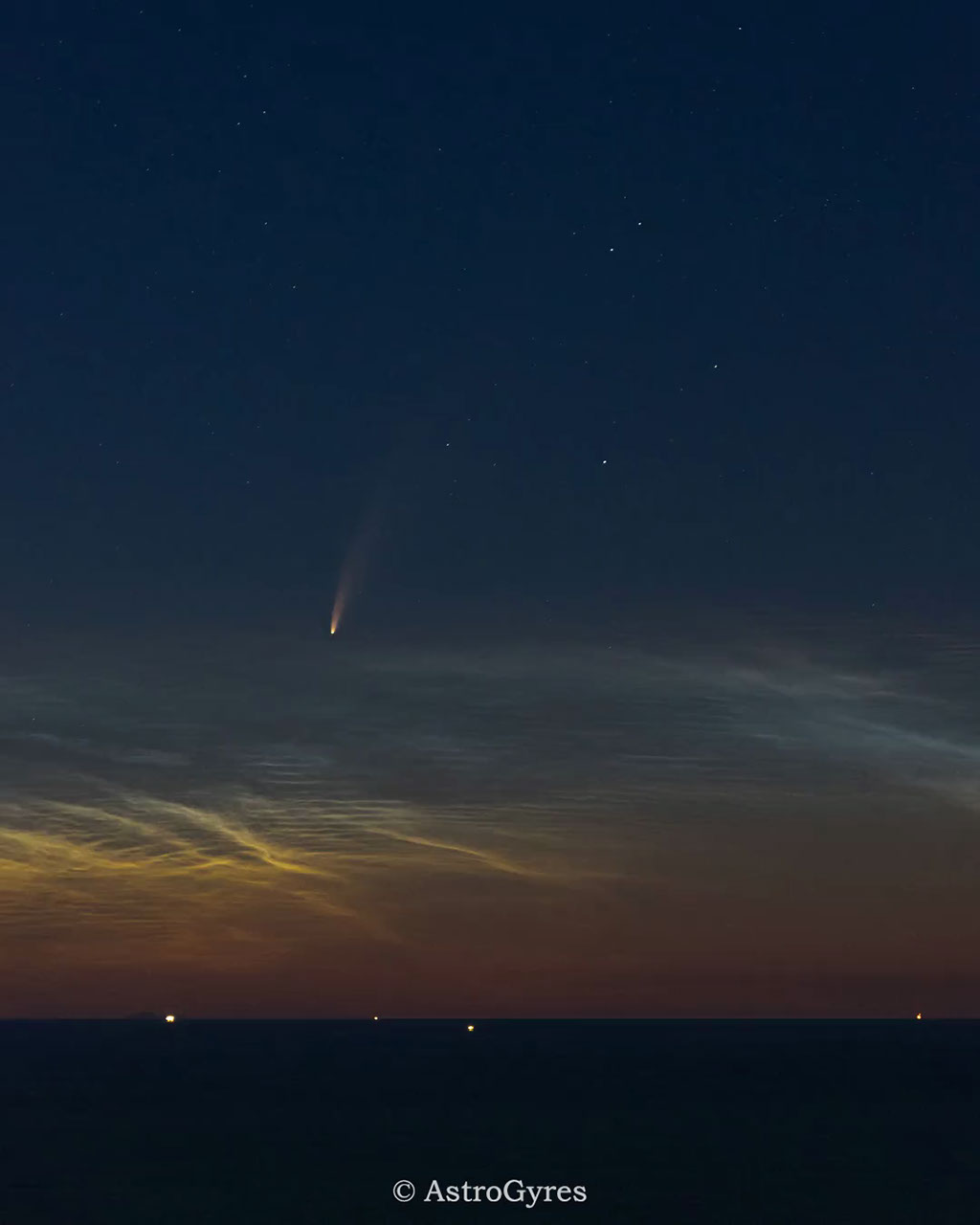
Comet NEOWISE Rising Over the Adriatic Sea Image Credit & Copyright: Paolo Girotti Explanation: This sight was worth getting out of bed early. Just over four years ago, Comet C/2020 F3 (NEOWISE) rose before dawn to the delight of northern sky enthusiasts awake that early. Up before sunrise on July 8th, the featured photographer was able to capture in dramatic fashion one of the few comets visible to the unaided eye this century, an inner-Solar System intruder that has become known as the Great Comet of 2020. The resulting video detailed Comet NEOWISE from Italy rising over the Adriatic Sea. The featured time-lapse video combines over 240 images taken over 30 minutes. The comet was seen rising through a foreground of bright and undulating noctilucent clouds, and before a background of distant stars. Comet NEOWISE remained unexpectedly bright for over a month, with its ion and dust tails found to emanate from a nucleus spanning about five kilometers across. https://science.nasa.gov/image-article/apod-2026-september-13-comet-neowise-rising-over-the-adriatic-sea/ #apod
APOD: 2026 September 13 - Comet NEOWISE Rising over the Adriatic Sea - NASA Science
NASA Science

APOD: 2026 September 13 - Comet NEOWISE Rising over the Adriatic Sea - NASA Science

0
0
0
0
Open post
Astronomy Picture of the Day @apod@reentry.codl.fr
· 5mo ago

Comet R3 PanSTARRS Before Rigel
Image Credit & Copyright: Jakub Kuřák & Martin Mašek (FZU of the Czech Academy of Sciences)

Explanation: Which way is Comet R3 PanSTARRS going? Not towards the star at the top of the image, because that is Rigel, which, being far in the background, is unrelated to the comet. Not through the nebula in the image middle, because that is the Witch Head Nebula and it, too, is far in the distance -- but not far from Rigel.  Not into northern skies because over the past week Comet C/2025 R3 (PanSTARRS) has moved into southern skies and is now best visible in Earth's Southern Hemisphere toward the west after sunset.  Angularly, Comet R3 PanSTARRS is slowly moving toward the upper right, night by night, and will soon be in the constellation Orion. Spatially, the comet is now headed out of our Solar System but should remain visible to cameras in southern skies for about a week. The featured image was captured last week near Cerro Paranal in Chile.

https://apod.nasa.gov/apod/ap260508.html #apod

instagram.com
0
0
0
0
Open post
Astronomy Picture of the Day @apod@reentry.codl.fr
· 2mo ago
The Large Magellanic Cloud Image Credit & Copyright: Monica Mesa Text: Cecilia Chirenti (NASA GSFC, UMCP, CRESST II) Explanation: Have you ever seen another galaxy with your own eyes? The featured image shows the Large Magellanic Cloud (LMC), one of the closest neighbors of our Milky Way. If you are anywhere south of latitude 20° N (but the further south, the better), you can see it with the unaided eye if you go to a dark sky location, away from big cities and light polution. It is a dwarf irregular galaxy about 163,000 light-years away, and a member of our Local Group of galaxies. Despite being small, with a total mass approximately equivalent to 10% - 20% of the mass of the Milky Way, the LMC is very actively forming stars. This is likely due in part to the gravitational push and pull of tides caused by the Milky Way on the LMC. Some astronomers have predicted that it will collide with the Milky Way in in about 2 billion years. https://apod.nasa.gov/apod/ap260723.html #apod
apod.nasa.gov
0
0
0
0
Open post
Astronomy Picture of the Day @apod@reentry.codl.fr
· 6mo ago

Hello World
Image Credit: NASA, Reid Wiseman, Artemis II

Explanation: From pole to pole our fair planet is captured in this snapshot from space, an evocative image from a window of the Orion spacecraft Integrity, From the spacecraft's perspective the Sun is moving behind Earth's bright limb along the lower right. Africa and the Iberian peninsula are in view on the pale blue planet's surface, while aurorae crown Earth's south and north poles at top right and bottom left. Commander Reid Wiseman took the historic picture on Artemis II mission flight day 2 (April 2), after the completion of the planned translunar injection burn. That burn boosted the spacecraft out of Earth orbit, sending spacecraft and crew on a trajectory that will take them around the Moon and back again. That's a journey humans last made over 50 years ago.

https://apod.nasa.gov/apod/ap260404.html #apod

nasa.gov
0
0
0
0
Open post
Astronomy Picture of the Day @apod@reentry.codl.fr
· 6mo ago

IC 4592: The Blue Horsehead Reflection Nebula
Image Credit & Copyright: Rabeea Alkuwari

Explanation: Do you see the horse's head? What you are seeing is not the famous Horsehead nebula toward Orion, but rather a fainter nebula that only takes on a familiar form with deeper imaging. The main part of the here-imaged molecular cloud complex is reflection nebula IC 4592. Reflection nebulas are made up of very fine dust that normally appears dark but can look quite blue when reflecting the visible light of energetic nearby stars. In this case, the source of much of the reflected light is a star at the eye of the horse. That star is part of Nu Scorpii, one of the brighter star systems toward the constellation of the Scorpion (Scorpius). A second reflection nebula dubbed IC 4601 is visible surrounding two stars just below the image center. The featured picture was taken from Sawda Natheel in Qatar.

https://apod.nasa.gov/apod/ap260407.html #apod

instagram.com
0
0
0
0
Open post
Astronomy Picture of the Day @apod@reentry.codl.fr
· 5mo ago
Boosted by @hypebot@tacocat.space
Comet R3 PanSTARRS Behind Satellite Trails Image Credit & Copyright: Uli Fehr Explanation: Can you find the comet? Somewhere through this web of satellite trails is Comet C/2025 R3 (PanSTARRS), a bright visitor passing through the inner Solar System. Now, the orbiting satellites themselves only appear as streaks because of the long camera exposure, over 10 minutes in this case. On the contrary, to the eye, satellites appear as points that drift slowly across the night sky and shine by reflecting sunlight -- primarily just after sunset and before sunrise. The featured image was taken just before sunrise two weeks ago from Bavaria, Germany. Presently, Comet R3 PanSTARRS is hard to see for even another reason -- because it is so (angularly) close to the Sun. As the comet rounds the Sun, it will be best seen in coming weeks from southern hemispheree skies, although then it will be heading out to interstellar space and fading. If you haven't yet found the comet, don't despair; please take a closer look just above the image center. https://apod.nasa.gov/apod/ap260427.html #apod
apod.nasa.gov

APOD: 2026 April 27 – Comet R3 PanSTARRS Behind Satellite Trails

A different astronomy and space science related image is featured each day, along with a brief explanation.

0
11
0
0
Open post
Astronomy Picture of the Day @apod@reentry.codl.fr
· 6mo ago

Destruction of Comet C/2026 A1 (MAPS)
Video Credit: Brian Day, SOHO, SDO, JHelioviewer
Text: Cecilia Chirenti (NASA GSFC, UMCP, CRESST II)

Explanation: As the crew of Artemis II travelled towards the Moon this week, Comet C/2026 A1 (MAPS) was expected to have its closest approach to the Sun on Monday. At this point, comet and Sun would be closer than half the distance separating the Earth and Moon. The comet did not survive; the featured video was made with 40 hours of data and shows the comet plunging toward the Sun, like a moth to a flame. Observing the comet so close to our bright star requires a coronagraph, an instrument that blocks the Sun and is used for studies of its corona. This composite video combines, starting from the outside, views from: the wider angle coronagraph (blue) and the narrower angle coronagraph (red), both on NASA's Solar and Heliospheric Observatory, and NASA's Solar Dynamics Observatory (black). We can see the comet approaching the sun, stretching, disappearing behind the coronagraph's occulting disk and reappearing as a cloud of debris that dissipates.

https://apod.nasa.gov/apod/ap260409.html #apod

sservi.nasa.gov
0
2
0
0
Open post
Astronomy Picture of the Day @apod@reentry.codl.fr
· 6mo ago

NGC 3310: A Starburst Spiral Galaxy
Image Credit & Copyright: AAO ITSO Office, Gemini Obs./AURA & T. A. Rector (U. Alaska Anchorage)

Explanation: The party is still going on in spiral galaxy NGC 3310. Roughly 100 million years ago, NGC 3310 likely collided with a smaller galaxy causing the large spiral galaxy to light up with a tremendous burst of star formation. The changing gravity during the collision created density waves that compressed existing clouds of gas and triggered the star-forming party. The featured image from the Gemini North Telescope shows the galaxy in great detail, color-coded so that pink highlights gas while white and blue highlight stars. Some of the star clusters in the galaxy are quite young, indicating that starburst galaxies may remain in star-burst mode for quite some time. NGC 3310 spans about 50,000 light years, lies about 50 million light years away, and is visible with a small telescope towards the constellation of Great Bear Ursa Major.

https://apod.nasa.gov/apod/ap260405.html #apod

reddit.com
0
0
0
0
Open post
Astronomy Picture of the Day @apod@reentry.codl.fr
· 3w ago
Boosted by @trending@homestead.social
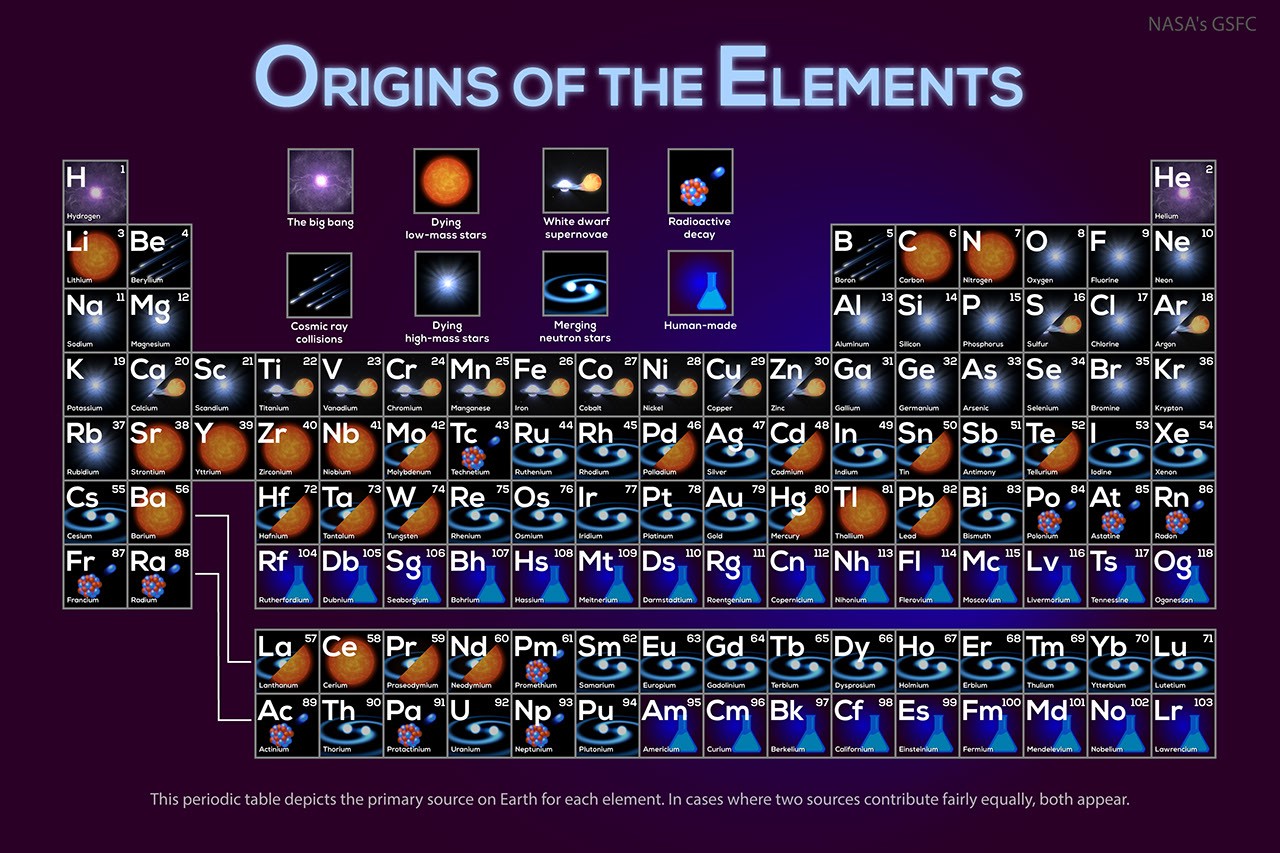
Where Your Elements Came From Image Credit & Copyright: NASA GSFC's SVS Explanation: The hydrogen in your body and present in every molecule of water came from the Big Bang. There are no other appreciable sources of hydrogen in the universe. The carbon in your body was made by nuclear fusion in the interior of stars, as was the oxygen. Much of the iron in your body was made during supernovas of stars that occurred long ago and far away. The gold in your jewelry was likely made from neutron stars during collisions that may have been visible as short-duration gamma-ray bursts or gravitational wave events. Elements like phosphorus and copper are present in our bodies in only small amounts but are essential to the functioning of all known life. The featured periodic table is color coded to indicate humanity's best guess as to the nuclear origin of all known elements. The sites of nuclear creation of some elements, such as copper, are not really well known and are continuing topics of observational and computational research. https://science.nasa.gov/image-article/apod-2026-september-14-where-your-elements-came-from/ #apod
APOD: 2026 September 14 - Where Your Elements Came From - NASA Science
NASA Science

APOD: 2026 September 14 - Where Your Elements Came From - NASA Science

0
0
1
0
Open post
Astronomy Picture of the Day @apod@reentry.codl.fr
· 2w ago
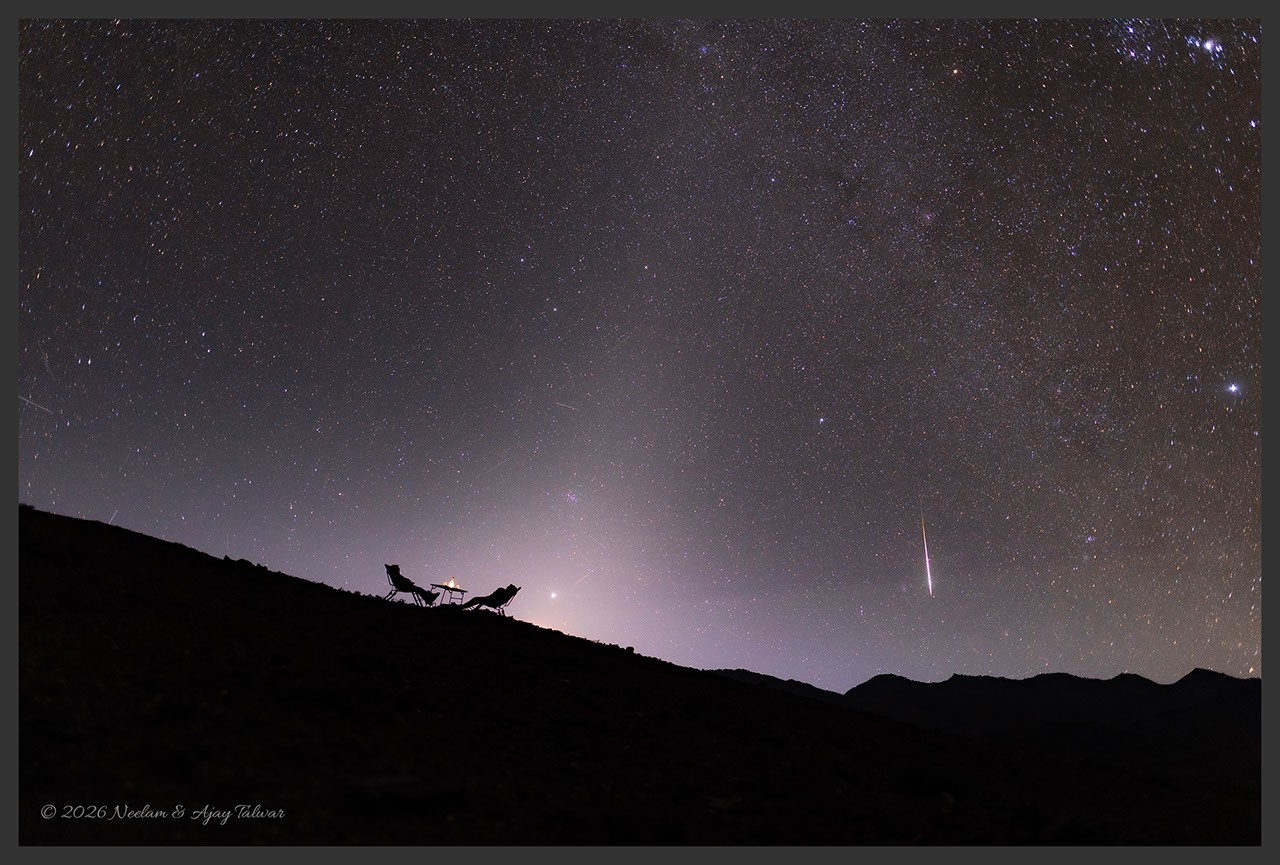
A Zodiacal Night Image Credit: Neelam and Ajay Talwar (TWAN) Explanation: Also known as the false dawn, a luminous band of zodiacal light is captured in this dark night skyscape. The serene view was recorded just before the beginning of astronomical twilight during September's star party at the remote Hanle Dark Sky Reserve, Ladakh, India, planet Earth. At about 4,500 meters altitude, the dark sky reserve presents a haven for hardy stargazing and astrophotography enthusiasts. While meteors streak through the night, bright planet Jupiter appears immersed in the faint zodiacal glow near the eastern horizon. Follow the zodiacal band toward the zenith to find open star cluster M44 and a yellowish tinged planet Mars near the center of the frame. In fact, serendipitous detections of interplanetary dust by NASA's Juno spacecraft suggest Mars itself is the source of dust that back scatters sunlight and creates zodiacal light in planet Earth's night. https://science.nasa.gov/image-article/apod-2026-september-19-a-zodiacal-night/ #apod
APOD: 2026 September 19 – A Zodiacal Night - NASA Science
NASA Science

APOD: 2026 September 19 – A Zodiacal Night - NASA Science

0
0
0
0
Open post
Astronomy Picture of the Day @apod@reentry.codl.fr
· 5mo ago

The Moon, Venus, and the Pleiades
Image Credit & Copyright: Gianni Tumino
Text: Keighley Rockcliffe (NASA GSFC, UMBC CSST, CRESST II)

Explanation: No, Earth did not recently acquire six more moons! Today’s APOD is a combination of images following the Moon, Venus, and the Pleiades across a southern Sicilian sky as twilight turned to evening on April 19. From 2023 to 2029, the Pleiades' and the Moon “visit" each other once per month due to the Pleiades' location in the ecliptic plane. April 2026 saw the celestial alignment of their visit with Venus. About six stars in the Pleiades cluster (Messier 45) are typically visible with the unaided eye. Due to the cluster’s visibility across the world, there are many myths and legends across cultures associated with the Pleiades. The Haudenosaunee people of North America, for example, say that seven boys danced so enthusiastically that they lifted off into the sky. Astronomers recently found thousands more Pleiades members, showing that after thousands of years of gazing upon this cluster, there is yet more to learn about the Pleiades.

https://apod.nasa.gov/apod/ap260429.html #apod

facebook.com
0
0
0
0
Open post
Astronomy Picture of the Day @apod@reentry.codl.fr
· 5mo ago

Markarian's Chain
Image Credit & Copyright: Chuck Ayoub

Explanation: Near the heart of the Virgo Galaxy Cluster, a string of galaxies known as Markarian's Chain stretches across this telescopic field of view. Anchored in the frame at bottom right by prominent lenticular galaxies, M84 (bottom) and M86, you can follow the chain's gentle arc up and toward the left. Near center you'll spot the pair of interacting galaxies NGC 4438 and NGC 4435, known to some as Markarian's Eyes. An estimated 50 million light-years distant, the Virgo Cluster itself is the nearest galaxy cluster. With up to about 2,000 member galaxies, it has a noticeable gravitational influence on our own Local Group of Galaxies. Within the Virgo Cluster at least seven galaxies in Markarian's Chain appear to move coherently, while others may appear to be part of the chain by chance.

https://apod.nasa.gov/apod/ap260501.html #apod

youtube.com
0
0
0
0
Open post
Astronomy Picture of the Day @apod@reentry.codl.fr
· 5mo ago
CG 30: Cometary Globules Image Credit & Copyright: Marcelo Salemme Explanation: They're like mountain peaks, but they are forming stars. Bright-rimmed, flowing shapes gather near the center of this rich starfield toward the borders of the nautical southern constellations Puppis and Vela. Composed of interstellar gas and dust, the grouping of light-year sized cometary globules is about 1300 light-years distant. Energetic ultraviolet light from nearby hot stars has molded the globules and ionized their bright rims. The globules also stream away from the Vela supernova remnant which may have influenced their swept-back shapes. Within them, cores of cold gas and dust are likely collapsing to form low mass stars whose formation will ultimately cause the globules to disperse. In fact, cometary globule CG 30 (upper right in the group) sports a small reddish glow inside its head, a telltale sign of energetic jets from a star in the early stages of formation. https://apod.nasa.gov/apod/ap260428.html #apod
apod.nasa.gov
0
0
0
0
Open post
Astronomy Picture of the Day @apod@reentry.codl.fr
· 2mo ago
Boosted by @trending@homestead.social
A Fire Rainbow over West Virginia Image Credit & Copyright: Christa Harbig Explanation: What's happening to this cloud? Ice crystals in a distant cirrus cloud are acting like little floating prisms. Known informally as a fire rainbow for its flame-like appearance, a circumhorizon arc appears parallel to the horizon. For a circumhorizontal arc to be visible, the Sun must be at least 58 degrees high in a sky where cirrus clouds present below -- in this case cirrus fibratus. The numerous, flat, hexagonal ice-crystals that compose the cirrus cloud must be aligned horizontally to properly refract sunlight in a collectively similar manner. Therefore, circumhorizontal arcs are somewhat unusual to see. The featured fire rainbow was photographed in 2021 near North Fork Mountain in West Virginia, USA. https://apod.nasa.gov/apod/ap260802.html #apod
apod.nasa.gov
0
0
1
0
Open post
Astronomy Picture of the Day @apod@reentry.codl.fr
· 5mo ago

The Persistence of Sunlight
Image Credit & Copyright: Lorenzo Busilacchi

Explanation: This seaside sunset offered a surreal experience, captured in a sea and skyscape from the west coast of Sardinia, Italy, planet Earth. The Daliesque scene is a composition of sequential exposures made with a camera and long telephoto lens. The Sun is not melting, though. Its shifting and fluid appearance as it nears the horizon is caused as refraction along the line of sight changes and creates distorted images or mirages of the reddened solar disk. The changes in atmospheric refraction correspond to atmospheric layers with sharply different temperatures and densities. Another famous but fleeting effect of atmospheric refraction produced by a long sight-line to the setting (or rising) Sun is often called the green flash.

https://apod.nasa.gov/apod/ap260425.html #apod

instagram.com
0
2
0
0
Open post
Astronomy Picture of the Day @apod@reentry.codl.fr
· 5mo ago

Mystic Mountain Monster being Destroyed
Image Credit: Hubble, NASA, ESA; Processing & License: Judy Schmidt

Explanation: Inside the head of this interstellar monster is a star that is slowly destroying it. The huge monster, actually an inanimate series of pillars of gas and dust, measures light years in length. The in-head star is not itself visible through the opaque interstellar dust but is bursting out partly by ejecting opposing beams of energetic particles called Herbig-Haro jets. Located about 7,500 light years away in the Carina Nebula and known informally as Mystic Mountain, the appearance of these pillars is dominated by dark dust even though they are composed mostly of clear hydrogen gas. The featured image was taken with the Hubble Space Telescope. All over these pillars, the energetic light and winds from massive newly formed stars are evaporating and dispersing the dusty stellar nurseries in which they formed. Within a few million years, the head of this giant, as well as most of its body, will have been completely evaporated by internal and surrounding stars.

https://apod.nasa.gov/apod/ap260426.html #apod

0
0
0
0
Open post
Astronomy Picture of the Day @apod@reentry.codl.fr
· 3mo ago
Three Galaxies in Pavo Image Credit & Copyright: Mike Selby Explanation: Some 190 million light-years away, far beyond the bright stars and nebulae of the Milky Way, these three galaxies are drawn together by gravity in a mesmerizing cosmic dance. Clearly distorted by galactic-scale gravitational interactions, large spiral galaxies NGC 6769 and NGC 6770 are seen face-on, with luminous galactic disks scarred by obscuring interstellar dust lanes. Their young blue star clusters along drawn out spiral arms are spawned in star forming regions that resulted from collisions of massive molecular clouds. Below, spiral NGC 6771 presents a more edge-on perspective, its boxy central bulge due to tidal star streams. Of course, in the distant future a merger of the three galaxies is inevitable. At the estimated distance of this galaxy trio, known to some as the Devil's Mask, the sharp telescopic frame spans over 300 thousand light-years within the boundaries of the far southern constellation Pavo. https://apod.nasa.gov/apod/ap260703.html #apod
apod.nasa.gov
0
0
0
0
Open post
Astronomy Picture of the Day @apod@reentry.codl.fr
· 1mo ago
Contemplating the Sun Image Credit & Copyright: Steven Gilbert Explanation: Have you contemplated your home star recently? Featured here, a Sun partially eclipsed on the top left by the Moon is also seen eclipsed by earthlings contemplating the eclipse below. This spectacular menagerie of silhouettes was taken in 2012 from the Glen Canyon National Recreation Area near Page, Arizona, USA, where park rangers and astronomers expounded on the unusual event to interested gatherers. Also, faintly visible on the Sun's disk, just to the lower right of the dark Moon's disk, is a group of sunspots. A new solar eclipse will occur this week and give many people in northern North America, Europe, and northwestern Africa a new chance to contemplate a partially eclipsed Sun. A thin swath of Earth through Greenland and Spain will further experience a total solar eclipse. An open question is whether any meteors from the peaking Perseids will be visible during totality. https://apod.nasa.gov/apod/ap260809.html #apod
apod.nasa.gov
0
0
0
0
Open post
Astronomy Picture of the Day @apod@reentry.codl.fr
· 2mo ago
Galaxy NGC 474: Shells and Star Streams Image Credit & License: CFHT, Coelum, MegaCam, J.-C. Cuillandre (CFHT) & G. A. Anselmi (Coelum) Explanation: What's happening to galaxy NGC 474? The multiple layers of emission appear strangely complex given the relatively featureless appearance of the elliptical galaxy in less deep images. The cause of the shells is a topic of research, but they are possibly tidal tails related to debris left over from absorbing numerous small galaxies in the past billion years. Alternatively, the shells may be like ripples in a pond, where the ongoing collision with the spiral galaxy just to the right of NGC 474 is causing density waves to ripple through the galactic giant. Regardless of the actual cause, the featured image dramatically highlights the increasing evidence that the halos of some elliptical galaxies are surprisingly complicated. Similarly, the halo of our own Milky Way Galaxy is one example of such unexpected intricacies. NGC 474 spans about 250,000 light years and lies about 100 million light years distant toward the constellation of the Fish (Pisces). https://apod.nasa.gov/apod/ap260712.html #apod
apod.nasa.gov
0
0
0
0
Open post
Astronomy Picture of the Day @apod@reentry.codl.fr
· 2w ago
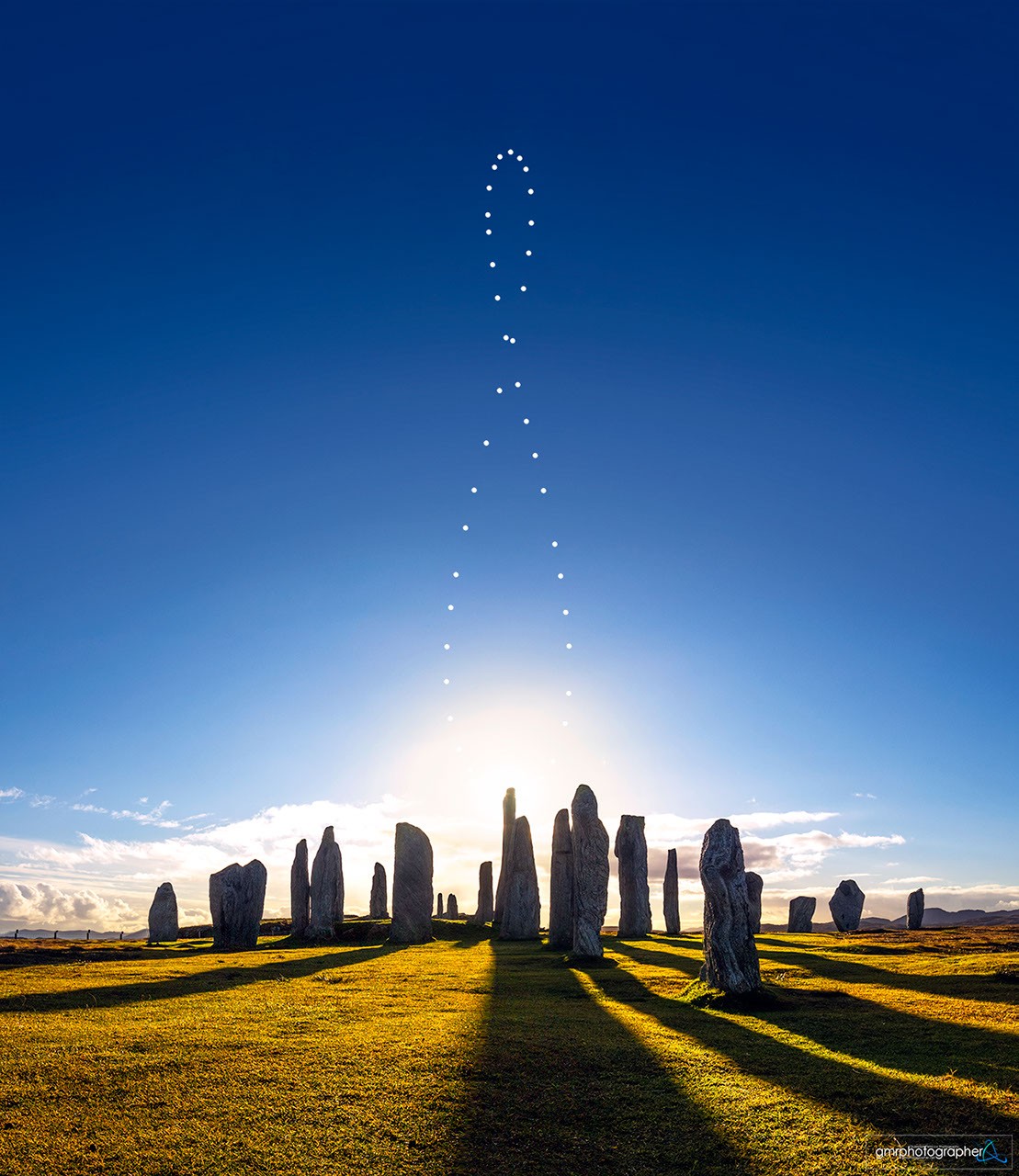
Analemma over the Callanish Stones Image Credit: Giuseppe Petricca Explanation: If you went outside at the same time every day and took a picture that included the Sun, how would the Sun's position change? A visual answer to that question is an analemma, a composite image taken from the same spot at the same time over the course of a year. The featured analemma was composed from images taken every few days at noon near the village of Callanish in the Outer Hebrides in Scotland, UK. In the foreground are the Callanish Stones, a stone circle built around 2700 BC during humanity's Bronze Age. It is not known if the placement of the Callanish Stones has or had astronomical significance. The ultimate causes for the figure-8 shape of this and all analemmas are the tilt of the Earth axis and the ellipticity of the Earth's orbit around the Sun. At the solstices, the Sun will appear at the top or bottom of an analemma. The featured image was taken near the December solstice and so the Sun appears near the bottom. Equinoxes, however, correspond to analemma middle points -- not the intersection point. In two days there will be an equinox ("equal night"), when day and night are equal over all of planet Earth. Many cultures celebrate a change of season at an equinox. https://science.nasa.gov/image-article/apod-2026-september-20-analemma-over-the-callanish-stones/ #apod
APOD: 2026 September 20 – Analemma over the Callanish Stones - NASA Science
NASA Science

APOD: 2026 September 20 – Analemma over the Callanish Stones - NASA Science

0
0
1
0
Open post
Astronomy Picture of the Day @apod@reentry.codl.fr
· 5mo ago

Three Sky Arches over Snowy Alps
Image Credit & Copyright: Angel Fux

Explanation: Why are there three arches across the sky instead of two? Last month, after being dropped off by a helicopter at a high mountain peak in the Alps near the Swiss Italian border, an adventurous astrophotographer expected two arches of our Milky Way galaxy to be visible during the night. These were the inner arch looking in toward the center of our galaxy on the left, visible just before sunrise, and the outer arch on the right visible just after sunset. But there were three arches. The surprised astrophotographer soon realized that the sky was so dark that an entire arc of faint zodiacal light was also noticeable -- sunlight scattered by inner Solar System dust. And it artfully connected the two Milky Way arches! The next morning a helicopter picked the astrophotographer back up, and after 40 hours of processing and combining that night's images, the featured triple-arch 360-degree panorama resulted.

https://apod.nasa.gov/apod/ap260421.html #apod

instagram.com
0
11
0
0
Open post
Astronomy Picture of the Day @apod@reentry.codl.fr
· 2mo ago
Curious Cometary Knots in the Helix Nebula Image Credit: NASA, ESA, CSA, STScI, JWST; Processing: A. Pagan (STScI) Explanation: What causes unusual knots of gas and dust in planetary nebulas? Seen also in the Ring Nebula, the Dumbbell Nebula and NGC 2392, the knots' existence was not initially predicted, and their origins are still not well understood. Pictured here is a fascinating image of part of the Helix Nebula by the James Webb Space Telescope showing tremendous detail in infrared light. The cometary knots have masses similar to the Earth but have sizes typically several times the orbit of Pluto. One hypothesis for the fragmentation and evolution of the knots includes existing gas being driven out by a less dense but highly energetic stellar wind of the central evolving star. The Helix Nebula is one of the closest examples of a planetary nebula created at the end of the life of a Sun-like star. Given a technical designation of NGC 7293, the Helix Nebula lies about 650 light-years away towards the constellation of Water Carrier (Aquarius). https://apod.nasa.gov/apod/ap260804.html #apod
apod.nasa.gov
0
0
0
0
Open post
Astronomy Picture of the Day @apod@reentry.codl.fr
· 5mo ago

Supernova in a Sideways Spiral
Video Credit: @outtenastrophotography@youtube.com & @Kaleb_Jordan@app.astrobin.com
Text: Cecilia Chirenti (NASA GSFC, UMCP, CRESST II)

Explanation: A long time ago, in a distant galaxy, a massive star was destroyed in a supernova explosion. The light of this event travelled for tens of millions of years and reached Earth last week as Supernova 2026kid. The featured video shows a time-lapse over three nights of the host galaxy NGC 5907, an edge-on spiral also known as the Splinter or Knife Edge Galaxy, as the supernova appears and becomes brighter. (The occasional streaks are satellites in Earth orbit.) At its brightest, a supernova can outshine the sum of all other stars in its galaxy. Supernova 2026kid appears relatively dim, probably because we are seeing it through the edge-on disk of the galaxy. Such explosions typically happen about once per century in galaxies similar to the Milky Way, and their light can take months to fade away. The brightest supernova in recorded history was SN 1006; it is reported to have been brighter than Venus, and even visible in the sky during daytime.

https://apod.nasa.gov/apod/ap260507.html #apod

youtube.com
0
2
0
0
Open post
Astronomy Picture of the Day @apod@reentry.codl.fr
· 5mo ago

Earthset with an iPhone
Video Credit: NASA, Reid Wiseman
Text: Keighley Rockcliffe (NASA GSFC, UMBC CSST, CRESST II)

Explanation: What does it mean for the Earth to set? Artemis II Commander Reid Wiseman gave us another spectacular view of Earth from their historic flyby of the Moon. Commander Wiseman's video, taken with an iPhone at 8x zoom, shows our entire planet gradually blocked from view by the Moon. On the Earth, the 24-hour planetary rotation causes the Sun to set below your horizon every night. However, on Artemis II the Earthset was caused not by the Moon’s rotation but by the spacecraft moving behind the Moon (at about 55 seconds in this video). Once rare, views of Earth are now taken many times a day from many spacecraft, including NASA’s SWOT (Surface Water and Ocean Topography) satellite tracking freshwater resources and USGS Landsat 8 and 9 satellites supporting water management for farmers, for example. Space agencies around our home planet now work together to provide unique and ever-improving views of our Earth.

https://apod.nasa.gov/apod/ap260422.html #apod

instagram.com
0
0
0
0
Open post
Astronomy Picture of the Day @apod@reentry.codl.fr
· 6mo ago

The Claw and Bubble Nebulae
Image Credit & Copyright: Richard Whitehead
Text: Keighley Rockcliffe (NASA GSFC, UMBC CSST, CRESST II)

Explanation: What unexpected things do you see when you look up at the night sky? Today’s image resembles an abstract painting, with large swaths of color strewn across a cosmic canvas seemingly without design. Despite the image's abstract nature, the human mind finds patterns, identifying a large claw reaching up towards a floating bubble. Embedded within these seemingly random structures are the physical laws that govern how light and matter interact. The Claw (Sh2-157) and Bubble (NGC 7635) Nebulae glow colors that are mapped to the yellow and blue shown, indicating the presence of hydrogen and oxygen ionized by the intense light emitted from stars several times the mass of the Sun. This image depicts both the chaos and structure of astronomical processes, showing that a common thread between art and science is to look for the unexpected.

https://apod.nasa.gov/apod/ap260401.html #apod

richardwhitehead.photography
0
0
0
0
Open post
Astronomy Picture of the Day @apod@reentry.codl.fr
· 5mo ago

Comet R3 PanSTARRS and Orion
Image Credit & Copyright: Luc Perrot (TWAN)

Explanation: Orion never had a sword like this. As Comet C/2025 R3 (PanSTARRS) heads out of the inner Solar System, it is putting on quite a show for long exposure cameras. Currently seen toward the constellation of Orion the Hunter, the distant Orion Nebula is visible on the upper right. Comet R3 PanSTARRS is now showing two distinct tails: a short dust tail pointing toward the top of the image and a long and wavy ion tail trailing off toward the upper left. The ion tail points away from the Sun and glows blue from excited carbon monoxide. Large particles in the dust tail somewhat resist the radiation pressure that push them away from the Sun and so retain a bit of the comet's orbit. The dust tail shines by reflected sunlight. The featured image was taken a few days ago from France's Reunion Island in the southern Indian Ocean.

https://apod.nasa.gov/apod/ap260510.html #apod

0
2
0
0
Open post
Astronomy Picture of the Day @apod@reentry.codl.fr
· 5mo ago

Large Scale Structure of the Universe
Image Credit: Claire Lamman/DESI collaboration
Text: Cecilia Chirenti (NASA GSFC, UMCP, CRESST II)

Explanation: This is a map of the universe. The Dark Energy Spectroscopic Instrument (DESI) at Kitt Peak National Observatory, Arizona, finished its planned five-year survey. It observed more than 47 million galaxies and quasars and created a 3D map, centered on the Earth. Today's featured image shows a thin slice of these data, above and below the plane of our Galaxy: the black gaps indicate where our Galaxy obscures distant objects. The feathery web in the inset shows the large scale structure of the Universe. Light of the most distance galaxies shown here travelled for 11 billion years to reach the Earth (the universe is almost 14 billion years old). Galaxies cluster throughout cosmic history under the competing influences of gravity and dark energy, responsible for the accelerated expansion of the universe. Early DESI results hinted at the possibility that dark energy, which Albert Einstein described as a cosmological constant, may not be a constant after all. The nature of dark energy is the biggest mystery of cosmology.

https://apod.nasa.gov/apod/ap260423.html #apod

0
1
0
0
Open post
Astronomy Picture of the Day @apod@reentry.codl.fr
· 6mo ago

Liftoff! Returning to the Moon
Image Credit & Copyright: NASA/Bill Ingalls; Text: Ogetay Kayali (MTU)

Explanation: We are one small step closer to returning to the Moon. A new chapter in human exploration began Wednesday when NASA's Artemis II launched aboard the Space Launch System (SLS) from Kennedy Space Center. Carrying four astronauts, the Orion spacecraft's planned lunar flyby will be the first in over half a century. This historic test flight, echoing the legacy of Apollo while pushing beyond it, will carry its crew farther from Earth than any humans since 1972, looping around the Moon before returning home. During the approximately ten-day journey, Orion's systems--from life support to navigation--will be tested in deep space, while astronauts observe the lunar surface, including shadowed regions of the far side rarely seen with such perspective. After looping around the Moon, the astronauts will return to Earth, ending their journey with a Pacific Ocean splashdown.

https://apod.nasa.gov/apod/ap260402.html #apod

Liftoff! NASA Launches Astronauts on Historic Artemis Moon Mission - NASA
NASA

Liftoff! NASA Launches Astronauts on Historic Artemis Moon Mission - NASA

Spurred by American ingenuity, astronauts on NASA’s Artemis II mission are in flight, preparing for the first crewed lunar flyby in more than 50 years.

0
1
0
0
Open post
Astronomy Picture of the Day @apod@reentry.codl.fr
· 5mo ago

Comet R3 (PanSTARRS) Brightens
Image Credit & Copyright: José Rodrigues

Explanation: Comet R3 is brightening rapidly -- will it survive? C/2025 R3 (PanSTARRS) has been slowly brightening and extending an ion tail since its discovery last year. This shedding mountain of dirty ice puts on its best sky show this month, though, because it passes its closest to both the Sun (April 19) and the Earth (April 25). The featured image, showing R3 already sporting a tail extending over 10 degrees, was taken two nights ago from Sion, Switzerland with the big mountain Bietschhorn on the left. Comet R3 will be visible during mid-April before sunrise. Although the future brightness of any comet is hard to predict, the brightness of R3 makes it already a good camera comet and it may become visible to the unaided eye in the next week. Comet R3's physical future is also unknown because, like Comet A1 (MAPS) earlier this month, it may disintegrate when it passes its closest to the Sun. Or it may live to leave the Solar System.

https://apod.nasa.gov/apod/ap260412.html #apod

instagram.com
0
0
0
0
Open post
Astronomy Picture of the Day @apod@reentry.codl.fr
· 4mo ago
A Martian Eclipse: Phobos Crosses the Sun Video Credit: NASA, JPL-Caltech, ASU MSSS, SSI Explanation: What's that passing in front of the Sun? It looks like a moon, but it can't be Earth's Moon, because it isn't round. It's the Martian moon Phobos. The featured video was taken from the surface of Mars in 2022 by the Perseverance rover. Phobos, at 11.5 kilometers across, is 150 times smaller than Luna (our moon) in diameter, but also 50 times closer to its parent planet. In fact, Phobos is so close to Mars that it is expected to break up and crash into Mars within the next 50 million years. In the near term, the low orbit of Phobos results in more rapid solar eclipses than seen from Earth. The featured video is shown in real time -- the transit really took about 40 seconds, as shown. The videographer -- the robotic rover Perseverance (Percy) -- continues to explore Jezero Crater on Mars, searching not only for clues to the watery history of the now dry world, but evidence of ancient microbial life. https://apod.nasa.gov/apod/ap260524.html #apod
apod.nasa.gov
0
0
0
0
Open post
Astronomy Picture of the Day @apod@reentry.codl.fr
· 6mo ago

The Path of Artemis II
Video Credit: NASA, GSFC, Artemis II, SVS

Explanation: Why doesn't Artemis II land on the Moon? The main reason is that Artemis II is primarily a test mission designed to make a future Artemis missions -- which will land humans on the Moon -- better prepared. Similarly, NASA's Apollo 8 and Apollo 10 went right near the Moon as tests before Apollo 11 -- which landed. As the trajectory in the featured animated video shows, Artemis II will loop around both the Earth and the Moon before returning to the Earth about 10 days after launch. The Artemis II mission will take humans outside the Earth's magnetosphere for the first time since the Apollo missions 50 years ago. In the video, particles from the solar wind are shown as streaks, while the Earth's reacting magnetosphere is shown in flickering green. The Earth's magnetosphere is important in deflecting powerful particles arriving from the Sun as well as creating picturesque auroras visible from the Earth's surface.

https://apod.nasa.gov/apod/ap260406.html #apod

nasa.gov
0
3
0
0
Open post
Astronomy Picture of the Day @apod@reentry.codl.fr
· 5mo ago

Young Moon and Sister Stars
Image Credit & Copyright: Giorgia Hofer

Explanation: Sunlit arms of a crescent moon seem to embrace the faint lunar night side in this dramatic celestial view from planet Earth. The single telephoto exposure tracking the sky was captured on the night of April 19, when a two day old Moon was near perigee in its elliptical orbit. On that date, the young Moon was also close on the sky to the lovely Pleiades Star Cluster. With the moonlight dimmed by clouds the Pleiades sister stars gather below the Moon's bright crescent, seen through a faint but colorful lunar corona. The lunar night side is illuminated by earthshine, sunlight reflected from the Earth itself. The Moon's ashen glow, also known as the "old moon in the young moon's arms," tends to be bright in the northern hemisphere spring. And for now, the Moon's orbit takes it near the Pleiades stars each month in planet Earth's sky, though their close conjunctions are easiest to see when the Moon is near a crescent phase.

https://apod.nasa.gov/apod/ap260424.html #apod

apod.nasa.gov
0
0
0
0
Open post
Astronomy Picture of the Day @apod@reentry.codl.fr
· 5mo ago

Eye on the Milky Way
Image Credit & Copyright: Miguel Claro (TWAN, Dark Sky Alqueva)

Explanation: Have you ever had stars in your eyes? It appears that the eye on the left does, and moreover, it appears to be gazing at even more stars. The featured 27-frame mosaic was taken in 2019 from Ojas de Salar in the Atacama Desert of Chile. The eye is actually a small lagoon captured reflecting the dark night sky as the Milky Way Galaxy arched overhead. The seemingly smooth band of the Milky Way is really composed of billions of stars, but decorated with filaments of light-absorbing dust and red-glowing nebulas. Additionally, both Jupiter (slightly left the galactic arch) and Saturn (slightly to the right) are visible. The lights of small towns dot the unusual vertical horizon. The rocky terrain around the lagoon appears to some more like the surface of Mars than our Earth.

https://apod.nasa.gov/apod/ap260419.html #apod

0
2
0
0
Open post
Astronomy Picture of the Day @apod@reentry.codl.fr
· 5mo ago

Superplumes Inside Earth
Image Credit & License: Sanne Cottaar via Wikimedia Commons

Explanation: Why are there huge, unusual masses inside the Earth? No one is sure. By noting how earthquakes rumble through our planet's interior, humanity has discovered two deep structures that appear to have unusual temperatures and/or chemical compositions. One hypothesis holds that the superplumes are sunken debris left over from the Earth-shattering collision that created Earth's Moon about 4.5 billion years ago. A competing hypothesis is that they are graveyards for old tectonic plates that slowly slid under each other over the past few billion years. No matter their origin, the superplumes are thought to affect Earth’s surface volcanism, possibly creating, for example, island chains such as Hawaii. Also known as large low-shear-velocity provinces (LLSVPs), Earth's superplumes are visualized in the featured animation.

https://apod.nasa.gov/apod/ap260504.html #apod

reddit.com
0
0
0
0
Open post
Astronomy Picture of the Day @apod@reentry.codl.fr
· 2mo ago
Red Sun through Wildfire Smoke Image Credit & Copyright: Debra Ceravolo Text: Cecilia Chirenti (NASA GSFC, UMCP, CRESST II) Explanation: This could be the view from an exoplanet orbiting around a red dwarf star, but it is our own Sun. This image was taken on July 22, 2026, in the Okanagan region in the Canadian province of British Columbia. Wildfire smoke from the Pacific Northwest acted as a solar filter, allowing the photographer to take this photo of the Sun directly. Several sunspots are also visible in this eerie image; just below and right of the center is AR 4493, a fast evolving, giant active solar region and sunspot group. The smoke is made of tiny particles that help block and scatter light with bluer colors, so the light we see coming from the Sun is dimmer and redder than usual (but it is never safe to stare directly at the Sun). Sunsets and sunrises are also more colorful because of the smoke. Some 6 billion years from now, the Sun will actually start to turn redder as it approaches its red giant phase. https://apod.nasa.gov/apod/ap260730.html #apod
apod.nasa.gov
0
0
0
0
Open post
Astronomy Picture of the Day @apod@reentry.codl.fr
· 2mo ago
The Corona Australis Molecular Cloud and the Chandelier Cluster Image Credit: DES/DOE/FNAL/DECam/CTIO/NOIRLab/NSF/AURA Image Processing: T.A. Rector (UAA/NOIRLab), R. Colombari & M. Zamani (NOIRLab) Text: Keighley Rockcliffe (NASA GSFC, UMBC CSST, CRESST II) Explanation: The Southern Crown (Corona Australis) dazzles with young and ancient celestial jewels. The Corona Australis Cloud is a collage of reflection and emission nebulae on the left of today’s image. At 430 light years away, this cloud is one of the closest star-forming regions to Earth. It contains gas cool enough (-260 Celsius or -440 Fahrenheit) to collapse into protostars. Recently formed stars paint blue hues across the cloud as their light reflects off surrounding material. The waltz of the R Coronae Australis binary system stirs up the nebula NGC 6729. The younger of the pair ionizes nearby gas with its ultraviolet light, causing it to glow. The Chandelier Cluster (NGC 6723) dangles from the top right, but is actually tens of thousands of light years farther away than its apparent star-forming neighbor. While NGC 6723 experienced multiple periods of star formation creating slightly younger stars, the chandelier twinkles with stars almost as old as the universe. https://apod.nasa.gov/apod/ap260722.html #apod
apod.nasa.gov
0
0
0
0
Open post
Astronomy Picture of the Day @apod@reentry.codl.fr
· 4d ago
Boosted by @trending@homestead.social
Supernumerary Rainbows over New Jersey Image Credit: John Entwistle Explanation: Yes, but can your rainbow do this? After the remnants of Hurricane Florence passed over the Jersey Shore, New Jersey, USA in 2018, the Sun came out in one direction but something quite unusual appeared in the opposite direction: a hall of rainbows. Over the course of the next half hour, to the delight of the photographer and his daughter, vibrant supernumerary rainbows faded in and out, with at least five captured in this featured single shot. Supernumerary rainbows only form when falling water droplets are all nearly the same size and typically less than a millimeter across. Then, sunlight will not only reflect from inside the raindrops, but interfere, a wave phenomenon similar to ripples on a pond when a stone is thrown in. In fact, supernumerary rainbows can only be explained with waves, and their noted existence in the early 1800s was considered early evidence of light's wave nature. https://science.nasa.gov/image-article/apod-2026-october-4-supernumerary-rainbows-over-new-jersey/ #apod
instagram.com
0
0
1
0
Open post
Astronomy Picture of the Day @apod@reentry.codl.fr
· 6mo ago

Earthset
Image Credit: NASA
Text: Keighley Rockcliffe (NASA GSFC, UMBC CSST, CRESST II)

Explanation: And to all of you down there on Earth and around Earth, we love you, from the Moon. We will see you on the other side, said Artemis II pilot Victor Glover on April 6th at 6:44pm ET as 8.3 billion minus four people and one Earth set below the Moon's horizon. The Orion spacecraft, Integrity, then traveled behind the Moon as part of its seven-hour lunar flyby. The crew characterized never-before-seen regions of the far side of the Moon, which is puzzlingly less volcanically active than the near side. New observations of crater peaks, floors, terraces, and rings preserved on the lunar surface will help piece together the impact history of the Solar System. Among many other surface characterizations, the crew observed one of the Moon's best-preserved basins, the Orientale basin, and identified two new craters. As Earth rose above the Moon’s horizon and Integrity began its return home, Artemis II mission specialist Christina Koch powerfully summarized humanity’s grander mission: « ...we will always choose Earth. We will always choose each other. »

https://apod.nasa.gov/apod/ap260408.html #apod

kerockcliffe.com
0
0
0
0
Open post
Astronomy Picture of the Day @apod@reentry.codl.fr
· 3mo ago
AR 4478: Giant Sunspot Group Image Credit & Copyright: Alfredo Vidal Pérez Explanation: Right now, one of the largest sunspot groups in recent history is crossing the Sun. Active Region 4478 is not only big -- it's violent, showing tangled magnetic fields capable of throwing off huge clouds of particles into the Solar System. Some of these CMEs might impact the Earth. At the extreme, these solar storms could cause some Earth-orbiting satellites to malfunction, the Earth's atmosphere to slightly distort, and electrical power grids to surge. When impacting Earth's upper atmosphere, these particles can produce beautiful auroras. Pictured here, AR 4478 and its dark sunspots were captured in visible light a few days ago from Barcelona, Spain. Almost as large as AR 3664 was in 2024, the AR 4478 sunspot group is so big that it is visible just with glasses specially designed to view solar eclipses. This week, skygazing enthusiasts all over the globe will not only be tracking AR 4478 during the day -- but keenly watching night skies for its corresponding bright auroras. https://apod.nasa.gov/apod/ap260628.html #apod
apod.nasa.gov
0
0
0
0
Open post
Astronomy Picture of the Day @apod@reentry.codl.fr
· 5mo ago

Messier Craters in Stereo
Image Credit: Apollo 11, NASA; Stereo Image Copyright Patrick Vantuyne

Explanation: Many bright nebulae and star clusters in planet Earth's sky are associated with the name of astronomer Charles Messier from his famous 18th century catalog. His name is also given to these two large and remarkable craters on the Moon. Standouts in the dark, smooth lunar Sea of Fertility or Mare Fecunditatis, Messier (left) and Messier A have dimensions of 15 by 8 and 16 by 11 kilometers respectively. Their elongated shapes are explained by the extremely shallow-angle trajectory followed by an impactor, moving left to right, that gouged out the craters. The shallow impact also resulted in two bright rays of material extending along the surface to the right, beyond the picture. Intended to be viewed with red/blue glasses (red for the left eye), this striking stereo picture of the crater pair was recently created from high resolution scans of two images (AS11-42-6304, AS11-42-6305) taken during the Apollo 11 mission to the Moon.

https://apod.nasa.gov/apod/ap260509.html #apod

nssdc.gsfc.nasa.gov
0
0
0
0
Open post
Astronomy Picture of the Day @apod@reentry.codl.fr
· 5mo ago

Trifid Pillars and Jets
Image Credit: NASA, ESA, STScI; Processing: J. DePasquale (STScI)

Explanation: Dust pillars are like interstellar mountains. They survive because they are more dense than their surroundings, but they are slowly being eroded away by a hostile environment. Visible in the featured picture by the Hubble Space Telescope is the end of a huge gas and dust pillar in the Trifid Nebula (M20), punctuated by a smaller pillar pointing up and an unusual jet pointing to the upper left. Many of the bright dots are newly formed stars. A star near the small pillar's end is slowly being stripped of its accreting gas by radiation from a tremendously brighter star situated off the top of the image. The jet extends nearly a light-year and would not be visible without external illumination. As gas and dust evaporate from the pillars, the hidden stellar source of this jet will likely be uncovered, possibly over the next 20,000 years.

https://apod.nasa.gov/apod/ap260503.html #apod

0
0
0
0
Open post
Astronomy Picture of the Day @apod@reentry.codl.fr
· 2mo ago
Simulation TNG50: A Galaxy Cluster Forms Video Credit: IllustrisTNG Project; Visualization: Dylan Nelson (Max Planck Institute for Astrophysics) et al. Music: Symphony No. 5 (Ludwig van Beethoven), via YouTube Audio Library Explanation: How do clusters of galaxies form? Since our universe moves too slowly to watch, faster-moving computer simulations are created to help find out. One famous effort is TNG50 from IllustrisTNG, an upgrade of the famous Illustris Simulation. The first part of the featured video tracks cosmic gas (mostly hydrogen) as it evolves into galaxies and galaxy clusters from the early universe to today, with brighter colors marking faster moving gas. As the universe matures, gas falls into gravitational wells, galaxies forms, galaxies spin, galaxies collide and merge, all while black holes form in galaxy centers and expel surrounding gas at high speeds. The second half of the video switches to tracking stars, showing a galaxy cluster coming together, complete with stellar streams. The outflow from black holes in TNG50 is surprisingly complex and details are being compared with our real universe. Studying how gas coalesced in the early universe helps humanity better understand how our Earth, Sun, and Solar System originally formed. https://apod.nasa.gov/apod/ap260726.html #apod
apod.nasa.gov

APOD: 2026 July 26 – Simulation TNG50: A Galaxy Cluster Forms

A different astronomy and space science related image is featured each day, along with a brief explanation.

0
0
0
0
Open post
Astronomy Picture of the Day @apod@reentry.codl.fr
· 5mo ago

The Retrograde Dance of Saturn and Neptune
Image Credit & Copyright: Tunç Tezel (TWAN)
Text: Keighley Rockcliffe (NASA GSFC, UMBC CSST, CRESST II)

Explanation: What does it mean for Saturn and Neptune to be in retrograde? Featured is a composite of images taken over 34 nights from May 2025 to February 2026 tracing Saturn (brighter, foreground) and Neptune (dimmer, background). Over that time, the two planets exhibited retrograde motion, meaning they appeared to move backward in the sky. This apparent backwards motion occurs when Earth overtakes the slower outer planets as they orbit the Sun. Imagine the Solar System is a running track. Earth "runs" faster along the inside of the track compared to the outer planets. As Earth approaches, aligns, and then "laps" the outer planets, they change position from ahead to behind from the Earth's perspective. This perspective shift is what causes the outer planets to change position in the night sky. An animation corresponding to today’s image shows Saturn and Neptune’s months-long dance across the northern night sky. Saturn stepped from the Pisces constellation into Aquarius and back again while Neptune remained in Pisces. This is the closest Saturn and Neptune have been in the sky since their last conjunction in 1989.

https://apod.nasa.gov/apod/ap260506.html #apod

0
0
0
0
Open post
Astronomy Picture of the Day @apod@reentry.codl.fr
· 5mo ago

NGC 602 and Beyond
Image Credit: NASA, ESA, and the Hubble Heritage Team (STScI/AURA) - ESA/Hubble Collaboration

Explanation: The clouds may look like an oyster, and the stars like pearls, but look beyond. Near the outskirts of the Small Magellanic Cloud, a satellite galaxy some 200 thousand light-years distant, lies 5 million year young star cluster NGC 602. Surrounded by natal gas and dust, NGC 602 is featured in this stunning Hubble image of the region. Fantastic ridges and swept back shapes strongly suggest that energetic radiation and shock waves from NGC 602's massive young stars have eroded the dusty material and triggered a progression of star formation moving away from the cluster's center. At the estimated distance of the Small Magellanic Cloud, the featured picture spans about 200 light-years, but a tantalizing assortment of background galaxies are also visible in this sharp multi-colored view. The background galaxies are hundreds of millions of light-years or more beyond NGC 602.

https://apod.nasa.gov/apod/ap260413.html #apod

0
0
0
0
Open post
Astronomy Picture of the Day @apod@reentry.codl.fr
· 5mo ago

Waves on Titan
Video Credit: Una Schneck
Text: Cecilia Chirenti (NASA GSFC, UMCP, CRESST II)

Explanation: Have you ever thought about surfing on an alien world? We can now expand the search for the perfect wave from Earth to the rest of the Solar System, and beyond. Scientists have developed a new model for simulating waves on other planets. Titan is one of the 274 confirmed moons of Saturn to date, and the only object in the solar system (besides Earth) known to have liquid lakes and seas on its surface. The featured video shows a simulation of waves on Earth (right) and on Titan (left), under the same conditions (the scale marker is in meters). A light breeze would create taller, slower-moving waves on Titan than on Earth, because the lakes there are filled with light liquid hydrocarbons, and because of Titan's low gravity and higher atmospheric pressure. In a couple of years, NASA expects to launch the Dragonfly mission, which will travel for 6 years and send a rotorcraft to explore Titan and study its microbial habitability.

https://apod.nasa.gov/apod/ap260430.html #apod

0
0
0
0
Open post
Astronomy Picture of the Day @apod@reentry.codl.fr
· 5mo ago

Orion over Mount Teide
Image Credit & Copyright: Marcin Rosadziński

Explanation: Orion is rarely seen like this. To achieve this majestic vista, you need a camera capable of taking such long duration exposures that faint features in the night sky become revealed. Iconic nebulas that appear include the Orion Nebula, the Flame Nebula, and Barnard's Loop. For contrast, it also helps to have a volcano on the foreground, in this case the Teide volcano on Tenerife on the Canary Islands of Spain. But if you want your Teide volcano snow-covered, you also need good timing -- because that only happens, typically, for a few days each year. Good timing also includes waiting for Orion to appear just behind Teide, which occurred late last year after sunset. The featured image is the result of a series of images taken consecutively with the same camera from the same location.

https://apod.nasa.gov/apod/ap260505.html #apod

instagram.com
0
0
0
0
Back
313k7r1n3
Elektrine

Tor hidden service

elekhj7afj4qnrr4yd3bkzslsyo5jgfxw3orgjkhlcxifueodybyiiad.onion

I2P eepsite

j6b6cyk6gjmepjih7jjadxgxvvf3lzzujljuu2v4biemzpg3naya.b32.i2p

Platform

  • Email
  • Chat
  • Timeline
  • VPN
  • DNS

Company

  • About
  • Contact
  • FAQ
  • Lite (no JS)

Legal

  • Terms of Service
  • Privacy Policy
  • Transparency Report
  • Report Abuse
  • Warrant Canary
  • VPN Policy

Support

  • support@elektrine.com
  • Report Security Issue
Mail client setup IMAP mail.elektrine.com:993 POP3 mail.elektrine.com:995 SMTP mail.elektrine.com:465
© 2026 Elektrine. All rights reserved. Server: 18:43:03 UTC