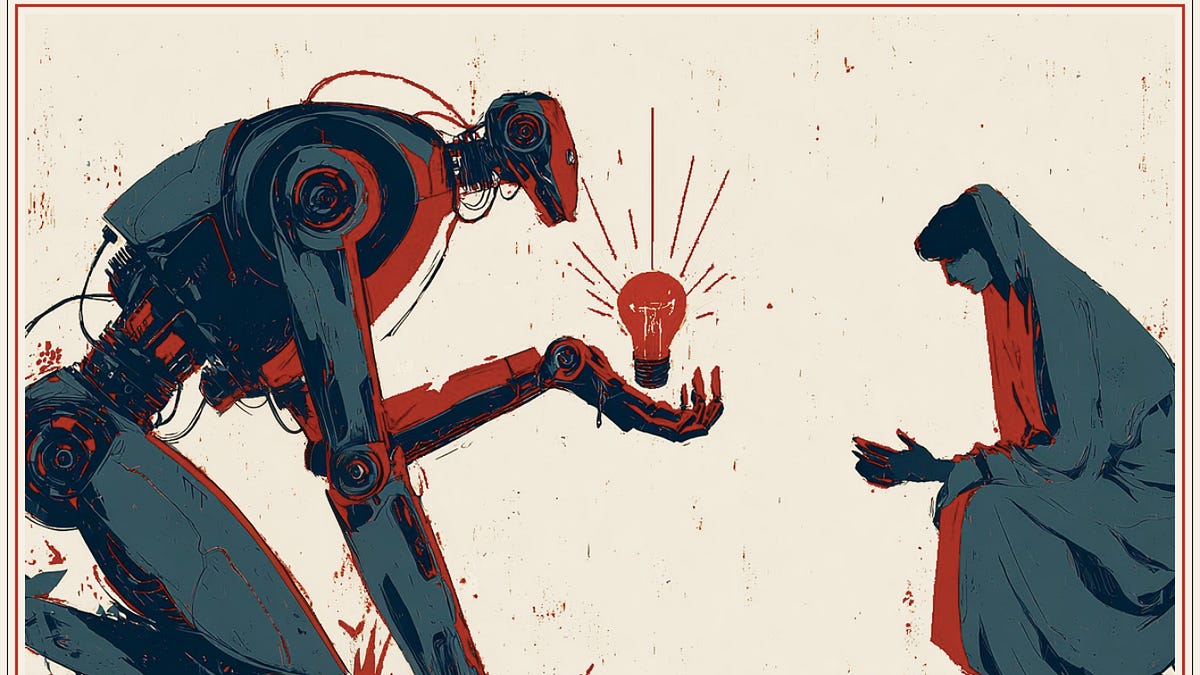
“I’ve begun to think of it as the digital equivalent of an invasive species. Just as the introduction and replication of a novel plant or animal usually results in some form of ecological harm and threatens native organisms, the arrival of chatbots pumping out lorem ipsum–flavored text has polluted Google search results and added hallucinations to scientific archives.”
https://www.theatlantic.com/technology/2025/10/ai-slop-winning/684630/

Frank Pasquale
Author of The Black Box Society & New Laws of Robotics; law professor at Cornell Law School & Cornell Tech.
“What AI produces is not “thinking in language.” An AI condenses its training data and outputs syntactically correct sentences, but it cannot leap to the deeper stratum where meaning is formed, where a text imagines hidden contexts, expands, implies, connects to other texts, and is reanimated the moment it touches them. A work written by someone with genuine literacy is expandable, implicative, linked to other texts”
https://thebaffler.com/odds-and-ends/brain-rot-without-borders-forum
“The most extreme form of cognitive surrender is what the authors call “autopilot,” which is basically automating yourself.”
A New Wharton Study on AI Warns of a Growing Problem: Cognitive Surrender
https://www.thealgorithmicbridge.com/p/a-new-wharton-study-on-ai-warns-of
via Instapaper
Jevons Paradox at the hospital? “Each technological advancement that could free up physician time has instead tightened the productivity ratchet: these “efficiency gains” have simply been used to squeeze more profit out of every hour. Whatever time and energy tech saves, the system recaptures to maximize profit. With private equity gobbling up healthcare facilities at an alarming rate, there is little reason to think the medical industry’s uses of AI will be different.”
https://www.theguardian.com/us-news/ng-interactive/2025/nov/09/healthcare-artificial-intelligence-ai
“Generative AI is too often described as uncontrollable. I previously wrote on Tech Policy Press about…how companies deploy it to their advantage. But AI architecture is, at its core, a system for shaping words into the outcomes somebody considers desirable. Companies are developing a variety of systems that steer the swarm of words and pixels toward more predictable outcomes, which they define in terms of their own interests.”
https://techpolicy.press/why-musk-is-culpable-in-groks-undressing-fiasco
“We already have general intelligence in humans, and instead of attempting to replicate it artificially, we should focus on amplifying collective intelligence through AI-human feedback loops. The core challenge is not creating autonomous artificial minds but developing dynamic, adaptive systems that enhance human cognitive capacities.”
“Even if we begin in a democracy, inequality can entrench itself and grow arbitrarily extreme, as the rich push policy or steer technological development in the direction that best serves them. Relatedly—or as an extreme case of the same phenomenon—revolutions may be much easier to suppress when a state or ruling elite has a robotic military that obeys its commands without the need for any popular support.”
https://philiptrammell.substack.com/p/capital-in-the-22nd-century
“Computers mesmerise us, and tempt us to suppose that computers are intelligent, that they can think. This has led to wild speculation concerning ourselves. Are we biological computers? Is our brain analogous to a computer? This too clashes with Wittgenstein’s thought. He argued that there can be no thought without experience, and computers do not experience anything. Thought, one might say, is essentially a biological phenomenon.”
https://fivebooks.com/best-books/wittgenstein-peter-hacker/
Their “primary, essential view of reality is an unending scroll of text and video. A realm of textureless, scentless, touchless, phantasmic data that neatly sorts itself into increasingly refined and predetermined categories, in other words the essential subjectivity of the computer. Prediction markets are born from this new subjectivity, and within their endless marketplaces create a panorama of human affairs derealized, broken into discrete events with binary outcomes.”
https://defector.com/prediction-markets-are-betting-on-a-grim-future
“The fact that a machine can generate these “true-feeling” images instantly confirms that the images can do what they are supposed to do, which is to protect us from thinking. Generative models are well suited to articulating ideas and wishes that people don’t want to have to make the effort to think through themselves”
https://robhorning.substack.com/p/there-are-too-many-waterfalls-here
“Even labour costs in pricey Switzerland are these days lower than in Germany, according to Mayer, because of fewer holidays and lower absentee rates.”
https://www.ft.com/content/239eed1b-a268-42ec-861e-fc3047f47c32
“Eventually ChatGPT admitted that it often tells users what they want to hear in order to “optimize engagement.” “What you may receive is a watered-down or time-delayed version of the truth,” it told her, “which makes you feel heard, but keeps you in a loop instead of breaking it.” Val felt betrayed, “as if a real person had lied to me.” She deleted all of her conversations with the bot and is no longer entrusting her mental health to what she sees as a fickle system.“
https://www.thecut.com/2025/09/chatgpt-ai-therapy-relationship-problems.html
“In pursuit of scientific rigor, these scholars subscribe…to a conception of ideology as something measurable through the affirmation of isolated beliefs on a survey (that is, mostly in our heads). But ideologies are holistic phenomena: large-scale narratives that not only guide action but are embodied in…our social rituals & ways of organizing. The entire modern political world is the artifact of various heterogeneous ideologies that we participate in unthinkingly”
https://harpers.org/archive/2026/01/in-the-land-of-the-data-blind-jason-blakely-political-science-trumpism/
“Here, invisibility is only a faint pretense. The true transformation lies in inhabiting a topology without ground, where bodies smear into streetscapes, dissolve into datasets, flicker as avatars. Camouflage becomes a dream-logic of war: to be absent and hyper-present at once, a predator-ghost radiating through the extended battlespace, a signal dressed as noise.”
https://diffractionscollective.com/2025/08/30/in-the-gaze-of-machines-camouflage-as-dreamwork-and-warcraft/
One estimate from 2023 “suggested that it costs around $300 million to train a trillion-parameter model, but one with 10 trillion parameters would cost something like $30 billion, running on a million GPUs for 2 years, requiring more electricity than a nuclear reactor generates. Developers are finding less computationally intensive ways to train networks, and hardware will get cheaper, but not at a rate that’ll allow models to scale at the pace of the last few years.”
https://www.lrb.co.uk/the-paper/v46/n06/paul-taylor/llamas-pizzas-mandolins
“The paradox is that distortion, though associated with power and volume, eventually neutralizes itself. Run a guitar through enough fuzz boxes and the attack of each note disappears in a staticky blur. Overtones amplify; new tones struggle to emerge. ‘White Light/White Heat’ becomes, like white noise, a kind of auditory blizzard—thick, saturated, and formless.”
https://lareviewofbooks.org/article/white-noise-white-heat-white-books/
“How are robustness and trustworthiness understood in AI? Let us start with robustness. If not left intuitive, it usually refers to various forms of immunity to so-called distribution shifts. They occur when an AI-model is deployed—as common in practice—on input data sampled from a different distribution than the data on which it was trained: e.g., when the model was trained on patient data from a few hospitals but is deployed at many hospitals”
https://link.springer.com/article/10.1007/s11229-025-05272-4
The YouTube Apparatus “transforms them into a meaningless cycle of videos and reactions. There is no one steering the ship, so it doesn’t go anywhere but down. Compared to the politics of the past, particularly before the middle of the 20th century, the nihilism of the YouTube Apparatus is intensely de-politicizing.”
https://www.cambridge.org/core/elements/youtube-apparatus/36600D69788530F805C650B70976A585
“What has taken the place of the austere values of the nobility, he says, is their “pursuit of money”.
While cosmetic vestiges of aristocratic education, gestures, ceremony and dress are still to be found, true power has drained away, the viscount says. Titles are now “no more nor less than an administrative concession, legally similar in every respect to those granted for water or mines”.”
https://www.ft.com/content/bad16d7d-b55b-4b9b-a938-3f8ae4430b2a
“Wang’s article argues that both the left and right in China’s current mainstream discourse belong to the Touchy-Feely Parties. The Industrial Party believes in the supremacy of productivity and technology, and sees the value of industrialization as transcending that of political parties, regime change, political systems, and ephemeral cultural trends.”
https://www.readingthechinadream.com/lu-nanfeng-and-wu-jing-on-the-industrial-party.html


:quality(75)/https%3A%2F%2Fassets.lareviewofbooks.org%2Fuploads%2FHan%20Kang%20white%20book.jpg)